


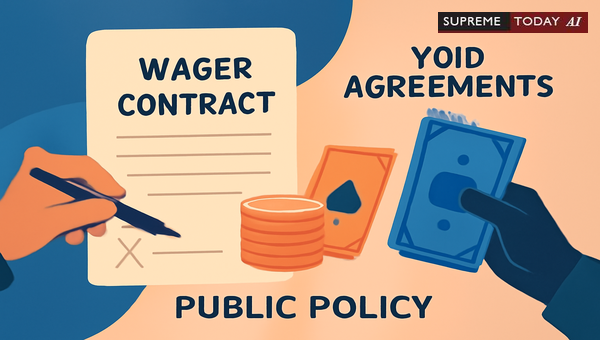
Wager Contracts in India: Definition and Legal Effects
In the world of contracts, not all agreements hold legal weight. Have you ever wondered what is a and its legal effect? Many people engage in bets or gambles casually, but when these turn into formal agreements, they can have serious legal implications. This blog post dives deep into wager contracts under Indian law, explaining their nature, why they're typically , and key exceptions. Whether you're a business owner, gamer, or just curious, understanding this can save you from deals.
What is a ?
A arises when two or more parties mutually agree that money or other consideration will be paid based solely on the outcome of an uncertain future event, with no other interest involved beyond the stake itself1966 0 Supreme(SC) 189. It's essentially a bet where the parties have no stake other than winning or losing the wager.
Key characteristics include:- Mutual agreement on an uncertain event, like a sports match or game result.- Consideration limited to the stake: No additional business, insurance, or other legitimate interest 1966 0 Supreme(SC) 189.- Terms like 'bet' and 'wager' are interchangeable, referring to risking money on chance 1984 0 Supreme(Kar) 33.
For instance, agreeing to pay ₹10,000 if Team A wins a cricket match, with nothing else at stake, qualifies as a wager. This definition extends to acts facilitating wagering, such as collecting bets or distributing winnings 2022 0 Supreme(Mad) 237.
Legal Effect of Wager Contracts
Under of the , agreements by way of wager are 1959 0 Supreme(SC) 34. This means:- No enforceability: Courts won't help recover losses or enforce payments. A suit for recovery is barred.- Opposed to : Wagering promotes gambling, seen as harmful to society 1959 0 Supreme(SC) 34.
As stated, Agreements by way of wager are and cannot be enforced in law 1959 0 Supreme(SC) 34. Even facilitators, like those handling bet collections, can't claim legally 2022 0 Supreme(Mad) 237.
In comparative contexts, similar principles apply elsewhere. For example, under Malaysia's , declares wager agreements , noting, Agreements by way of wager are ; and no suit shall be brought for recovery
. This underscores a regional consensus against enforcing such contracts.
Why Are They ? Rationale
The law discourages gambling due to its social ills—addiction, financial ruin, and corruption. Wagering diverts productive energy into chance-based activities, conflicting with public morals 1959 0 Supreme(SC) 34.
Courts emphasize: These contracts lack mutuality of obligation beyond the gamble, making them speculative and unworthy of judicial intervention 1959 0 Supreme(SC) 34.
Distinction: vs.
Not all bets are wagers. The law differentiates:- (e.g., lotteries, pure gambling): as wagers.- (e.g., chess, certain sports): May be lawful.
Horse racing is a prime example. When proven predominantly skill-based (judging horse form, jockey skill), betting on it isn't wagering 1996 1 Supreme 322. However, if chance dominates, it's prohibited 1974 0 Supreme(SC) 428.
This distinction is crucial: Horse racing, when proven to be predominantly a game of skill, is not considered gambling 1996 1 Supreme 322.
Exceptions and Limitations
While broadly voids wagers, nuances exist:- Skill-based activities: Legal if skill predominates 1996 1 Supreme 322.- Regulated betting: Lotteries or state-authorized games may be exempt, but pure wagers remain 1959 0 Supreme(SC) 34.- No prohibition on all betting: Only as contracts; possession of stakes isn't illegal unless other laws apply.
In one case, a counterclaim for gambling debts was dismissed as the agreement was illegal under similar statutes, reinforcing unenforceability
.
Practical Implications and Case Insights
Parties entering wagers can't sue for recovery. For example, if you lose a bet on an election outcome, the winner can't force payment via court—it's ab initio 1959 0 Supreme(SC) 34.
Broader context from legal texts shows wagering includes cyberspace activities, with penalties for facilitation 2022 0 Supreme(Mad) 237. Dictionaries and judgments affirm: No other interest beyond the stake makes it a wager 1966 0 Supreme(SC) 189.
Note: Unrelated employment terms like 'daily wager' (casual labor) don't apply here; our focus is contractual wagers.
Recommendations for Compliance
To avoid pitfalls:- Scrutinize agreements: Ensure legitimate interest beyond chance.- Analyze skill vs. chance: Consult for events like e-sports or fantasy leagues.- Seek legal advice: Before betting pools or stakes in business.
Parties should steer clear of pure wagers, as they're legally and .
Conclusion: Key Takeaways
A is a mutual bet on an uncertain event with no other stake, rendered under of the Indian Contract Act due to 1959 0 Supreme(SC) 34. While exceptions exist for skill games like horse racing 1996 1 Supreme 322, pure gambling agreements offer no legal recourse.
This is general information, not legal advice. Laws vary by jurisdiction and facts; consult a qualified lawyer for your situation. Stay informed to navigate contracts wisely.
References:- 1959 0 Supreme(SC) 34: Indian Contract Act, .- 1966 0 Supreme(SC) 189: Wager definitions.- 2022 0 Supreme(Mad) 237: Wagering facilitation.- 1996 1 Supreme 322: Skill vs. chance.- 1984 0 Supreme(Kar) 33: Bet/wager synonyms.-
: Comparative voidness. #WagerContract #IndianContractAct #GamblingLaw















