
 Back
Back





IN THE HIGH COURT OF KARNATAKA (DHARWAD BENCH)
ANANT RAMANATH HEGDE, J.
Shreeshail - Appellant
Versus
Basavaraj and Ors. - Respondents
Regular First Appeal No. 100205 of 2016 (PAR)
Decided on : 30-08-2023
| Table of Content |
|---|
| 1. (Para 1 , 2 , 3 , 4 , 5 , 6 , 11 , 12 , 14 , 16 , 17 , 18 , 19 , 20 , 21 , 22 , 23 , 24 , 25 , 26 , 27 , 28 , 29) |
JUDGMENT :
Mr. Anant Ramanath Hegde, J. - Defendant No.1-Shrishail in OS.no.66/2010 On the file of the I Additional Senior Civil Judge Dharwad, is aggrieved by the decree for partition granted in favour of the plaintiffs who are three in number. The admitted genealogy is as under:-
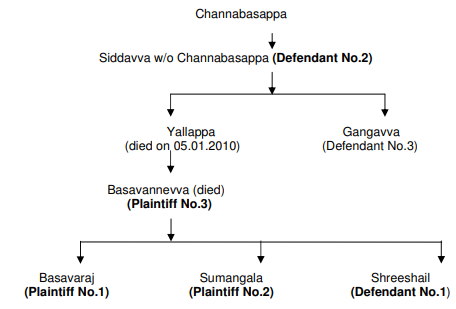
2. One Yallappa the propositus died on 05.01.2010. The propositus is survived by Basavannevva his wife, Basavaraj and Shrishail his two sons and Sumangala the only daughter. The suit is filed in the year 2010 by Basavaraj S/o Yallappa Ghalappanavar, Sumangala the daughter of Yallappa and Basavannevva- the wife of Basavaraj.
3. The suit is filed against Shrishail, the son of Yellappa. Later, on an application, the mother of Yallappa by name Siddawwa, the sister of Yallappa by name Gangawwa were impleaded.
4. The plaintiffs contend that item Nos.(a) and (b) of the suit schedule the properties were allotted to the share of Yallappa in the partition which took place in the between Yallappa, his mother and his sister. In the said partition, item Nos.(a) and (b) properties were allotted to the share of Yallappa. Item No.(c) is the property purchased in the name of defendant no.1 under the registered sale deed dated 04.06.1987. Item no.(d) and (e) are the ancestral properties. It is the case of the plaintiffs that though the property at item no.(c) was purchased in the name of first defendant, the said property is acquired in the name of first defendant from the income derived from the ancestral properties standing in the name of Yallappa. Thus, the plaintiffs claimed share in the aforementioned properties on the premise that they have acquired right in the properties by reason of birth in the family.
5. The plaintiffs also contend that the registered gift deed executed in favour of first defendant dated 10.12.2008, without the consent and knowledge of the plaintiffs, in respect of item Nos.(a) and (b) properties in favour of first defendant is impermissible under law. The plaintiffs contend that Yallappa could not have executed the aforementioned gift deed as he had no exclusive right over the aforementioned properties. Even the execution of the gift deed is disputed.
6. The second defendant-the mother of Yallappa supported the case of the plaintiff. Third defendant did not contest the matter. First defendant took a contention that the father -Yallappa was competent to execute a registered gift deed in his favour as it was his exclusive property and the gift deed was executed with the consent and knowledge of the plaintiffs. Pursuant to the gift deed in the year 2008, there was change in the mutation in respect of the properties covered by the registered sale deed. Thus, it is urged that the plaintiffs cannot claim any share in the suit properties.
7. It is also urged that the father purchased the property in the year 1987 in the name of the first defendant who was aged eleven, with an intention to confer exclusive title in favour of first defendant. Hence, the suit for partition in respect of item No.(c) property is not maintainable as first defendant is the exclusive owner of item no.(c) property.
8. The Trial Court rejected the contention that the properties are the exclusive properties of Yallappa and also held that the properties are the joint family properties of Yallappa and granted a decree for partition in respect of item Nos.(a) and (b) properties granting 1/4th share to each of the plaintiffs and first defendant. And granted a decree for partition of 1/5th share to each of the plaintiffs and defendants No.1 and 2 in respect of item No.(c) to (e) properties.
9. Aggrieved by the aforementioned judgment and decree, the first defendant is in appeal.
10. Heard Sri Gurudev I. Gachchinamath, learned counsel appearing for the appellant and Sri. Arun L. Neelopant, learned counsel appearing for respondents No.1 to 3.
11. Shri Gurudev
AI


The court ruled that an oral partition established the properties as separate and self-acquired, barring claims for partition after 18 years and validating a gift deed executed by the coparcener.


The court ruled that disputed gift deeds require credible evidence for enforcement; joint property claims must prioritize actual possession and entitlement over mere assertions of gift.

Gift by a coparcener of his undivided interest in coparcenery properties as void - Coparcener can make a gift of his undivided interest in coparcener property to another coparcener or to a stranger....
The central legal point established in the judgment is the interpretation of the validity of settlement and sale deeds, the nature of the suit property, and the right of pre-emptive purchase.
A daughter can claim a share in ancestral properties despite prior claims of partition if evidence for such partition is not established.
A claimant must prove the ancestral nature of properties to claim entitlement under the amended Hindu Succession Act; mere assertions without evidence are insufficient.



An indispensable Tool for Legal Professionals, Endorsed by Various High Court and Judicial Officers
Please visit our Training & Support
Center or Contact Us for assistance

Scan Me!
India’s Legal research and Law Firm App, Download now!


For Daily Legal Updates, Join us on :



 Back to top


