


 Back
Back





2023 Supreme(Kar) 1283
IN THE HIGH COURT OF KARNATAKA (DHARWAD BENCH)
ANANT RAMANATH HEGDE, J.
Smt. Niramal and Ors. - Appellant
Versus
Smt. Kannawwa and Ors. - Respondents
Regular First Appeal No. 100074 of 2014 (PAR/POS).
Decided on : 28-08-2023
For the Appellant :Sri. Vitthal S Teli, Advocate
For the Respondent:Sri. Sangram S Kulkarni, Sri. Ajay U Patil, Advocate
Headnote:(A) Hindu Succession Act, 1956 - Section 15(1)(a) - Partition and separate possession - Appeal filed by defendant challenging the trial court's decision granting shares in joint family properties and service benefits of deceased - Court decrees that service benefits entirely belong to the wife of the deceased; the share of deceased's mother devolves to her daughter as per law. (Paras 18-20)
(B) Legal principles - Nominee to service benefits does not exclusively inherit; obligations under Law of Succession apply - Both husband and wife are Class-I heirs, impacting their rights to family property and benefits. (Paras 15-16)
Facts of the case:
The appeal involves disputes over partition of property and the allocation of service benefits following the death of a railway employee, along with issues regarding the entitlements of the deceased’s wife and mother postmortem. (Paras 1-4)
Findings of Court:
The trial court's partition decree is upheld while clarifying the eligibility of the service benefits, which completely belong to the deceased's wife, with subsequent distribution of property shares adjusted due to the mother's death. (Paras 18-20)
Issues: Whether the trial court correctly allocated service benefits and addressed maintainability concerning joint family properties not included in the original suit. (Paras 11-12)
Ratio Decidendi: The court clarifies that under section 15 of the Hindu Succession Act, the deceased's mother's share devolves to her daughter, while service benefits designated to the nominee do not confer exclusive rights, necessitating equitable distribution among Class-I heirs. (Paras 19-20)
Result: Appeal allowed in part, modifying the previous decree as outlined.
JUDGMENT :
Mr. Anant Ramanath Hegde, J. - This appeal is filed by defendant No.1 in O.S.No.19/2010 on the file of the Senior Civil Judge, Raibag, assailing the judgment and decree dated 26.02.2014.
2. The suit was one for partition and separate possession. The suit is decreed as prayed for awarding 1/3rd share each to plaintiffs No.1 and 2 as well as defendant No.1. The genealogy of the parties is as under:
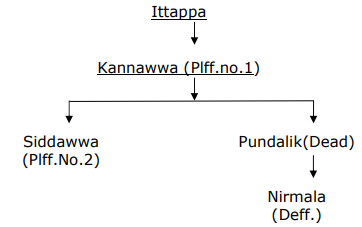
3. One Ittappa was the propositus. Plaintiff No.1 Kanakavva is the wife of Ittappa. Siddawwa and Pundalik are the daughter and son of Ittappa and Kannawwa. Ittappa died prior to 1994. Pundalik died in the year 2009 and he is survived by his wife Nirmala (defendant No.1) and Kannawwa, his mother the plaintiff No.1. Admittedly, Pundalik was serving as an employer in the South Western Railway prior to his death.
4. The plaintiffs claimed share in the immovable properties described in suit 'A' schedule property and also share suit 'B' schedule property i.e., in Rs. 6,00,000/-, service benefits alleged to have been received by the defendant No.1 - Nirmala, the wife of Pundalik.
5. Plaintiff No.1/respondent No.1 died during the pendency of this appeal on 03.01.2022. Application is filed before this Court by the 2nd respondent, who claims to be the legatee under the alleged Will dated 24.12.2010. Application was allowed for a limited purpose of enabling the 2nd respondent to defend the appeal as a legatee of the deceased 1st respondent.
6. The suit was contested by the defendant No.1 Nirmala and defendants No.2 and 3, the employer of Pundalik also contested the suit and took a stand that the plaintiffs are not entitled for the service benefits of late Pundalik. The defendant No.1 also took a contention that other two joint family properties are not included in the suit and as such, the suit is not maintainable.
7. The trial Court decreed the suit holding that the plaintiff No.1 is entitled to 1/3rd share, plaintiff No.2 is entitled for 1/3rd share and defendant No.1 is entitled to 1/3rd share in the suit 'A' schedule property. The trial Court also held that the plaintiff No.1 is entitled to 1/2 share in the suit 'B' schedule property, i.e., the service benefits received after the demise of Pundalik.
8. Sri. Vitthal S. Teli, learned counsel appearing for the defendant no.1/appellant, submits that;
8.1. The impugned judgment and decree awarding 1/2 share in favour of the plaintiff No.1 in respect of suit 'B' schedule property are impermissible.
8.2. The mother of the deceased employee is not entitled to any share in the service benefits after the demise of late Pundalik and all the service benefits should go to defendant No.1, wife of late Pundalik.
8.3. The suit is not maintainable as other two properties belonging to joint family are not included in the suit for partition.
8.4. Though specific stand is taken in the written statement, issue is not framed by the trial Court relating to maintainability of the suit for not including other two joint family properties.
9. Sri. Sangram Kulkarni, learned counsel appearing for the plaintiffs/respondents, would submit that;
9.1. The trial Court is justified in passing the decree for partition and separate possession.
9.2. As far as suit 'A' schedule property is concerned, there is no dispute that the properties originally belonged to one Itappa and are inherited by the plaintiff and the defendant.
9.3. As far as service benefits is concerned, that is the estate standing in the name of deceased Pundalik at the time of his death, who is the son of plaintiff No.1 and that being the case, plaintiff No.1 and defendant No.1 would succeed to the estate as Class-I heirs.
10. This Court has considered the contentions raised at the bar and also perused the impugned judgment and decree.
11. The following points arise for consideration:
i. Whether the trial Court is justified in granting ½ share in the service benefits of deceased Pundalik in favour of plaintiff No.1 and ½ share in favour of defendant No.1?
ii. Whether th












