
 Back
Back





IN THE HIGH COURT OF KARNATAKA AT BENGALURU
Anant Ramanath Hegde, J.
P R Purushothama, S/o P C Ramalingappa And Ors. - Appellants
Versus
P. C. Ramalingappa, S/o Chikkegowda Since Dead By Lrs And Ors. - Respondents
Regular Second Appeal No. 1425 of 2013 (PAR-)
Decided On : 02-09-2025
| Table of Content |
|---|
| 1. plaintiffs' genealogical claims and suit background. (Para 3 , 4 , 5 , 6 , 7 , 8 , 9 , 10 , 11) |
| 2. contentions regarding property ownership. (Para 12 , 13 , 14) |
| 3. court's observations on property classification. (Para 15 , 18 , 19) |
| 4. issue of the gift deed relevance. (Para 16 , 17) |
| 5. remand of the case for fresh consideration. (Para 20) |
JUDGMENT :
Anant Ramanath Hegde, J.
Heard.
This appeal is admitted to consider the following substantial question of law:
i) Whether the plaintiffs/appellants are entitled to succeed to the property of defendant No.1, who has died during the pendency of this appeal?
2. With the consent of both the parties, the appeal is taken up for consideration on merits.
3. This is an appeal against the concurrent finding in a suit for partition and separate possession. The suit is dismissed. The plaintiffs appeal in R.A.No.177/2011 is also dismissed. Hence, the second appeal by the plaintiffs.
4. The genealogy claimed by the plaintiffs, to some extent disputed by the defendants is as under:
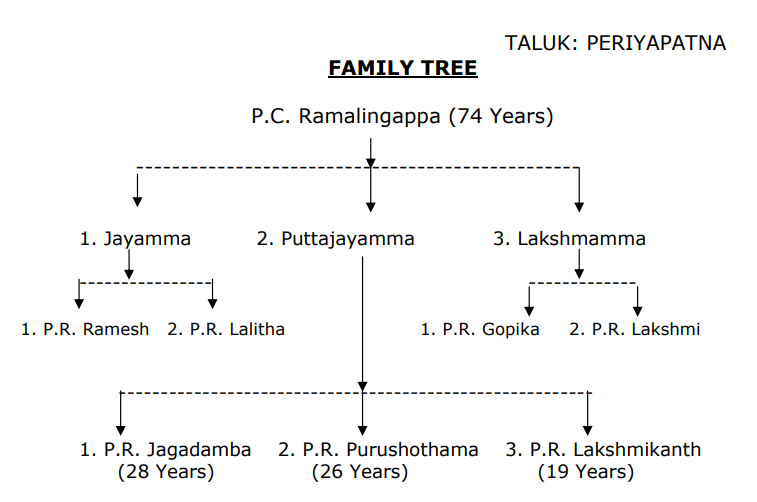
5. One P.C. Ramalingappa was the propositus. It is stated by the plaintiffs that he had two wives, namely, Jayamma and Puttajayamma. Defendants contend that P.C. Ramalingappa had 9 wives.
6. In the genealogy furnished by the plaintiffs, the name of alleged third wife, Lakshmamma is mentioned and names of alleged remaining wives are not mentioned.
7. It is stated that the Jayamma had two sons from P.C. Ramalingappa, namely, P.R.Ramesh and P.R. Lalit and second wife Puttajayamma had three children, namely, P.R.Jagadamba, P.R.Purushotham and P.C.R. Lakshmikanth and alleged third wife Lakshmamma had two children, namely, P.R.Gopika and P.R.Lakshmi.
8. The suit is filed by P.R.Purushotham and P.C.Lakshmikanth, two children from Puttajayamma - alleged 2nd wife of P.C. Ramalingappa. Defendant No.1 is P.C. Ramalingappa. Jagadamba, sister of plaintiffs was arrayed as defendant No.2. Defendant No.3 is alleged to be the wife of P.C. Ramalingappa, which contention is disputed.
9. Defendants No.4 and 5 are children of P.C.Ramalingappa from wife Jayamma. The plaintiffs, who claim to be children from the 2nd wife of P.C.Ramalingappa, filed the suit for partition and even according to the plaintiffs, P.C.Ramalingappa married Puttajayyamma their mother when the first marriage of P.C.Ramalingappa with Jayamma was subsisting.
10. The suit was dismissed primarily on the premise that children of 2nd wife are not entitled to claim any shares in the properties of P.C.Ramalingappa when he was alive.
11. First Appellate Court took the same view. Hence, the appeal was dismissed. Now P.C. Ramalingappa, the propositus died during the pendency of this appeal.
12. Learned counsel for the appellants would contend that the except item No.5 of suit schedule properties, all other suit schedule properties are self acquired properties of P.C. Ramalingappa. It was his contention in the Trial Court that all properties except item No.5 are self acquired properties. Thus, it is urged that the plaintiffs are entitled to equally inherit all the self acquired properties of P.C. Ramalingappa along with the children of first wife.
13. It is also urged that as far as item No.5 is concerned, plaintiffs are entitled to inherit in the notional share that is to be allotted to P.C.Ramalingappa immediately before his death.
14. Learned counsel for the defendants would contend that all the properties are not self acquired properties of P.C.Ramalingappa and in fact, the properties are all the ancestral properties of P.C.Ramalingappa. It is his further contention that some of the properties are sold prior to the institution of the suit by P.C.Ramalingappa and those persons are not made parties to the suit.
15. This Court has considered the contentions raised at the Bar.
16. It is noticed that the defendants have raised the contention that P.C.Ramalingappa had executed the Gift Deed before the institution of the suit. However, the gift deed was not produced before the Trial Cou
AI
The nature of properties as self-acquired or ancestral critically impacts inheritance rights of heirs in partition suits.

Joint family properties are established through contributions from family income, and the validity of a gift deed in such cases necessitates consent from all joint owners.

A claimant must prove the ancestral nature of properties to claim entitlement under the amended Hindu Succession Act; mere assertions without evidence are insufficient.

A daughter can claim a share in ancestral properties despite prior claims of partition if evidence for such partition is not established.
The principles of self-acquired versus joint family property were affirmed, establishing the burden of proof on those claiming joint ownership, and determining that mere possession does not suffice f....
Joint family properties cannot be classified as self-acquired. Partition rights extend to all legitimate heirs, including daughters, affirming their claim to a share.
The court ruled that an oral partition established the properties as separate and self-acquired, barring claims for partition after 18 years and validating a gift deed executed by the coparcener.
The court upheld that the valid execution of a Will and distinction between self-acquired and ancestral property were critical to the suit's outcome, determining testamentary intentions of the deceas....



An indispensable Tool for Legal Professionals, Endorsed by Various High Court and Judicial Officers
Please visit our Training & Support
Center or Contact Us for assistance

Scan Me!
India’s Legal research and Law Firm App, Download now!


For Daily Legal Updates, Join us on :



 Back to top


