
 Back
Back





IN THE HIGH COURT OF KARNATAKA, AT DHARWAD
M.NAGAPRASANNA, J.
Javeed S/o Mahabub Attar – Appellant
Versus
The Common Cadre Committee, Employees of Primary Co-operative Agriculture and Rural Development Banks – Respondent
Writ Petition No. 103449 of 2016
Decided On : 08-12-2025
| Table of Content |
|---|
| 1. petitioner seeks regularization of employment. (Para 1 , 2) |
| 2. details of petitioner's employment and service. (Para 3 , 4 , 5) |
| 3. claims of discrimination in regularization addressed. (Para 6 , 7 , 9) |
| 4. court's observations on the service of petitioners. (Para 10 , 11 , 12) |
| 5. directive issued for regularization of services. (Para 14 , 15) |
ORDER :
1. The petitioner is before this Court seeking for the following prayer:
a. To Issue writ in the nature of mandamus direct the respondents no.1 to 4 to regularize the service of the petitioner to his posts held by him in their 4th respondent banks from the date of their initiation appointment and to pay all monetary benefits by allowing this writ petition.
b. To Issue any other orders, directions as deems fit in the circumstances of the case.
2. Heard the learned counsel Sri.Shivaraj Mudhol for the petitioner, learned HCGP Smt.Girija Hiremath for the respondent Nos.2 and 3-State, the learned counsel Sri.P.R.Bentur appearing for respondent No.1 and the learned counsel Sri.K.H.Bagi appearing for respondent No.4.
3. The petitioner is initially employed by the Primary Co-operative Agriculture and Rural Development Bank. The petitioner is discharging his duties in respondent No.4-Bank which come under the supervision of the respondent No.1-Common Cadre Committee.
4. The petitioner was employed by the respondent No.4-Bank on 07.09.1995. The petitioner is said to be working even as on date in the respondent No.4-Bank as clerk/junior assistant on daily wages. The petitioner registers his claim for regularisation of his services by submitting a representation to the respondent No.4-Bank. It transpires that the respective Banks on the strength of the service rendered by the present petitioner along with other petitioners recommended their cases for regularisation by communication to the first respondent. The recommendation from one of the respondent Banks to the Common Cadre Committee is as follows:
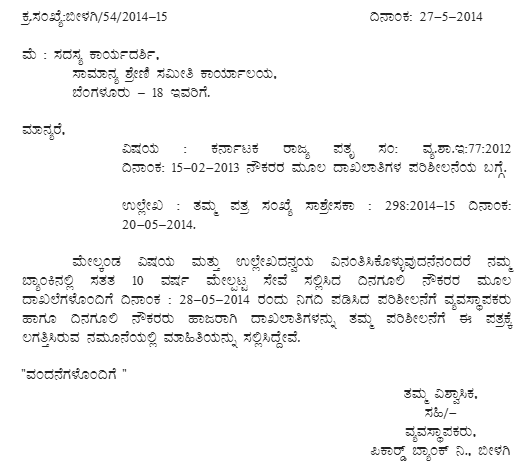
5. To the said document, the entry and subsistence of services of this petitioner along with other petitioners are also indicated. Identical representations were submitted by several of the employees and those employers to whom the said employees had submitted their representations also had recommendations in their favour made to the Common Cadre Committee, the first respondent. Those representations did merit consideration at the hands of the Common Cadre Committee and ultimately approved by the Government by directing regularisation of their services. The communication and the order read as follows:
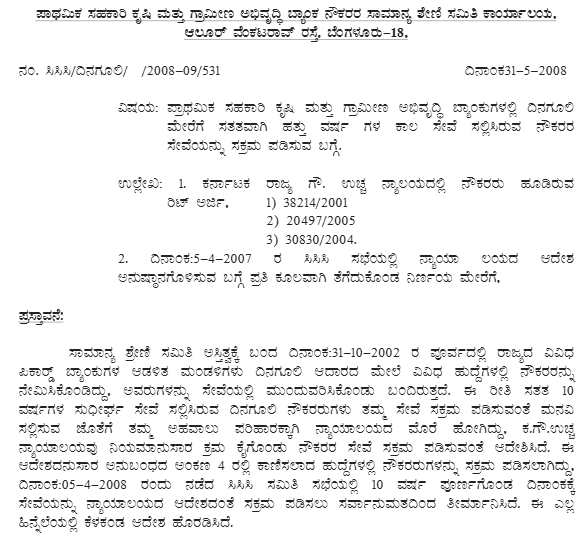
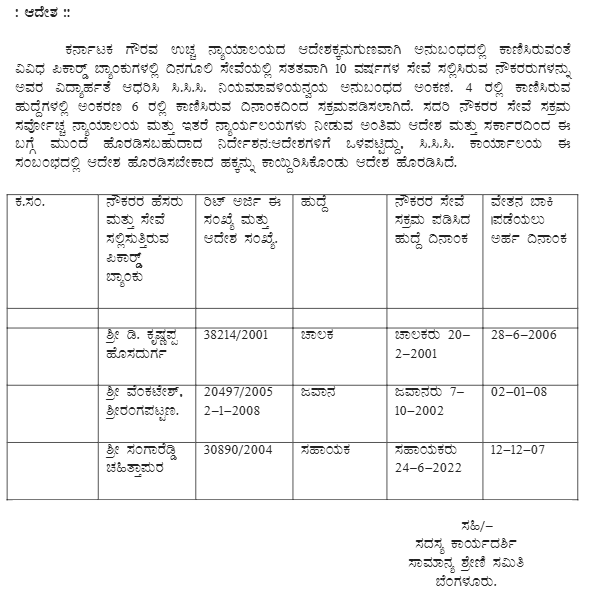
6. It was concerning three employees who had entered service or joined services in those respective Banks on 20.02.2001, on 07.10.2002 and on 24.06.2002. Their services had not yet been completed to the tune which the Apex Court had directed in State of Karnataka v. Umadevi , (2006) 4 SCC 1. Notwithstanding the same, those services of those employees come to be regularised, while the same treatment is not meted out to this petitioner along with other petitioners. Therefore this petitioner is before the Court seeking a direction by chance of a writ in the nature of mandamus directing the respondents to consider his case for regularisation as was considered by the Common Cadre Committee and approved by the Competent Authority, as is found in the order quoted supra. It is therefore, he is at the doors of this Court.
7. The learned counsel appearing for the petitioner would vehemently contend that the respondents has practised invidious discrimination in ordering regularisation of its employees as one set of similarly placed employees have had the benefit of regularisation and the other set, the petitioner herein is left out. Therefore the learned counsel would seek parity in treatment towards the regularisation of their cases by the hands of the respondent-State.
8. The learned HCGP, appearing for the respondent Nos.2 and 3 would vehemently refute the submissions in contending that these employees
AI
Long-standing service without a formal appointment does not deny employees the right to regularization; discriminatory treatment of similarly situated employees violates principles of equity and fair....

Long-standing service and fulfillment of criteria establish entitlement for regularization under service law, preventing arbitrary denial of rights.
Regularization of employees with irregular appointments who have served for a significant duration is constitutionally mandated when they fulfill essential duties, emphasizing equity and justice in p....
Long-serving employees in essential roles are entitled to consideration for regularization despite initial irregular appointments, ensuring fairness and adherence to constitutional principles.
Regularization of long-serving daily wage employees is mandated after 10 years of service, acknowledging functional continuity despite initial irregularities, violating constitutional rights otherwis....
Long-term employees performing essential and continuous functions may claim regularization after a decade of service, despite previous procedural irregularities.

The court reaffirmed that long-serving employees, despite irregular appointments, are entitled to regularization, emphasizing the importance of continuity of service without considering minor lapses ....
Longstanding service in public roles warrants regularisation and cannot be arbitrarily denied based on technicalities; constitutional principles require fair treatment of employees.
Long-term employees, fulfilling essential duties, are entitled to regularization after 10 years of service despite irregular appointments, emphasizing fairness and preventing exploitation.



An indispensable Tool for Legal Professionals, Endorsed by Various High Court and Judicial Officers
Please visit our Training & Support
Center or Contact Us for assistance

Scan Me!
India’s Legal research and Law Firm App, Download now!


For Daily Legal Updates, Join us on :



 Back to top


