
 Back
Back





HIGH COURT OF JUDICATURE FOR RAJASTHAN BENCH AT JAIPUR
VINOD KUMAR BHARWANI, J.
Sanjay Chawda, FC No.1744 son of Shri Yadram – Appellant
Versus
The State of Rajasthan, through Director General of Police – Respondent
S.B. Civil Writ Petition No. 2354 of 2020
Decided On : 07-11-2025
| Table of Content |
|---|
| 1. assailing disciplinary orders (Para 1 , 2) |
| 2. argument for lack of due process (Para 3 , 4 , 5 , 6 , 7 , 8) |
| 3. review of disciplinary authority's orders (Para 9 , 10 , 11 , 12) |
| 4. necessity of recording reasons (Para 13 , 14 , 15 , 16 , 17 , 18 , 19) |
| 5. writ petition allowed and orders quashed (Para 20 , 21 , 22 , 23 , 24) |
ORDER :
VINOD KUMAR BHARWANI, J.
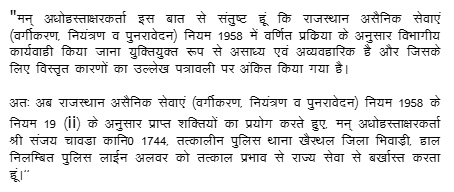
1. By way of filing instant writ petition under Article 226 of the Constitution of India the petitioner has assailed the order dt.12.10.2019 passed by the respondent No.3/Superintendent of Police, Bhiwadi [For short 'the Disciplinary Authority'] whereby he was dismissed from service after exercising the powers under Rule 19 (ii) of the Rajasthan Civil Services (Classification, Control & Appeal) Rules, 1958 (for short 'the Rules of 1958).
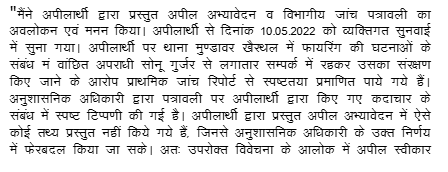
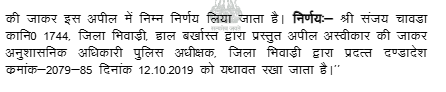
2. The petitioner has also assailed the order dt.16.06.2022 passed by the respondent No.2/Inspector General of Police, Jaipur Range, Jaipur (for short 'the Appellate Authority), whereby the appeal of the petitioner filed against the aforesaid punishment order dt.12.10.2019 was dismissed and the penalty imposed upon him of dismissal from service was upheld.
3. Learned counsel appearing for the petitioner submitted that the petitioner was appointed as Constable (GD) in the Rajasthan Police on 30.04.2012. In May, 2019 the petitioner was served by a letter for submitting his explanation with regard to his communications with Sonu Gurjar (Criminal). The petitioner submitted his explanation and later-on, Inquiry Officer has submitted a negative preliminary Inquiry Report. Thereafter, relying upon the preliminary Inquiry Report, the impugned order dt.12.10.2019 dismissing the petitioner from the service invoking Rule 19 (ii) of the Rules of 1958 was passed. The petitioner has also preferred an appeal which was dismissed vide order dt. 16.06.2022 without adhering to the basic provisions of the Constitution of India and the Rules of 1958.
4. Learned counsel appearing for the petitioner contended that no opportunity of hearing was accorded to the petitioner before his dismissal from service after exercising the powers under Rules 19 (ii) of the Rules of 1958, which is ex-facie, arbitrary, illegal and is a sheer case of misuse of the powers. Counsel further contended that neither any notice to show cause nor any notice of hearing was served upon the petitioner nor any inquiry was conducted into the allegations levelled against him. Counsel also contended that the exception to the said power has been carved out in Article 311 (2) (b) of the Constitution of India whereby the authority concerned has been empowered to act without an inquiry, if he has reasons therefor which he should record in writing that the inquiry is not reasonably practicably.
5. Learned counsel appearing for the petitioner submitted that such reasons have nowhere been recorded in the impugned orders, either by the Disciplinary Authority or the Appellate Authority. Counsel further submitted that the Rule 19(ii) of the Rules of 1958 is having the same purport as that of Article 311 (2)(b) of the Constitution of India. Counsel also submitted that the Appellate Authority has taken into consideration the allegations regarding the phone calls and the petitioner being in touch with the persons accused of the offence of kidnapping and murdering. Counsel submitted that such allegations, if are to be rebutted, then the petitioner should have been afforded proper and adequate opportunity by holding proper inquiry as envisaged under the Rules of 1958. Counsel further contended that the opportunity of hearing and a proper inquiry has been seriously jeopardized by the invocation of Rule 19(ii) of the Rules of 1958.
6. Learned counsel appearing for the petitioner submitted that the basic principle is that a civil servant shall not be dismissed, removed or reduced in rank without proper inquiry & information of the charges as well as without giving him proper & reasonable opportunity to take h
AI
Dismissal of a civil servant without proper inquiry violates constitutional safeguards and is arbitrary; procedural requirements must be strictly followed.

The judgment emphasizes the requirement of concrete and appropriate reasons for dispensing with an inquiry before dismissing a government servant, as mandated by Rule 19(ii) of the Rajasthan Civil Se....

Dismissal from service matter - Rule 23 of Rules of 1991 clearly indicate that provisions of Revision are not mandatory in nature and are clearly at discretion of Officer whose appeal has been reject....

The main legal point established in the judgment is the requirement of recording reasons for dispensing with the enquiry while removing a person from service, as mandated by Rule 19 (ii) of the Rules....

The disciplinary authority must provide valid reasons for invoking immediate dismissal under rule 19(ii) of the Rules of 1958, and cannot bypass the inquiry process without justification.



An indispensable Tool for Legal Professionals, Endorsed by Various High Court and Judicial Officers
Please visit our Training & Support
Center or Contact Us for assistance

Scan Me!
India’s Legal research and Law Firm App, Download now!


For Daily Legal Updates, Join us on :



 Back to top


