Back
Back





2024 Supreme(Mad) 994
IN THE HIGH COURT OF JUDICATURE AT MADRAS
THE HON'BLE MR JUSTICE V. LAKSHMINARAYANAN
The Pazhaverkadu Venkataswamy Gramani Trust represented by its Hereditary trustee S.Venkataraman - Appellant
Versus
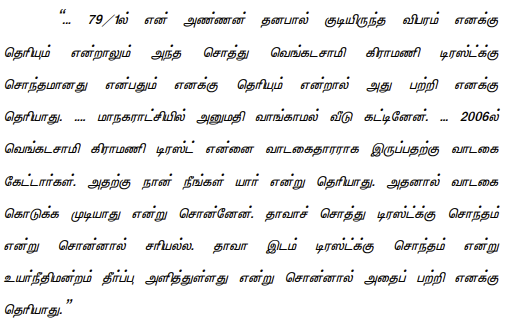
S.Paul (Died) and ors. – Respondents
Second Appeal No.735 of 2013 & M.P.No.1 of 2013 & CMP.No.8831 of 2024
Decided On : 14-06-2024
Advocate Appeared:
For the Appellant : Mr.M.S.Subramanian
For the Respondent: Mr.P.Mohan Raj, Mr.P.Rajendran, Mr.B.Tamil Nidhi, Additional Government Pleader
A decree in rem under a scheme governs property rights and binds all parties, establishing that mere occupation does not negate the superior title claimed by a trust.
Headnote:(A) Code of Civil Procedure - Order XLI Rule 27 - Evidence Act - Section 13 - Public charitable trust claiming possession of property - Plaintiff trust asserted title based on scheme decree; defendants alleged adverse possession - Lower courts found in favor of defendants, ruling trust did not prove title - Appeal court held scheme decree as a decree in rem, binding on all parties; found plaintiff established ownership through prior documentation and evidence. (Paras 11, 76-82)
(B) Adverse Possession - Legal principles established that occupation alone does not suffice to defeat superior title; admission of reliance on adverse possession led to withdrawal of such plea by defendants - Trust's possession and title established precedence over mere possession claimed by defendants. (Paras 79, 87)
Facts of the case:
This appeal arises out of a property dispute where a public charitable trust claimed unlawful occupation of land by defendants, asserting legitimate title through a scheme decree and previous court rulings; defendants claimed possession based on adverse possession without proper documentation.
Findings of Court:
The appeal court found the plaintiff trust had not only the documented title but also established evidence of exercising ownership rights including lease agreements to support their claim.
Issues: Whether the trust's scheme decree constituted a strong title against the defendants and whether mere occupation could override the trust's documented claims.
Ratio Decidendi: The court emphasized that a decree in rem binds all parties in interest; mere possession cannot defeat a superior title, highlighted by the defendants' admission of title while contextually retaining an adverse possession plea that was eventually withdrawn.
Result: Appeal allowed, with the trust recognized as the rightful owner and granted possession.
| Table of Content |
|---|
| 1. factual background of the case. (Para 1 , 3 , 4 , 5 , 6) |
| 2. foundation of trust's claim to property. (Para 7) |
| 3. issues framed regarding property title. (Para 8 , 12) |
| 4. court's analysis on earlier judgments and evidence. (Para 10 , 11 , 20 , 21 , 24) |
| 5. arguments presented by the parties regarding title and adverse possession. (Para 17 , 18 , 19 , 79 , 80) |
| 6. legal standards for establishing possession and title. (Para 39 , 44 , 46 , 47 , 68) |
| 7. application and interpretation of decree in rem. (Para 48 , 49) |
| 8. final judgement ordering eviction. (Para 87 , 88) |
JUDGMENT :
THE HON'BLE MR JUSTICE V. LAKSHMINARAYANAN
The present second appeal arises out of the judgment and decree of the court of IV Additional City Civil Judge at Chennai in A.S.No.79 of 2010 dated 23.08.2011 in confirming the judgment and decree of the court of XII Assistant City Civil Judge at Chennai in O.S.No.1803 of 2007 dated 17.10.2008.
2. For the sake of convenience, the parties will be referred to as per their ranks in the suit.
3. O.S.No.1803 of 2007 is a suit filed by a public charitable trust. The case of the plaintiff is that it was formed by one Venkataswamy Gramani and is being administered pursuant to a scheme decree of this Court in CS.No.221 of 1951. The plaintiff is represented by its hereditary trustee. The trustee and the committee members have been appointed by the High Court, pursuant to the aforesaid decree.
4. The plaintiff trust has properties at Mylapore, Tondiarpet, Thiruvallur, Vembanur and Kadapakkam. It performs both Hindu and Muslim festivals. The plaintiff trust performs daily poojas at Valleeswarar Temple in Mylapore, and also Brahmotsavam at Veeraraghavaswamy Temple at Thiruvallur, and Allah Sami Peeligoondu Procession at Mannadi at Chennai.
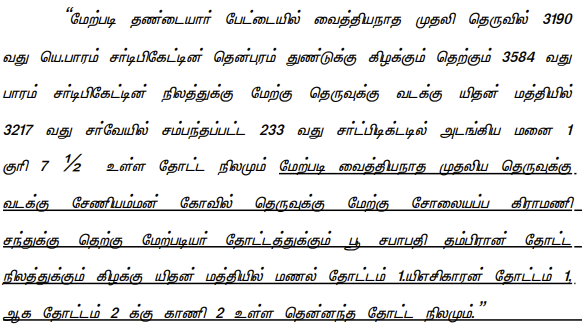
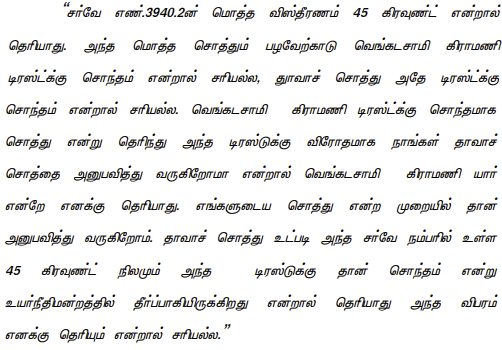
5. It is the case of the plaintiff that the defendants are occupying land measuring 1125 sq.ft in survey number 3940/2 at Vaidhiyanadha Mudali Street in Tondiarpet. The entire extent of the land situated in S.No.3940/2 belongs to the plaintiff and it is about 45 grounds. The defendants, without obtaining any permission or consent from the plaintiff, had unauthorisedly and unlawfully occupied the property.
6. Since the occupation is unauthorized and unlawful, the plaintiff issued a notice on 23.09.2006 to the defendants calling upon them to enter into a lease agreement and to pay the land rent to the plaintiff trust. The defendants had received the letter, but did not issue any reply. They also did not come forward to execute a lease agreement. Thereafter, several oral and written requests were made by the plaintiff trust and they were of no use. Finally on 18.10.2006, a suit notice was issued by the plaintiff calling upon the defendants to surrender the land to the plaintiff trust. The defendants, on receipt of the notice, issued reply on 02.11.2006 refusing to surrender the said property and claiming that they are in peaceful and uninterrupted possession of the property. Being left with no other option, the plaintiff came forward with the suit for recovery of possession.
7. The defendants, on being served with the summons in the suit, filed a detailed written statement. They admitted that they are in occupation of the property. They would state that the property had been occupied by their grandfather, one Mr.Raghavan, and after his death, by the defendants' father, R.Selvaraj, without interference from any third parties including the plaintiff trust. They submitted that at no point of time, they paid rent to anybody and they are not a tenant under the plaintiff or any other person. They pleaded that the plaintiff trust does not have right, title or interest over the property and in any event, if at all it had a right, it has lost the same by virtue of adverse possession of the property by the defendants. Though the plaintiff had not pleaded that there was a lease agreement between them, the defendants denied the existence of any relationship of landlord and tenant. They would plead that th