
 Back
Back





BEFORE THE MADURAI BENCH OF MADRAS HIGH COURT
P. DHANABAL, J.
K. Rajeswari – Appellant
Versus
Kungumayee (Deceased) – Respondent
A.S. (MD) No. 63 of 2011, M.P. (MD) No. 1 of 2012
Decided On : 30-04-2024
JUDGMENT :
P. DHANABAL, J.
1. This appeal has been preferred as against the judgment and decree passed in O.S. No. 144/2008 on the file of the learned Additional District Judge, Fast Track Court, Dindigul wherein the respondent herein had filed a suit as against the appellants for the relief of declaration and recovery of possession of 1st Item of the suit schedule properties and sought for the relief of partition of her 1/4th share over the 2nd to 4th Items of the suit schedule properties and also for mesne profits.
2. The trial Court has decreed the suit in its entirety. Aggrieved by the said decree and judgment, the present appeal has been filed by the defendants/appellants.
3. The brief averments of the plaint are as follows:
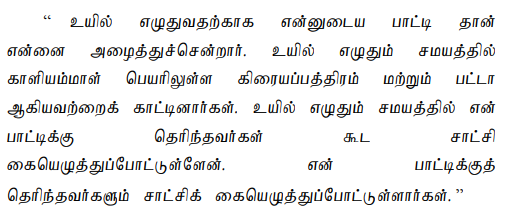
Originally the land in Survey No. 120/1, Chitharevu Village, Palani, belonged to the parents of the plaintiff through sale deed. In the year 1988, the father and mother of the plaintiffs partitioned their properties and 1st Item of the suit schedule properties was allotted to the mother of the plaintiff by name Kaliammal. Thereafter, the mother of the plaintiff had been in possession and enjoyment of the said property by obtaining separate patta and paying kist to the properties. While so, the mother of the plaintiff executed a Will dated 21.11.1996 in favour of the plaintiff and the said Will is the last Will. The mother of the plaintiff died on 07.12.2001. After the demise of Kaliammal, the plaintiff is enjoying the property through the Will dated 21.11.1996 as her exclusive properties.
3.1 The 2nd Item of the suit schedule properties belonged to the father of the plaintiff by name Vadivel Chettiar through partition in the year 1988. The said Vadivel Chettiar died intestate on 02.03.1982 leaving behind the plaintiff and husband of the first defendant and mother of the plaintiff as his only legal heirs. One Krishnamoorthi who was born to the parents of the plaintiff, predeceased his father Vadivel Chettiar in the year 1988. The said Krishnamoorthi is the husband and father of the defendants respectively. Therefore, the plaintiff is entitled to half share and the husband of the first defendant is entitled to half share.
3.2 After the demise of the said Krishnamoorthi, the defendants 2 and 3 are in possession and enjoyment of the 2nd and 3rd Items of the suit schedule property and also they shared the income with the plaintiff. However, for the past two years, they refused to give share to the plaintiff.
3.3 The 3rd item of the suit schedule property originally belonged to one Ponnan Chettiyar who is the grandfather of the plaintiff. Since the said property is an ancestral property, the father of the plaintiff is entitled to half share and his son, the brother of the plaintiff namely Krishnamoorthi, is entitled to half share of the property. The share of Krishnamoorthi goes to the defendants and the share of the father of the plaintiff has to be divided into four shares.
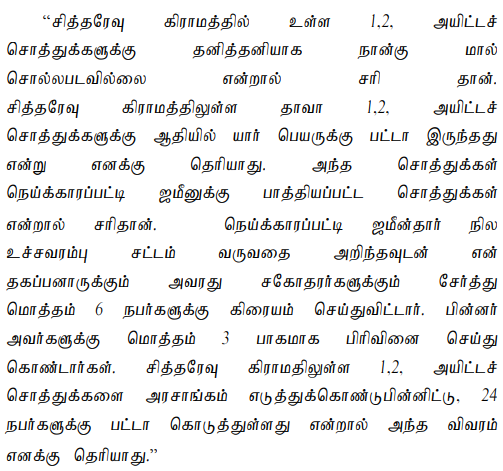
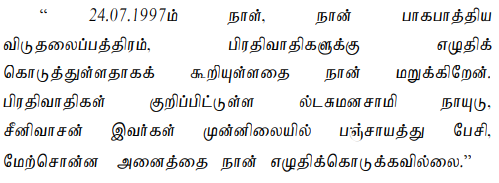
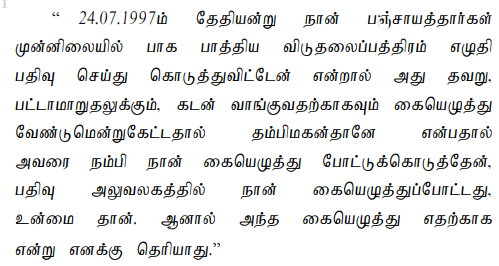
3.4 The 4th Item of the suit schedule properties was purchased by the father of the plaintiff. All the 2nd to 4th Items of the suit schedule properties are under the joint possession and enjoyment of the plaintiff and the defendants. Therefore the plaintiff has filed the suit for recovery of possession in respect of 1st Item of the property and for partition over the other properties. The defendants denied the share of the plaintiff on the ground that the plaintiff executed a release deed. In fact, the plaintiff did not execute any release deed and she has only put her signature in blank papers and thereby, the defendants created the forged release deed. The plaintiff never relinquished her right over the suit properties. The said release deed is a forged one and the same is not binding upon the plaintiff. Therefore, the plaintiff filed the suit.
4. The brief averments of the written statement filed by the second defendant are as follows:
The plaintiff and the husband of the first defendant and father of defendants 2 and 3 are the daughter and so
AI
The court emphasized the necessity of proving a Will through independent witnesses and upheld the validity of a release deed executed by the plaintiff, leading to the dismissal of her claims.

Presumption under Section 90 of Evidence Act is applicable to Wills – Registration, by itself, in all cases, is not a proof of execution.
The classification of properties as joint family or self-acquired depends on the presence of a joint family nucleus; discrepancies in the execution of the Will sow doubt on its validity due to mental....

The court established that unregistered documents affecting rights in immovable property are inadmissible in evidence, and that joint family properties are subject to partition among all rightful hei....
The validity and binding nature of the settlement deed, the requirement of proof of execution under Section 68 of the Indian Evidence Act, and the applicability of the Hindu Succession Act were centr....


The burden of proof lies on the party asserting the validity of a Will, and properties acquired in a wife's name are presumed to benefit her unless proven otherwise.

The court affirmed the validity of a Release Deed executed by a legal heir, emphasizing the burden of proof lies on the party disputing its execution.



An indispensable Tool for Legal Professionals, Endorsed by Various High Court and Judicial Officers
Please visit our Training & Support
Center or Contact Us for assistance

Scan Me!
India’s Legal research and Law Firm App, Download now!


For Daily Legal Updates, Join us on :



 Back to top


