Back
Back





2024 Supreme(All) 2190
IN THE HIGH COURT OF ALLAHABAD
Ashwani Kumar Mishra, Gautam Chowdhary, JJ.
Israr – Appellant
Versus
State of U.P. – Respondent
Criminal Appeal No. -3414 of 2019
Decided On : 15-10-2024
Advocate Appeared:
For the Appellant : Khalid Mahmood, Nazrul Islam Jafri (Senior Adv.)
For the Respondent: G.A.
The court emphasized that a dying declaration must be corroborated and reliable; procedural irregularities and delays in lodging the FIR can undermine its credibility.
Headnote:(A) Indian Penal Code, 1860 - Section 302 - Criminal Procedure Code, 1973 - Section 161 - Dying declaration - Accused sentenced to life imprisonment for murder - Prosecution relied on dying declaration and statements of witnesses - Court found dying declaration unreliable due to lack of corroborative evidence and procedural irregularities - Delay in lodging FIR raised doubts on prosecution's case. (Paras 1, 30, 33)
(B) Dying Declaration - Admissibility and reliability - Court emphasized that dying declarations must inspire confidence and be corroborated by other evidence - The absence of the treating doctor and procedural lapses undermined the reliability of the dying declaration. (Paras 27, 28)
Facts of the case:
The accused was charged with murdering the deceased by setting her ablaze due to unrequited love. The incident occurred on 22.02.2010, and the FIR was lodged 15 days later. The prosecution's case relied heavily on the dying declaration of the deceased, which was recorded shortly before her death. (Paras 2, 3)
Findings of Court:
The trial court's reliance on the dying declaration was deemed unjustified due to significant doubts regarding its reliability and the prosecution's failure to establish the case beyond a reasonable doubt. (Paras 33)
Issues: The main issues included the reliability of the dying declaration, the delay in lodging the FIR, and the adequacy of evidence against the accused. (Paras 30, 31)
Ratio Decidendi: The court ruled that the prosecution failed to prove its case beyond a reasonable doubt, emphasizing that the dying declaration lacked corroboration and was not credible due to procedural irregularities. (Paras 33)
Result: Appeal allowed; conviction and sentence set aside.
JUDGMENT :
Ashwani Kumar Mishra, J.
1. This criminal appeal has been preferred by the accused appellant-Israr challenging the judgment and order dated 23.04.2019, passed by the Sessions Judge, Meerut in Sessions Trial No.597 of 2010 (State Vs. Israr), arising out of Case Crime No.83 of 2010, under Section 302 IPC, Police Station–Bhawanpur, District–Meerut, whereby he has been sentenced to life imprisonment along with fine of Rs.10,000/- and in default of payment of fine to undergo one year simple imprisonment.
2. Briefly stated the prosecution case is that an incident occurred on 22.02.2010 at about 5.00 p.m. in which the deceased has been done to death by the accused appellant by pouring kerosene and setting her ablaze. The report in respect of the incident has been lodged by the father of the deceased on 7th of March, 2010. This report is the basis of lodging of the first information report as Case Crime No.83 of 2010 on 8th of March, 2010. The written report has been exhibited as Ex.Ka-2, which records that informant’s daughter got married to one Naeem, who is a resident of village Aurangabad, Police Station Bhawanpur, District Meerut. The accused wanted to marry the deceased and was having a bad eye on her on account of which he had earlier abducted the deceased and a complaint in that regard was also lodged. It is for this reason that the accused maintained enmity. The accused had openly claimed that if the deceased is not married to him, he would not allow her to be of someone else. The incident occurred at about 5.00 in the evening when nobody was at home. On hearing scream of the deceased, her husband Naeem rushed to the house and found his wife to be substantially burnt. The deceased was rushed to the Medical College, where she was struggling and the entire family was engaged in her treatment. It is for this reason that the report has been lodged on 7th of March, 2010. The written report is typed on which the informant has put his thumb impression.
3. The prosecution case basically relies upon the dying declaration made by the deceased to implicate the accused, which is exhibited as Ex-Ka15. The contents of the dying declaration are reproduced hereinafter:-
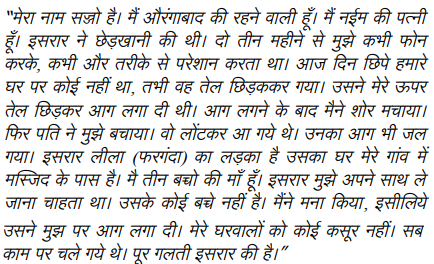
4. The deceased also gave her statement to the I.O. on 8th of March, 2010, which is incidentally the date when the deceased died. There is, however, no recording of the time when such statement was recorded. This statement is on similar lines as that of the dying declaration. Relying upon the dying declaration as well as the statement of witnesses, the prosecution has implicated the accused appellant.
5. It transpires that on 8th of March, 2010, the deceased succumbed to her burn injuries. The inquest was conducted on the same day and in light of the opinion expressed by the inquest witnesses, the body was sent for postmortem. The postmortem report is on record, as per which the deceased was around 25 years of age and she died as a result of septiceamic shock arising out of ante mortem burn injuries. In the opinion of the doctor following injuries were found on the body of the deceased:
“Superficial to deep burn all over body except suprapubic area 34 c.m. x 10 c.m. And 14 c.m. x 7 c.m. on xiphisternum area and lower back at the level of lumboscaccral region, a strip 30 c.m. x 2 c.m., would is infected and granulation tissue seen inside superficial to deep sluff present. Both sole and head hair unburned.”
6. The investigation ultimately concluded with submission of a charge-sheet against the accused appellant on 27th of March, 2010. The concerned Magistrate having taken cognizance in the matter committed the case to the Court of Session, where it got registered as Sessions Trial No.597 of 2010 (State Vs. Israr). The concerned Sessions Judge, Meerut framed charges against the accused appellant under Section 302 I.P.C. on 18th of June, 2010. The charges were handed over and explained to the accused appellant in Hindi, who pleaded not guilty and demanded trial.
7. The trial c