
 Back
Back





IN THE HIGH COURT OF ALLAHABAD
SARAL SRIVASTAVA, J.
Kamlesh Kumar – Petitioner
Versus
Sardar Manjeet Singh – Respondent
Matters Under Article 227 No. 7570 of 2018
Decided On : 12-08-2024
(A) Uttar Pradesh Act No. 13 of 1972 - Section 30(1) - Uttar Pradesh Urban Buildings (Regulation of Letting, Rent and Eviction) Rules, 1972 - Rule 21(5) - Eviction proceedings - The petitioner-landlord sought eviction of the respondent-tenant for default in rent payment - The Trial Court ruled in favor of the landlord, but the Revisional Court reversed this decision citing jurisdictional confusion - The court emphasized the necessity of strict compliance with statutory provisions for rent deposits, reaffirming that non-compliance invalidates the deposit under Section 30(1) of the Act. (Paras 8, 10, 24, 32)
(B) Jurisdiction - The court clarified that the tenant's deposit of rent in the wrong court constituted a default, and the landlord's refusal to accept rent does not absolve the tenant from compliance with procedural requirements. (Paras 30, 31)
Facts of the case:
The petitioner-landlord filed for eviction based on the tenant's alleged non-payment of rent since November 2001, while the tenant claimed compliance with rent payment procedures.
Findings of Court:
The court restored the Trial Court's decree for eviction, emphasizing the tenant's failure to comply with the statutory requirements for rent deposit.
Issues: The main issues included the validity of the rent deposit and the jurisdiction of the courts involved.
Ratio Decidendi: The court ruled that strict adherence to the statutory provisions is mandatory for tenants to benefit from rent control legislation.
Result: The writ petition succeeds and is allowed.
JUDGMENT :
SARAL SRIVASTAVA, J.
1. Heard Sri P.K. Jain, learned Senior Counsel assisted by Sri Himanshu Singh, learned counsel for the petitioner-landlord, and Sri Kiran Kumar Arora, learned counsel for the respondent-tenant and perused the records.
2. The petitioner through the present petition has assailed the judgment and decree dated 29.1.2014 passed by the Additional District Judge, Court No. 10, Moradabad in S.C.C. Revision No. 24 of 2010, whereby the learned Judge has allowed the revision of the respondent-tenant and set aside the judgment and decree dated 3.5.2010 passed by the Judge, Small Causes Court, Moradabad in S.C.C. Suit No. 58 of 2006, whereby the Trial Court has decreed the suit of the petitioner-landlord for eviction of the respondent-tenant on the ground of default in payment of rent.
3. Brief facts of the case are that the petitioner-landlord had instituted a S.C.C. Suit No. 58 of 2006 contending, inter alia, that the respondent-tenant is the tenant of one shop in a commercial building situated at Mohalla Bishanpura, main market, Kasba Kanth, District Moradabad. It is also alleged that the tenancy of the respondent-tenant was month to month and began on the 10th of every month and ended on the 9th of the succeeding month. It is further alleged that the rent has been paid by the respondent-tenant till 09.11.2001, and after that the rent was not paid which led the petitioner-landlord to send notice dated 04.08.2006 to the respondent-tenant terminating the tenancy of the respondent-tenant. The said notice was received by the respondent-tenant on 05.08.2006. It is further pleaded that the respondent-tenant in his reply to the notice dated 04.08.2006 has incorrectly stated that the petitioner-landlord had stopped accepting rent from him. It is further pleaded that the respondent-tenant in reply to the said notice has incorrectly stated that he had sent the rent for the period from 10.11.2001 to 09.05.2002 by two money orders, which the landlord refused to accept. It is further pleaded that the respondent-tenant had sent a money order of Rs. 900 to the petitioner-landlord in December 2001 and another money order of the same amount in January 2002, which was not accepted by the petitioner-landlord for the reason that the rents for the months for which two money orders by the respondent-tenant were sent were not due, therefore, the petitioner-landlord was not bound to accept the rent sent by two money orders.
4. It is also pleaded that the rent deposited by the respondent-tenant under Section 30(1) of the Uttar Pradesh Act No. 13 of 1972 (hereinafter referred to as ‘the Act’) was not deposited in the prescribed manner and the petitioner-landlord has not received any summon or notice from any competent court in respect to the deposit of the rent by the respondent-tenant under Section 30(1) of the Act. The petitioner-landlord specifically pleaded that the summons in Misc. Case No. 6 of 2002 under Section 30(1) of the Act was never received by the petitioner-landlord. On the aforesaid facts, the petitioner-landlord prayed for a decree of eviction and recovery of rent, etc.
5. The respondent-tenant filed a written statement contending, inter alia, that there was no default in payment of rent.
6. The Trial Court framed as many as four issues. On issue no. 1, with respect to the applicability of Uttar Pradesh Act No. 13 of 1972, the Trial Court held that provisions of Uttar Pradesh Act No. 13 of 1972 apply to the shop.
7. Issue no. 2, regarding service of notice was decided in favour of the petitioner-landlord. The Trial Court decided issue nos. 3 and 4 together which reads as under:
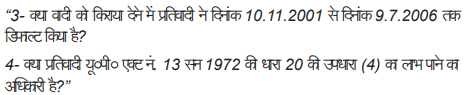
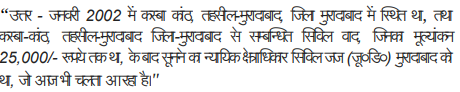
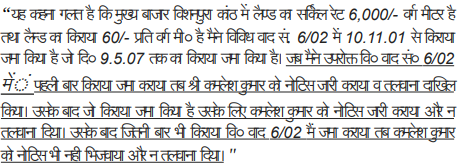
8. On the issue nos. 3 and 4, the Trial Court held that since the deposit under Section 30(1) of the Act had been made by the respondent-tenant in District Court, J.P. Nagar, whereas after 30th of July, 2002 by the notification dated 30th of July, 2002 of the Governor, the Tehsil Kanth fell under the jurisdiction of the Court of Moradabad, therefore
AI
Strict compliance with statutory provisions for rent deposits is mandatory; failure to comply invalidates the deposit and can lead to eviction.

Point of Law : The provisions under Order XV Rule 5(2) provides a locus poenitentiae to the defaulting tenant to make a representation, which must be made within ten days of the first hearing or with....

The judgment emphasized the mandatory nature of the provisions of the Rent Control Act and the requirement for the tenant to offer rent to the landlord before depositing it in Court.

Tenant can only deposit rent in Court as long as landlord has refused to accept rent – Once landlord expresses his willingness to accept rent, tenant has no option but to deposit rent to landlord.

Tenants cannot be evicted for non-payment of rent if they have made proper deposits under legal requirements, and landlords had knowledge of these deposits.
Section 30 of the U.P. Act No. 13 of 1972 cannot be invoked for rent deposits once an eviction suit is pending, requiring adherence to procedural rules of the ongoing legal proceedings.

A tenant's failure to communicate rent deposits and respond to rent demands constitutes default, justifying eviction under the Bombay Rent Act.


A tenant must deposit all arrears of rent, including time-barred amounts, to claim protection from eviction under Section 15(3) of the Maharashtra Rent Control Act.

The failure of the tenant to deposit the rent under Section 27 of the Act, after the landlord's refusal to accept the tendered rent, makes the tenant liable for eviction under Section 14(1)(a) of the....



An indispensable Tool for Legal Professionals, Endorsed by Various High Court and Judicial Officers
Please visit our Training & Support
Center or Contact Us for assistance

Scan Me!
India’s Legal research and Law Firm App, Download now!


For Daily Legal Updates, Join us on :



 Back to top


