
 Back
Back





ALLAHABAD HIGH COURT
J.J. MUNIR, J.
Smt. Gauri Shukla - Petitioner
Versus
State of U.P. and Others - Respondents
Civil Misc. Writ Petition No. 19270 of 2023
Decided On : 31-05-2024
JUDGMENT :
(J.J. Munir, J.)
This writ petition is directed against an order passed by the Executive Officer, Nagar Panchayat Tirwaganj, District Kannauj dated 29.9.2023, dismissing the petitioner, a Class-IV employee (peon) from service after disciplinary proceedings.
2. Admittedly, the petitioner's deceased husband, Atul Kumar Shukla was an employee of the Nagar Panchayat, Tirwaganj, District Kannauj. He died in harness. While the late Atul Kumar Shukla was around, the petitioner and her husband had some marital discord, on account of which the petitioner went over to her parents' place alongwith her sons Kartik Shukla, a boy aged 15 years and Raghav Shukla, who was still younger and aged 10 years. It is the petitioner's case that taking advantage of the discord between parties and to grab the late Atul Kumar Shukla's estate, the deceased's mother and brother made him execute a Will dated 1.6.2018 in favour of his mother, Abhilasha Devi, carrying terms to the effect that after his demise, all his movable and immovable property, proceeds of insurance, provident fund and agricultural land, situate at Mudarawang, Tehsil Tirwaganj, would vest exclusively in the testator's mother, who would become the sole owner in possession thereof. The Will also says that his wife and sons would not be entitled to any share in the testator's property, including his insurance proceeds and funds. Sometime after execution of the aforesaid Will, Atul Kumar Shukla expired. It is the petitioner's case that the petitioner and the late Atul Kumar Shukla were never divorced or judicially separated by a decree of Court and until his demise, the petitioner and the Atul Kumar Shukla were lawfully wedded man and wife. After her husband's demise, the petitioner, who was his dependent, applied for compassionate appointment and appointed on a peon's post on compassionate grounds in accordance with rules vide letter of appointment dated 5th January, 2019 issued by the Executive Officer, Nagar Panchayat Tirwaganj, District Kannauj. The aforesaid facts are not in issue.
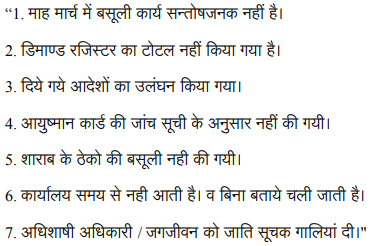
3. After her appointment, the petitioner discharged her duties, as she says, to the best of her abilities with full devotion, integrity and sincerity. There was no complaint against the petitioner. It is the petitioner's case that the Executive Officer, Nagar Panchayat Tirwaganj, misusing his authority as such, for no reason, indulged in misbehaviour with the petitioner and harassed her socially, economically and physically. The petitioner resisted the second respondent's overtures, which led the second respondent to tell the petitioner that if she did not obey the second respondent, she would be fired. On the 20th of March, 2023, the petitioner received a letter from the Executive Officer, which she says, was issued mala fide to effect that several tasks assigned to the petitioner, such as preparation of the demand register, non-provision of the list of Ayushman Cards, making recovery from liquor shops, had not been undertaken. It was also said that the petitioner abused one Jagjeewan Ram in caste suggestive words and did not deposit taxes in the office of the Nagar Panchayat. The petitioner was imputed with the misconduct of leaving office without informing anyone. The petitioner was asked to answer these allegations and also asked to show-cause why disciplinary proceedings be not initiated against her. The petitioner wrote a letter to the Sub-Divisional Magistrate/Administrator, Nagar Panchayat Tirwaganj, District Kannauj saying that the work assigned to the petitioner was not the work of a Class-IV employee and yet she discharged those duties to the full satisfaction of her superiors. It was in the month of March, 2023 that the petitioner suffered a reverse to her health. This gave occasion to Jagjeewan Ram to harass the petitioner. He addressed a complaint against the petitioner to the Sub-Divisional Magistrate/Administrator, Nagar Panchayat Tirwaganj, which was received in the S.D.M.'s office o
AI
Disciplinary proceedings must adhere to principles of natural justice, including proper notice and opportunity for defense, especially when imposing major penalties.

In disciplinary proceedings involving major penalties, the burden of proof lies with the establishment to substantiate charges through a fair inquiry process that includes the presentation of evidenc....
A disciplinary inquiry must follow procedural fairness, including the establishment's burden to prove charges through evidence, especially when major penalties are at stake.
A fair inquiry process is essential in disciplinary proceedings, and failure to adhere to procedural requirements can invalidate dismissal orders.
The main legal point established in the judgment is that the failure to conduct a proper departmental enquiry, especially in cases involving major penalties, violates the principles of natural justic....
The inquiry process for major penalties must adhere to principles of natural justice, requiring evidence from the Establishment and proper notice to the accused.
The main legal point established in the judgment is the requirement for a formal inquiry in matters involving the imposition of a major penalty, with the burden of proof on the Establishment to produ....

Disciplinary inquiry under 1999 Rules vitiated without oral hearing opportunity to delinquent, even absent proposed witnesses by either side, as implicit in rules for natural justice compliance.



An indispensable Tool for Legal Professionals, Endorsed by Various High Court and Judicial Officers
Please visit our Training & Support
Center or Contact Us for assistance

Scan Me!
India’s Legal research and Law Firm App, Download now!


For Daily Legal Updates, Join us on :



 Back to top


