
 Back
Back





IN THE HIGH COURT OF ALLAHABAD
SAURABH LAVANIA, J.
Shashi Devi Sachan and Others – Petitioners
Versus
State of U.P. and Others – Respondents
Writ (C) No. 511 of 2024
Decided On : 19-01-2024
JUDGMENT :
SAURABH LAVANIA, J.
1. Heard Sri Sanjay Kumar Srivastava, Advocate alongwith Sri Akshat Kumar, learned counsel for the petitioners, Sri Hemant Kumar Pandey, learned State counsel and Sri Ashok Kumar Verma, learned counsel for the contesting respondent No. 5. Other private opposite parties, as stated by Sri Verma, are formal parties.
2. By means of this petition, the petitioners have assailed the order dated 23.10.2021 passed by the respondent No. 4/Sub-Divisional Magistrate, Sarojni Nagar, Lucknow on an application instituted under Section 24 of U.P. Revenue Code, 2006 (in short “Code of 2006”) registered as Case No. 13504/2021, Computerized Case No. T202110460513504 (Bhola vs. Smt. Shashi Devi and others) and the order dated 06.10.2022 passed by respondent No. 3/Commissioner, Lucknow Division, Lucknow in Appeal No. 1757/2021, Computerized Case No. C202110000001757 (Smt. Shashi Devi and others vs. Bhola and others) instituted under Section 24(4) of the Code of 2006 as also the order dated 20.12.2023 passed by the respondent No. 2/Board of Revenue, Uttar Pradesh, Lucknow in Revision No. REV/2563/2022/Lucknow, Computerized Case No. R20221046002563 (Smt. Shashi Devi Sachan and others vs. Bhola) instituted under Section 210 of the Code of 2006.
3. By the order dated 23.10.2021, the respondent No. 4 had confirmed the demarcation report dated 24.08.2021. The order dated 23.10.2021 on reproduction reads as under:
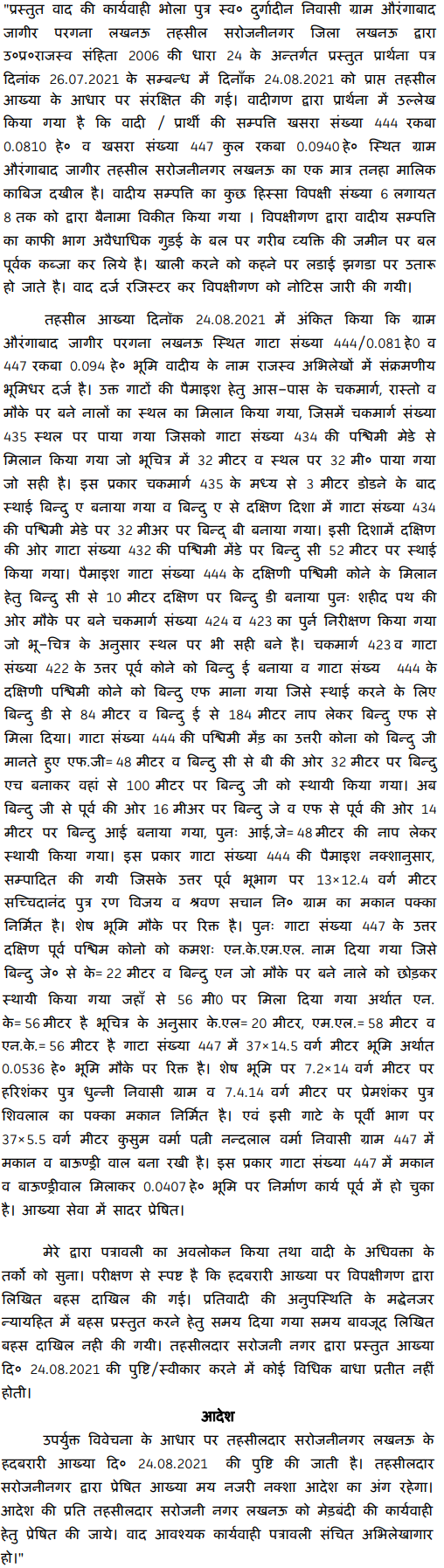
4. Being aggrieved by the order dated 23.10.2021, an Appeal No. 1757/2021, Computerized Case No. C202110000001757 (Smt. Shashi Devi and others vs. Bhola and others) was filed under Section 24(4) of the Code of 2006, which was dismissed by the respondent No. 3 vide order dated 06.10.2022 affirming the order dated 23.10.2021 passed by respondent No. 4.
5. Being aggrieved by the order dated 06.10.2022, a Revision No. REV/2563/2022/Lucknow, Computerized Case No. R20221046002563 (Smt. Shashi Devi Sachan and others vs. Bhola) was filed under Section 210 of the Code of 2006, which was also dismissed by the respondent No. 2 vide order dated 20.12.2023.
6. On several issues and factual aspects of the case, petitioners’ counsel as well as learned counsel for the respondent No. 5 have advanced their submissions. This Court however is not inclined to deal with the same at this stage, as only one ground is relevant for the purposes of final disposal of this petition at the admission stage more so when there going to be no prejudice caused to the parties to the litigation in view of order proposed to be passed.
7. The only ground relevant for the purposes of final disposal of this petition is to the effect that the revenue court of first instance i.e. respondent No. 4 while dealing with the application under Section 24 has not passed the reasoned and speaking order and this aspect has also not been taken note of by appellate authority and revisional authority. The reasons are required to be recorded.
8. It is a settled principle of law that an order passed by a quasi-judicial authority or even an administrative authority affecting the rights of parties, must be a ‘speaking order’ and it must not be like the ‘inscrutable face of a sphinx’.
9. In judgment passed in the case of Union of India Vs. Mohan Lal Capoor and Others, (1973) 2 SCC 836, the Apex Court observed as follows:
“28.... Reasons are the links between the materials on which certain conclusions are based and the actual conclusions. They disclose how the mind is applied to the subject matter for a decision whether it is purely administrative or quasi judicial. They should reveal a rationale nexus between the facts considered and conclusions reached. Only in this way can opinion or decisions recorded to be shown to be manifestly just and reasonable.”
10. Lord Denning M.R. in the case of Breen v. Amalgamated Engineering Union, (1971) 2 QB 175, 191 : (1971) 1 All ER 1148, observed as under:
“the giving of reasons is one of the fundamentals of good administration.” Sir Donaldson, in th
AI
Quasi-judicial authorities must provide reasoned and speaking orders to ensure transparency and prevent arbitrary decision-making.

A quasi-judicial authority must provide a reasoned order to ensure transparency and accountability in decision-making.

Quasi-judicial authorities must record detailed reasons for decisions, ensuring procedural fairness and preventing arbitrary action.

The necessity of providing reasons in appellate decisions is crucial for ensuring judicial accountability, transparency, and fairness.

It is a settled legal proposition that not only administrative but also judicial order must be supported by reasons, recorded in it. Thus, while deciding an issue, the Court is bound to give reasons ....

Judicial proceedings must follow prescribed procedures; failure to document and hear parties leads to invalid orders, undermining public trust in the justice system.

Point of Law : It is no doubt true that if there was any provision to be found in impugned Act which prevented the Wage Board from giving reasons for its decision, it might be construed to mean that ....



An indispensable Tool for Legal Professionals, Endorsed by Various High Court and Judicial Officers
Please visit our Training & Support
Center or Contact Us for assistance

Scan Me!
India’s Legal research and Law Firm App, Download now!


For Daily Legal Updates, Join us on :



 Back to top


