
 Back
Back





HIGH COURT OF JUDICATURE AT ALLAHABAD, LUCKNOW
AMITABH KUMAR RAI, J.
Mohd. Arif – Petitioners
Versus
U.P. State Road Transport Corp. Through Its M.D. And Ors. – Respondents
Writ A. No. 6734 of 2002
Decided On : 19-12-2025
| Table of Content |
|---|
| 1. factual background of disciplinary proceedings (Para 2 , 3 , 4 , 5 , 6 , 7 , 8) |
| 2. grounds of appeal against removal (Para 9) |
| 3. court's analysis on procedural compliance (Para 10 , 11 , 12 , 13 , 14 , 15 , 16 , 17 , 18 , 19 , 20 , 21 , 22 , 23 , 24 , 25 , 26) |
| 4. final judgment on petition dismissal (Para 27 , 28 , 29) |
JUDGMENT :
AMITABH KUMAR RAI, J.
1. Heard Sri Sameer Singh, learned counsel for the petitioner, and Sri Ratnesh Chandra, learned counsel for the respondents.
2. The present writ petition has been filed challenging the order dated 31.05.2002 passed by the Regional Manager, Uttar Pradesh State Road Transport Corporation (hereinafter referred to as ‘UPSRTC’) Lucknow Region, Lucknow, whereby the petitioner was awarded punishment of removal from service, as well as the appellate order dated 10.09.2002 by which the appeal of the petitioner was rejected by respondent no. 3, Mandaliya Pradhan Prabandhak (Central Zone), UPSRTC, Terhi Kothi, Lucknow.
3. The brief facts of the case are that the petitioner, while posted on the post of Conductor at Mirzapur Depot, Allahabad Region, was running passenger bus bearing vehicle registration no. U.R.S. 9938 en route from Renukot to Lucknow on 09.03.1990. At about 16:45 hours, between Renukot and Robertsganj, the bus was stopped by the inspection team at a place namely Gurmura, and on inspection it was found that out of 83 passengers, 30 passengers were without tickets, though the fare from them was realised by the petitioner. The inspection team was headed by Sri Heera Lal Upadhyay, Senior Centre In-charge (Checking), along with two Assistant Traffic Inspectors. The inspection team, on finding that 30 passengers were without ticket, issued a common ticket no. 660966 for all passengers, and an inspection report dated 15.09.1990 was forwarded to the Regional Office for further action.
4. Thereafter, a charge-sheet dated 25.09.1990 was issued in which it was alleged that the petitioner realised Rs. 285 from 30 passengers out of a total of 83 passengers but did not issue tickets to them for travelling from Renukot to Robertsganj, as per inspection held on 09.03.1990 at 16:45 hours. By such conduct, the petitioner was held guilty of four charges, i.e., (i) taking 30 passengers for travel in the bus without tickets; (ii) attempt to embezzle the income of the corporation; (iii) involving himself in corruption and misconduct; and (iv) discharging duty in violation of rules. In support of the charges, the inspection report was annexed with the charge-sheet, and it was also provided that the way-bills and tickets, could be pursued by the petitioner the same in the Regional Office. It was further required by the charge-sheet that the petitioner should file a reply to the charges within 15 days and also inform about the witnesses whom he wanted to cross-examine and other evidence which he wanted to rely upon in defence of the charges against him.
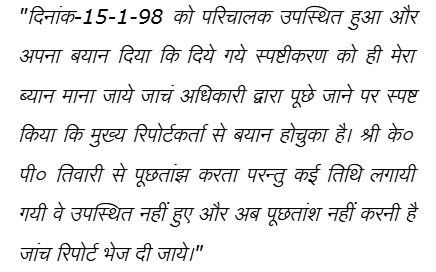
5. The petitioner filed his reply to the charges vide his letter dated 30.11.1990 denying the charges, in which he specifically mentioned for examining of two passengers who were present in the bus on the date of the inspection / checking on 09.03.1990. He also made reference that the inspection report was not supported by any independent witness and, as such, could not be relied upon. During the course of inquiry, the inspection report was proved by Heera Lal Upadhyay, In-charge of the Inspection Team, and the petitioner also cross examined Sri Heera Lal Upadhyay in detail. The petitioner could not get his witnesses examined, and in the meantime he was transferred to Faizabad Region and the Assistant Regional Manager (Karmik) was nominated as the new Inquiry Officer. Thereafter, the Inquiry Officer called upon the petitioner for personal hearing, and Sri K.P. Tiwari, Assistant Traffic Inspector, one of the members of the inspection team, was examined at the instance of the petitioner on 15.03.1998.
6. The petitioner, during the course of inq
AI
The court affirmed that disciplinary proceedings followed appropriate regulations and natural justice principles, validating the removal of an employee for misconduct in ticket issuance.

The court upheld that procedural irregularities in domestic enquiries do not invalidate findings if substantiated by evidence, reaffirming the limited scope of judicial review against disciplinary ac....

The court upheld the dismissal of an employee based on sufficient evidence in a domestic enquiry, affirming that procedural fairness does not require the same strict standards as formal court proceed....

The court upheld the dismissal of the employee, affirming that hearsay evidence is permissible in domestic enquiries and that the disciplinary authority can conduct the enquiry without inherent preju....

Disciplinary proceedings must adhere to principles of natural justice, including the right to a fair hearing and the requirement for oral evidence. Failure to comply renders the proceedings and resul....


The judgment emphasizes the importance of specific and proven charges, adherence to procedural rules, and consideration of the petitioner's explanation in disciplinary proceedings.
The court emphasized that charges of misconduct must be supported by substantial evidence and that the prescribed procedures must be followed. The court also highlighted the principle that the punish....

The Disciplinary Authority must issue a reasoned notice of disagreement when departing from exonerating findings in disciplinary proceedings, ensuring the principles of natural justice are upheld.

Judicial review in disciplinary matters is limited to process legality; evidence evaluation remains within the disciplinary authority's purview.



An indispensable Tool for Legal Professionals, Endorsed by Various High Court and Judicial Officers
Please visit our Training & Support
Center or Contact Us for assistance

Scan Me!
India’s Legal research and Law Firm App, Download now!


For Daily Legal Updates, Join us on :



 Back to top


