
 Back
Back





IN THE HIGH COURT OF MADHYA PRADESH AT GWALIOR
ANAND SINGH BAHRAWAT, J.
Rajendra Singh Bhadoriya – Petitioner
Versus
The State of Madhya Pradesh And Others – Respondents
Writ Petition No. 5144 of 2017
Decided On : 08-05-2026
| Table of Content |
|---|
| 1. challenge to denial of promotion based on dpc's acr reassessment. (Para 1 , 2 , 3 , 5) |
| 2. downgrading acrs requires recorded reasons and opportunity of hearing. (Para 6 , 7 , 13 , 14) |
| 3. uncommunicated adverse acrs cannot be used to deny promotion. (Para 8 , 9 , 11 , 12) |
| 4. departmental error entitles employee to full benefits via retrospective promotion. (Para 10 , 15) |
ORDER
This petition, under Article 226 of the Constitution of India, has been filed by petitioner seeking following relief (s):-
"(i) That, the present petition filed by the petitioner may kindly be allowed;
(ii) That, the impugned order of promotion dated 29.7.2017 Annexure P/1 may kindly be directed to be set aside or the petitioner may kindly be granted promotion with effect from the date the other persons out of the order dated 29.7.2017 Annexure P/1 have been given benefit of promotion on the post of Asstt. Engineer with all consequential benefits including arrears of salary etc.
(iii) That, further the case of the petitioner for his promotion on the post of Executive Engineer in case occasion so arise be directed to be considered.
(iv) That, any other just, suitable and proper relief, which this Hon'ble Court deems fit, may also kindly be granted to the petitioner. Costs be also awarded in favour of the petitioner."
2. Learned counsel for petitioner submits that petitioner was holding the post of Sub Engineer. At the relevant point of time, i.e., 03.03.2014, the DPC was convened to consider the cases of eligible Sub Engineers for their promotion to the post of Assistant Engineer and the criteria for promotion was merit-cum-seniority. It is further submitted that petitioner had secured A+ ACRs during the relevant period, i.e., from 2007-2008 till 2011-2012. Meaning thereby, petitioner was entitled to be granted promotion on the basis of his seniority. One Shri I.M. Khan, who was placed at Serial No.56 in the gradation list, whereas the petitioner was placed at Serial No.49, was promoted by the DPC despite being junior to the petitioner. It is further submitted that at the time of the DPC, no departmental inquiry was pending against the petitioner and without having any jurisdiction, the DPC in its meeting dated 03.03.2014 made its own assessment whereby the petitioner was graded as “Very Good” instead of “Outstanding” and on that basis, it was held that petitioner was not entitled to promotion. Consequently, the promotion of petitioner was denied. Thereafter, the petitioner submitted a detailed representation but the same has not been considered. It is further submitted that the petitioner is senior to Shri I.M. Khan. Petitioner was placed at Serial No.49, whereas Shri I.M. Khan was placed at Serial No.56 in the gradation list showing the position as on 01.01.2012. It is further submitted that once the petitioner had secured outstanding gradings in his ACRs from 2007-2008 to 2011-2012, there was no reason for the DPC to make its own assessment and the DPC wrongly misinterpreted the provisions of the M.P. Public Service (Promotion) Rules, 2002. It is further submitted that once the petitioner had outstanding gradings in the last five years’ ACRs, the respondents could not have overlooked the said ACRs and made a fresh assessment by downgrading them to “Very Good”. It is further submitted that no reason has been assigned by the DPC as to why the grading in the ACRs of petitioner was reduced from “Outstanding” to “Very Good”.
3. Per contra, learned counsel for the respondent/State submits that the DPC considered the ACRs of petitioner and that the State Government, vide circular dated 06.07.2002 issued by the GAD, had empowered the DPC to reduce or enhance the grading of ACRs while considering the cases of employees for promotion. It is further submitted that in the present case, the DPC, while considering the case of petitioner for the year 2009-2010, found that there was no endorsement of the accepting officer for the relevant year 2009-2010 and the

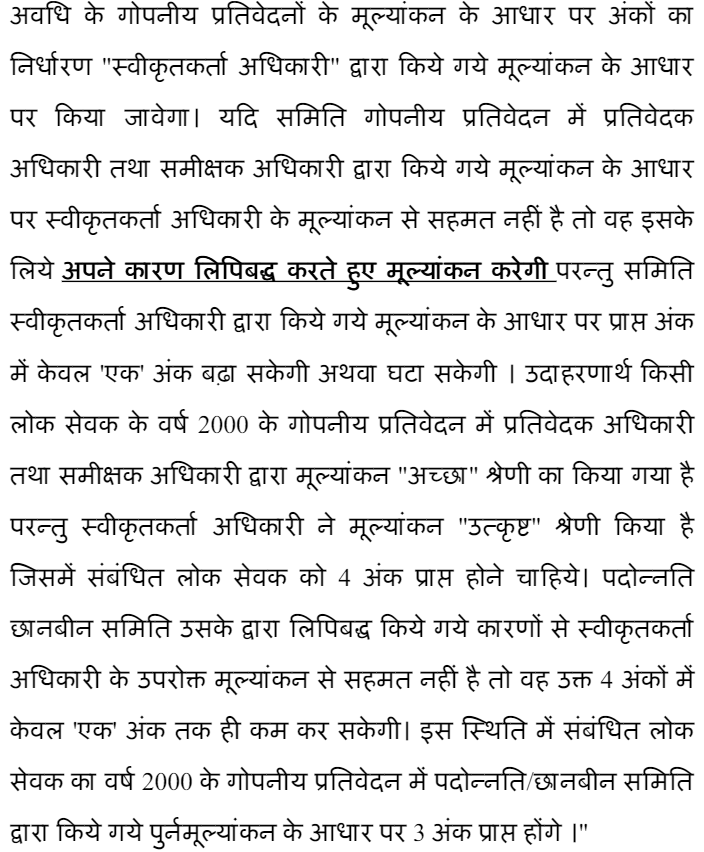
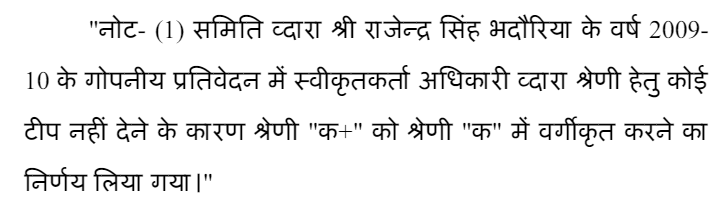
AI
Downgrading an employee's performance ratings without communicating the reasons or providing an opportunity for a hearing violates the principles of natural justice. Uncommunicated adverse entries ca....


Denial of promotion based on non-communicated below benchmark ACRs violates Article 14, and such non-communication is arbitrary and illegal.

No prejudice has been caused to the petitioner, as the petitioner was considered for promotion. However, he was not promoted due to the petitioner not attaining the bench mark.



An indispensable Tool for Legal Professionals, Endorsed by Various High Court and Judicial Officers
Please visit our Training & Support
Center or Contact Us for assistance

Scan Me!
India’s Legal research and Law Firm App, Download now!


For Daily Legal Updates, Join us on :



 Back to top


