1. Appeal against sentence imposed following guilty plea for causing death by reckless driving under the Road Transport Act 1987. (Para 2 , 3 , 4 , 5 , 6 , 7 )
 Back
Back
Next 





2026 MarsdenLR 960
HIGH COURT SABAH & SARAWAK TAWAU
STEVE RITIKOS, JC
CHEONG KAT MENG @ WELLY CHEONG – Appellant
Versus
PP – Respondent
[Criminal Appeal No: TWU-41S-11-11/2024]
Petitioner Advocates:Lim Chun Yuan ,Respondent Advocate: Nur Nisla Abdul Latif
A plea of guilty does not entitle an offender to the minimum sentence; public interest and legislative intent for severe deterrence in fatal reckless driving cases override personal mitigation, especially where multiple child deaths occur.
Headnote:(A) Road Transport Act 1987 - Section 41(1) - Criminal Procedure Code - Sections 173(a), 173(b), 305, 323(1) - Causing death by reckless or dangerous driving - Sentence - Mandatory imprisonment of not less than five years and not more than ten years - Mandatory fine of not less than RM20,000.00 and not more than RM50,000.00. (Paras 4, 11, 13, 14, 15, 16, 17, 22, 24, 25, 26, 27, 28, 29, 30, 31, 32, 33, 34, 35)
(B) Appeal against sentence - Appellate court will not interfere unless sentencing judge erred in law, failed to appreciate material facts, or passed a manifestly excessive or inadequate sentence - Principles in PP v. Mohamed Nor & Ors [1985] 1 MLRA 501; PP v. Jafa Daud [1981] 1 MLRH 800; and PP v. Prabu Veeramuthu & Ors [2010] 2 MLRA 287 restated. (Paras 8, 9, 10, 19, 20, 21)
(C) Plea of guilty - Section 305 CPC precludes appeal against conviction except as to extent or legality of sentence - Recording of plea must comply with s 173 CPC - Court must ensure accused understands nature and consequence of charge. (Paras 13, 14, 15, 16, 17)
(D) Mitigation - Personal and familial hardship is a natural consequence of offender's deliberate choices and should not be given undue weight in grave offences - PP v. Teh Ah Cheng [1976] 1 MLRH 76 and PP v. Shahrul Azuwan Adanan & Anor [2012] MLRHU 1720 referred. (Paras 27, 28) (E) Public interest - Courts have a duty to reflect Parliament's and the public's concern regarding rise in fatal traffic offences - Amendment to s 41(1) RTA 1987 signaling severe deterrence - Minimal sentence inappropriate where multiple child fatalities occurred. (Paras 26, 29, 30)
Facts of the case:
The Appellant pleaded guilty to a charge under s 41(1) of the Road Transport Act 1987 for causing death by reckless or dangerous driving. The incident occurred on 11 September 2023 at approximately 1350 hours at KM24, Jalan Semporna - Tawau, when the Appellant lost control of his vehicle, crossed the middle line, and collided head-on with an oncoming car. The collision resulted in the deaths of a three-month-old infant and a three-year-old child. The road was dry, it was broad daylight, and the vehicle was travelling at exceptionally high speed on a gradual bend. The learned Magistrate sentenced the Appellant to seven years imprisonment, a fine of RM20,000.00, and a five-year driving disqualification.
Findings of Court:
The appellate court found that the learned Magistrate had meticulously complied with s 173 CPC in recording the plea, and the conviction was safe. The sentence of seven years imprisonment, RM20,000.00 fine, and five-year driving disqualification was within the statutory range, proportionate, and not manifestly excessive. The court held that a timely plea of guilt does not confer an automatic right to the minimum sentence, especially where multiple child fatalities occurred, and that public interest requires absolute deterrence for such offences.
Issues: (1) Whether the learned Magistrate failed to ascertain that the Appellant understood the nature and consequence of the charge under s 173(a) and (b) of the Criminal Procedure Code; (2) Whether the sentence imposed was manifestly excessive; (3) Whether the learned Magistrate erred in failing to consider the totality of mitigating factors.
Ratio Decidendi: The appellate court ruled that the recording of the plea was in accordance with law and the conviction was safe. On sentence, the court held that the statutory minimum sentence is not automatically warranted merely because of a guilty plea, and public interest demands severe punishment for reckless driving causing death, particularly where multiple young children are killed.
Result: Appeal against conviction and sentence dismissed; decision of the learned Magistrate affirmed.
Legal Category Hierarchy
-
crime and sentencing
- offences against the person
- sentencing
- practice and procedure
Table of Contents
2. Appellant argued plea was not understood and sentence excessive; prosecution argued sentence was proper. (Para 11 , 12 , 23 )
3. Appeal dismissed; sentence of imprisonment, fine, and disqualification affirmed. (Para 34 , 35 , 36 )
4. What is the requirement for recording a guilty plea under section 173 of the Criminal Procedure Code?
The magistrate must explain the nature and consequences of the charge to ensure the accused understands and pleads voluntarily. The proceedings must comply with the procedure laid down in the section. (Para 15 , 16 , 17 , 18 )
5. Can an appellant who pleaded guilty appeal against conviction?
Under section 305 of the Criminal Procedure Code, an appeal against conviction is prohibited except as to the extent or legality of the sentence, unless the conviction was illegal or unlawful. (Para 13 , 14 , 22 )
6. What is the sentencing range for causing death by reckless or dangerous driving under section 41(1) of the Road Transport Act 1987?
The amended section prescribes a mandatory imprisonment of not less than five years and not more than ten years, and a fine of RM20,000 to RM50,000. (Para 24 )
7. What weight should be given to personal and familial hardship as a mitigating factor in fatal traffic offences?
Personal hardships are the natural consequences of the offender's deliberate choices and do not override public interest, especially in grave offences causing death. (Para 27 , 28 )
8. Does a timely plea of guilt entitle the offender to the minimum sentence?
A timely plea of guilt is a mitigating factor but does not confer an automatic right to the minimum sentence; the court must balance public interest. (Para 25 , 26 )
JUDGMENT
Introduction
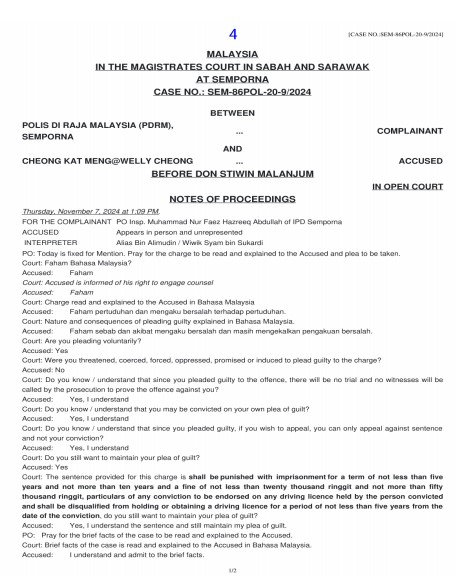
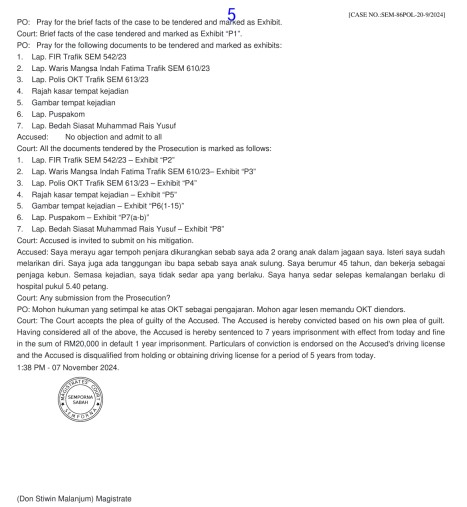
[1] This is an appeal by the Appellant against the sentence imposed by the learned Magistrate at Semporna on 7 November 2024.
[2] The Appellant had pleaded guilty to a charge of causing death by reckless or dangerous driving under s 41(1) of the Road Transport Act 1987 ("RTA 1987").
[3] The learned Magistrate sentenced the appellant to seven (7) years imprisonment with effect from the date of conviction, a fine of RM20,000.00 in default one (1) year imprisonment, and a mandatory disqualification from holding or obtaining a driving license for five (5) years.
Facts Of Case
[4] The facts admitted by the Appellant showed that on 11 September 2023 at approximately 1350 hours, a fatal head-on collision occurred at KM24, Jalan Semporna - Tawau.
[5] The Appellant was driving a Toyota Hilux with five passengers toward Semporna town when his vehicle lost control, crossed the middle line, and encroached directly into the opposite lane. It collided violently with an oncoming Proton Saga.
[6] The incident occurred during broad daylight on a dry road surface. The post-mortem and extensive vehicle damage reports indicated that the Appellant was traveling at an exceptionally high speed on a gradual bend.
[7] The impact resulted in the tragic deaths of a three-month-old infant, pronounced dead at the scene, and a three-year-old child who succumbed to chest and abdominal injuries shortly after.
Principles On Appeals On Sentencing
[8] It is trite that an appellate court will not readily interfere with a sentence passed by a lower court unless it is shown that the sentencing judge fell into an error of law, failed to appreciate material facts, or passed a sentence that is manifestly excessive or inadequate. See PP v. Mohamed Nor & Ors ; ; [1985] 2 MLJ 200b.
[9] Following the principles in PP v. Jafa Daud [1981] 1 MLRH 800; [1981] 1 MLJ 315, a sentence according to law must be assessed in accordance with established judicial principles rather than in a vacuum. This court must weigh the public interest against the mitigating circumstances of the offender to determine if the learned Magistrate exercised his judicial discretion correctly.
[10] In PP v. Prabu Veeramuthu & Ors ; [2010] 8 CLJ 257 the court of Appeal said:
"[11] In an appeal against sentence an appellate court would not disturb the sentence imposed unless the trial court had erred in applying the correct principles of sentencing or had embarked on some unauthorized or extraneous exercise of discretion (see Ganesan Nachiappan & Ors v. PP ; [2000] 3 MLJ 244; [2000] 3 CLJ 302; [2000] 3 AMR 2621; PP v. Loo Choon Fatt ; [1976] 2 MLJ 256; Bhandulananda Jayatilake v. PP [1981] 1 MLRA 304; [1982] 1 MLJ 83 and Yit Kean Hong v. PP ; [2005] 4 CLJ 592; [2005] 6 AMR 637)".
Grounds Of The Appeal
[11] Three main grounds outlined in this appeal are:
(a) That the learned Magistrate has failed to ascertain whether the Appellant has fully understood the nature and consequence of the charge pursuant to s 173(a) and (b) of the Criminal Procedure Code.
(b) That even if the plea of guilty of the Appellant was safe to be taken and accepted by the learned Magistrate, the sentence imposed by the learned Magistrate was manifestly excessive; and
(c) The learned Magistrate had erred in law and in fact in failing to consider the totality of the mitigating factors and the Appellant's mitigating submission before passing the sentence against the Appellant and imposing the seven (7) years imprisonment from the date of conviction and fine of RM20,000.00.
Evaluation And Findings
Appeal Against Conviction
Ground (a): That The Learned Magistrate Has Failed To Ascertain Whether The Appellant/Accused Has Fully Understood The Nature And Consequence Of The Charge Pursuant To Section 173(a) And (b) Of The Criminal Procedure Code
[12] It was the contention of the Appellant that the Appellant did not understand the nature and consequence of the charge pursuant to s 173(a) and (b) of the Criminal Procedure Code whe