


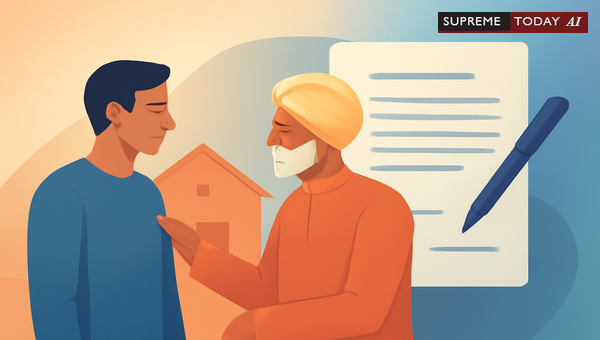
Adopted Son's Rights to Father's Property During Lifetime Under Hindu Succession Act
In Hindu families, questions about inheritance often arise, especially regarding adopted children. A common query is: How much claim does an adopted son have over the property of his father during his lifetime under the Hindu Succession Act? This issue blends adoption laws with property rights in (). While the (HSA) primarily governs succession upon death, principles allow certain claims even during the father's lifetime. This post breaks it down, drawing from key legal principles and judgments. Note: This is general information, not legal advice. Consult a qualified lawyer for your specific situation.
Legal Framework: Adoption and Succession
The (HAMA) governs adoption among Hindus. states that an adopted child is deemed to be the child of the adopter for all legal purposes, including inheritance. Thus, an adopted son enjoys the same status as a natural-born son under both HAMA and HSA.
The HSA deals with post-death, but for (prevalent in most of India), coparceners in a hold birthrights in . Succession opens only on death, but coparceners can seek partition during the father's lifetime2024 0 Supreme(Kar) 613.
Key distinction:- : Passed down up to four generations; coparceners (father, sons including adopted) have undivided interest by birth.- : Father's sole property; no coparcener rights.
It is settled that the property inherited by a male Hindu from his father, father's father or father's father's father is an . 2024 0 Supreme(Kar) 613
Rights in During Father's Lifetime
An adopted son, like a natural son, becomes a coparcener by virtue of adoption, treated as born in the family on the adoption date. He acquires an undivided interest in the 's immediately.
- Claim via Partition: The father, as (manager), controls the property but cannot alienate it without coparceners' consent (post-2005 for daughters too). The adopted son can file a to claim his share, even while the father is alive. Courts uphold this, invalidating unilateral partitions excluding coparceners.
In a relevant case, the court emphasized that retains its character post-partition, entitling sons and daughters to equal shares under amended HSA provisions. The partition deed was held not binding on excluded daughters, a principle extending to sons 2024 0 Supreme(Kar) 613.
Another judgment noted: daughters (now coparceners like sons) could challenge exclusion from partition deeds executed without their inclusion 2023 0 Supreme(Mad) 1090. Similarly, an adopted son excluded from family arrangements can seek his share.
Post-2005 HSA Amendment (Section 6), daughters are coparceners by birth, equal to sons. This reinforces that adopted sons, always coparceners, have robust claims 1956 0 Supreme(Ori) 45 2020 4 Supreme 193.
- Limitations: Share calculated notionally; father retains management rights until partition. Alienations for bind the son.
No Rights in
For property acquired by the father through his efforts (not inherited), the adopted son has no claim during the father's lifetime. The father can gift, sell, or will it freely. Only on death does HSA succession apply, where the adopted son inherits equally with other (mother, siblings) 2022 Supreme(Online)(MAD) 28495.
He inherited the suit property under after the death of his father... all his sons and daughters are entitled to get equal share. 2022 Supreme(Online)(MAD) 28495
Impact of Father's Actions During Lifetime
If the father partitions the property or gifts self-acquired assets before death, the son's claim diminishes:- Valid Partition: Binds coparceners if fair; son gets defined share.- Invalid Deeds: Excluding coparceners (e.g., sons/daughters) are . Courts cancel such deeds, granting shares 2022 0 Supreme(Mad) 2047.
One court held: Suit properties are ancestral properties allotted to 1st defendant in the suit in a partition - Held, Defendant was in possession of ... sale deed as both documents are void ab-initio in so far as respondents 1 & 2 are concerned. 2023 0 Supreme(Mad) 1090
Further, if the father had himself parted with share in property during his lifetime, there would be nothing for his daughter to claim on succession. 2015 0 Supreme(P&H) 514. This underscores the importance of asserting rights promptly.
Relevant Case Insights and Principles
Courts consistently affirm rights:
1. by Birth/Adoption
Daughters' inclusion via amendments mirrors sons' pre-existing rights. The judgment establishes the principle that the rights of daughters in are determined by... . 2022 0 Supreme(Mad) 2047. Adopted sons' rights are analogous and stronger, unchallenged by amendments.
2. Partition Suits
Plaintiffs (daughters/sons) succeeded where brothers excluded them: The court found that the partition deed was executed without including married daughters, thus not binding on them. 2024 0 Supreme(Kar) 613.
3. State Amendments and Equality
Tamil Nadu amendments (e.g., ) granted daughters pre-2005 nationally, highlighting evolving equality 2023 0 Supreme(Mad) 1090.
4. Conversion/Status Changes
Status at right accrual matters. Though primarily for converts, principles apply: rights vest if Hindu/coparcener at vesting
. Hindu converted to other religion is not disqualified to claim property under . An adopted son's status remains intact unless disrupted.
Hindu Succession Act was not applicable to children of convert but convert himself or herself was not excluded...
Post-Amendment Landscape (2005 Onwards)
The HSA Amendment equalized daughters, but sons/adopted sons retained full . Property devolves by succession if no survivorship post-death (Section 6). During lifetime, partition remains key remedy 2020 0 Supreme(Mad) 1036.
Key Takeaways
- : Adopted son has birthright; can claim partition anytime during father's life.
- Self-Acquired: No claim until death.
- Act Promptly: Father's lifetime dispositions can limit future claims.
- Equal Shares: With siblings, including daughters post-2005.
| Property Type | Claim During Lifetime | Post-Death Succession ||---------------|-----------------------|----------------------|| Ancestral () | Yes, via partition | Equal Class I share || Self-Acquired | No | Yes, if intestate |
In summary, an adopted son typically has a strong claim on during his father's lifetime through partition, but none on self-acquired assets. Legal nuances depend on facts like property nature and family arrangements. For personalized guidance, seek expert advice.
References:1.
: Conversion and disqualification principles.2. 1956 0 Supreme(Ori) 45: Daughters' ownership rights.3. 2020 4 Supreme 193: Coparcener amendments.4. 2024 0 Supreme(Kar) 613: character.5. 2023 0 Supreme(Mad) 1090: Partition and state amendments.6. Others as cited.
Word count approx. 1050. Stay informed on evolving Hindu law judgments.
#HinduSuccessionAct #AdoptedSonRights #AncestralProperty















