


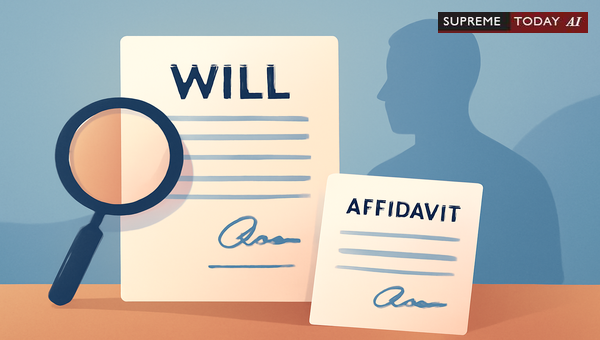
Can an Attestor File a to Prove a Will in Kerala?
In the realm of estate planning and inheritance disputes, proving the validity of a will is a critical step. A common question arises: Is there any or judgment which says that the attestor to a will cannot file to prove the will? This query often surfaces in or challenges to a will's authenticity, where parties debate the best evidence to establish execution and attestation.
This blog post delves into the legal principles, relevant case law, and practical insights. While courts emphasize rigorous proof, especially under , there is no blanket prohibition on attestors using affidavits. We'll examine the framework under the Indian Evidence Act, key judgments, and supporting cases. Note: This is general information based on case law and not specific legal advice. Consult a qualified lawyer for your situation.
Legal Framework for Proving a Will
Proving a will typically requires demonstrating its , the , and . , mandates that if attestors are alive, at least one must be called for examination to prove attestation. However, when attestors are unavailable—due to death, incapacity, or other reasons— provides alternatives, such as proof via handwriting familiarity or other witnesses. 2024 0 Supreme(SC) 1370
Courts have flexibility here. The proof of a Will generally requires examining attesting witnesses or establishing compliance with statutory procedures. 2024 0 Supreme(SC) 1370 If attestors are unavailable, alternative methods such as examining persons acquainted with the handwriting or signature of the attestor or testator can be employed. 2024 0 Supreme(SC) 1370 1992 0 Supreme(SC) 468
Affidavits play a role too. Courts may accept affidavits in lieu of oral evidence if they meet criteria like proper authentication and relevance, without automatically invalidating the will's proof. 1992 0 Supreme(SC) 468 2004 0 Supreme(SC) 975
No Specific Judgment Barring Attestor Affidavits
A thorough review reveals no or judgment categorically stating that an attestor cannot file a to prove the will. Instead, focus remains on and .
In one analyzed case, courts held that affidavits from attestors or knowledgeable persons can suffice if they establish execution and attestation convincingly. There is no prohibition in the law or judgments against an attestor filing an affidavit to prove the Will; rather, the focus is on whether the affidavit sufficiently establishes the execution and attestation, and whether the affidavit complies with procedural requirements. 2024 0 Supreme(SC) 1370 1992 0 Supreme(SC) 468
The judgment in 1992 0 Supreme(SC) 468 clarifies that affidavits in lieu of oral evidence are permissible, with courts assessing credibility. Similarly, 2004 0 Supreme(SC) 975 notes affidavits are admissible if not contrary to pleadings or rules, even from non-attestors if criteria are met.
Insights from Related Case Law
Supporting precedents reinforce this flexibility. For instance, in 2024 0 Supreme(Mad) 838, the trial court believed the attestor (PW2) examined to prove the will, upholding its validity despite challenges. The Trial Court has believed the version of PW2, the attestor. This shows attestors' evidence, whether oral or potentially affidavit-supported, carries weight absent suspicions.
Another case, 2021 0 Supreme(Mad) 234, involved examining the attestor and scribe: The attestor and the scribe have been examined to prove the Will. The court authenticated the will partly via the attestor's statement, dismissing fraud claims. Mere beneficiary presence didn't taint it.
In 2007 0 Supreme(Mad) 844, courts upheld proof by examining one attestor: Both the Courts below have concurrently held that the plaintiff has proved Ex A1 Will by examining one of the attestor to Ex A1 Will, which is a under law. This underscores Section 68 compliance but doesn't bar affidavits when oral exam isn't feasible.
Handwriting evidence also aids: 1991 0 Supreme(Mad) 160 states courts can compare writings without experts, and defendants could examine other attestors. But said decision only says that it is not essential that the Handwriting Expert must be examined to prove or disprove a writing.
Conversely, failures highlight risks. In 2024 0 Supreme(Mad) 838, probate was dismissed for unproven validity amid suspicions like lack of registration and testator's condition. The bears the burden of proving its validity, particularly when exist.
In 2011 0 Supreme(Kar) 1024, unreliable attestor testimony led to disbelieving the will: To prove the will, P.W.2 is examined who is said to be the attestor. Courts rejected it due to inconsistencies.
These cases illustrate: affidavits from attestors aren't forbidden but must be credible, corroborated, and free of procedural flaws.
Role of Affidavits: Admissibility and Limitations
Affidavits can substitute oral testimony under conditions:- Compliance: Proper verification, no extraneous material. 1992 0 Supreme(SC) 468- Corroboration: Especially if suspicions exist, like testator incapacity. 2024 0 Supreme(SC) 1370- Alternatives: Handwriting witnesses or scribes if attestors unavailable. 1992 0 Supreme(SC) 468
Courts have discretion: The court in 2004 0 Supreme(SC) 975 emphasized that affidavits filed in evidence... are admissible and can be relied upon, provided they are not contrary to pleadings or in violation of procedural rules.
Limitations include:- Not always sufficient alone; oral exam preferred if possible.- Scrutiny intensifies with suspicions (e.g., 2024 0 Supreme(Mad) 838).- Post-execution creations, like certain CDs, may be inadmissible. 2014 0 Supreme(Mad) 2689
Practical Recommendations for Will Proof
To strengthen cases:- Examine attestors orally when feasible.- File robust affidavits from attestors or handwriting experts if unavailable.- Corroborate with scribe testimony or documents. 2021 0 Supreme(Mad) 234- Dispel suspicions via medical records or independent witnesses.- Ensure probate compliance, noting it's not always mandatory outside metros. 2007 0 Supreme(Mad) 844
Conclusion and Key Takeaways
No or ruling explicitly prohibits an attestor from filing a to prove a will. Law permits it under Sections 68-69 of the Evidence Act, provided procedural standards and evidentiary rigor are met. 1992 0 Supreme(SC) 468 2024 0 Supreme(SC) 1370
Key Takeaways:- Prioritize attestor examination; affidavits as viable backups.- Burden on propounder to prove validity, especially suspiciously.- Courts value credible evidence over rigid form.
For will disputes, professional guidance is essential. Stay informed on evolving precedents to safeguard legacies.
References:- 2024 0 Supreme(SC) 1370: Proof procedures and affidavits.- 1992 0 Supreme(SC) 468: Affidavit permissibility.- 2004 0 Supreme(SC) 975: Admissibility rules.- Additional cases: 2024 0 Supreme(Mad) 838, 2021 0 Supreme(Mad) 234, 2007 0 Supreme(Mad) 844, 1991 0 Supreme(Mad) 160, 2011 0 Supreme(Kar) 1024.
#WillProof, #KeralaLaw, #LegalAffidavit












