


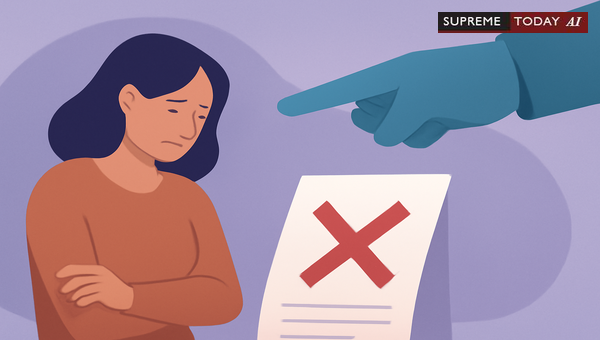
How to Delete Your Name as in the Act
() is a crucial legislation aimed at safeguarding women from abuse within domestic settings. However, instances arise where individuals are named as respondents without meeting the Act's strict criteria, leading to unwarranted legal proceedings. If you're facing such a situation, understanding how to delete your name as in the Act can provide significant relief. This blog explores the legal framework, grounds, procedure, and key judicial insights to guide you through this process.
Note: This article provides general information based on legal principles and case laws. It is not a substitute for professional legal advice. Consult a qualified lawyer for your specific case.
Understanding the Legal Question: Application to Delete Name as
A common query in proceedings is: Application to Delete Name as in Act. This typically occurs when a person is impleaded as a but argues they do not qualify under the Act's definitions. Courts have consistently emphasized adherence to statutory definitions to prevent misuse. 2013 8 Supreme 416
Key Legal Principles Under the
Definition of ''
defines a as an adult male person who is, or has been, in a with the . This excludes females and minors, focusing solely on adult males with a proven domestic nexus. Without this relationship, inclusion as a is invalid. 2021 0 Supreme(HP) 168
For context, a '' under Section 2(f) includes relationships between two persons who live or have lived together in a , typically arising from marriage, consanguinity, or adoption. Courts scrutinize this closely to filter out extraneous parties. 2022 0 Supreme(Gau) 713
Grounds for Deletion of Name
Applications for deletion succeed on specific grounds:
Lack of : If you can prove no or relational tie (e.g., not related by marriage or cohabitation), courts typically grant deletion. This is vital for distant relatives or unrelated individuals mistakenly named. 2023 0 Supreme(Bom) 1432
Misuse of the Act: Judicial precedents recognize the 's potential for abuse. Frivolous allegations lacking evidence may lead to deletion. For instance, in cases where specific of are absent, proceedings against non-qualifying respondents are quashed. 2020 0 Supreme(Bom) 848 As noted, Perusal of the said application goes to show that there are specific regarding committed on the by the petitioners herein. Without such , deletion is warranted. 2020 0 Supreme(Bom) 848
No Act of : Section 3 defines broadly, including acts that harms or injures or endangers the health, safety, life, limb or well-being... of the . 2022 0 Supreme(Gau) 713 If allegations don't meet this threshold, especially without a , deletion follows. 2018 0 Supreme(Gau) 436
Courts exercise discretion judiciously, evaluating merits to avoid perpetuating injustice. In one case, findings of were upheld only when aligned with Section 3, reversing higher court errors. 2022 0 Supreme(Gau) 713
Procedure for Filing the Deletion Application
Navigating the process requires precision:
File a Formal Application: Submit under the relevant court (Magistrate handling the Section 12 DV application), citing Section 2(q), lack of , and misuse. Reference Sections 482 or 482 for if needed. 2020 0 Supreme(All) 1490
Attach Supporting Evidence: Include affidavits, documents proving no cohabitation (e.g., separate addresses, no marriage proof), or evidence of fabricated claims. Salary documents or communication records can rebut economic abuse claims. 2019 0 Supreme(Bom) 2074
Court Hearing: Both sides argue; prepare to demonstrate why inclusion is 'unwarranted.' Courts may grant under Section 23 if urgency exists, but no separate application is needed for interim orders on Section 12 filings. 2020 0 Supreme(All) 1490 From a bare reading of Section 23 it is clear that no separate application is required to be filed for exercise of powers under Section 23 of the Act. 2020 0 Supreme(All) 1490
: Seek stay on proceedings pending deletion. Courts balance equities, especially in maintenance claims under Sections 18-23, distinct from Section 125. 2020 0 Supreme(All) 1490
Insights from Landmark Cases and Additional Contexts
Judicial trends reinforce deletion remedies:
In a , exclusion hinged on relational proof. 2021 0 Supreme(HP) 168
dismissed petitions where existed but allowed scrutiny for abuse. 2020 0 Supreme(Bom) 848 Specific regarding and in an application under the Act constitute acts of . 2020 0 Supreme(Bom) 848
rulings emphasize evidence review, restoring trial court findings on violence. 2013 8 Supreme 416 2016 4 Supreme 481
Even divorced women qualify as 'aggrieved persons' if a past existed, but respondents must still fit Section 2(q). 2018 0 Supreme(Gau) 436 A divorce wife is entitled to claim maintenance under the provisions of the Act, as the definition of '' includes any woman who is, or has been, in a with the . 2018 0 Supreme(Gau) 436
Maintenance quanta consider prior awards across statutes, preventing double-dipping. 2022 0 Supreme(Gau) 713
Cases from , , and others highlight consistent application. 2010 0 Supreme(Del) 518 2023 0 Supreme(Mad) 1874
Potential Challenges and Precautions
Evidentiary Burden: Respondents must proactively disprove ties; mere denial suffices if complainant lacks proof.
Interlinked Proceedings: DV claims often overlap with 125 or cases; deletion doesn't bar other reliefs. 2019 0 Supreme(Bom) 2074
Time Sensitivity: File early to avoid prolonged harassment.
Conclusion and Key Takeaways
Deleting your name as a under the is feasible if you don't meet the adult male/ criteria or face misuse. Courts prioritize statutory fidelity, offering discretion for meritorious applications. Key takeaways:
- Prove no under Section 2(f)/(q). 2022 0 Supreme(AP) 1114
- Highlight frivolous claims with evidence.
- Follow structured procedure for best outcomes.
Prepare meticulously and seek legal counsel promptly. Resources from , , and cases underscore these principles. 2014 0 Supreme(Raj) 749 2007 0 Supreme(MP) 580
For tailored advice, contact a specialist. Stay informed, stay protected.
#DVA ctIndia, #DomesticViolenceLaw, #LegalReliefDV












