


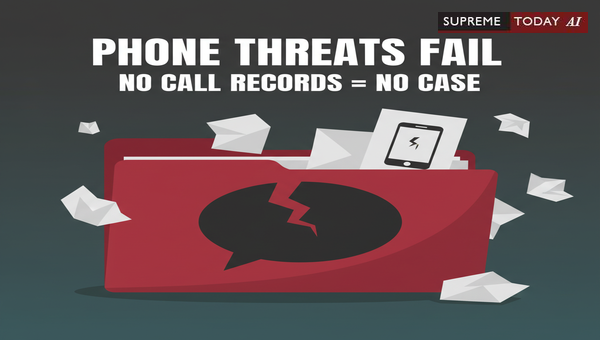
Vague Threatening Phone Calls: Why They Fail in Court
In today's digital age, phone calls can escalate disputes quickly, but not every alleged threat holds up in court. A common question arises: Threatening in Phone Call Allegation is Vague—is that enough to dismiss such claims? Generally, courts require specificity and concrete evidence for threat allegations to succeed. Vague or cryptic phone calls rarely qualify as credible threats, as they lack the clarity needed to meet legal standards. This blog post dives into the legal principles, key judgments, and practical recommendations, drawing from established case law. Note: This is general information, not specific legal advice. Consult a qualified attorney for your situation.
Main Legal Finding
The core principle is clear: allegations of threatening behavior via phone calls must be specific and detailed to be actionable. Vague descriptions do not constitute valid evidence, and prosecutions must prove threats with clarity. As established in legal documents, cryptic calls cannot form the basis of an or reliable evidence of intimidation 2010 3 Supreme 190. Courts consistently demand identifiable content, timing, and corroboration, such as ), to substantiate claims 2023 0 Supreme(AP) 639.
Without these elements, such allegations are typically deemed unsubstantiated, protecting individuals from baseless accusations.
Key Points on Vague Phone Threat Allegations
- Vague calls aren't -worthy: Cryptic or ambiguous communications post-incident don't qualify as formal complaints or threats 2010 3 Supreme 190.
- Specificity is required: Threats must include clear, identifiable details—not mere summons or reports— to be legally established 2010 3 Supreme 190.
- Lack of records undermines cases: No or content details weaken credibility significantly 2023 0 Supreme(AP) 639.
- Courts prioritize concrete proof: Unverified calls fail to link accused parties to offenses, as seen in multiple rulings.
These points highlight why many phone-based threat claims falter early in proceedings.
Detailed Analysis: Legal Standards for Phone Threats
Vague Calls and Validity
Legal standards emphasize that phone calls immediately after an incident aren't automatically FIRs if vague. Courts note: vague or cryptic calls do not constitute a valid 2010 3 Supreme 190. Mere reports without specific threat content fall short. This protects against inflated claims while ensuring genuine threats are pursued with proper evidence.
Challenges in Proving Threatening Calls
Allegations relying solely on vague phone calls often collapse. In one case, the prosecution couldn't produce or call content linking the accused, leading courts to rule the claims unsubstantiated 2023 0 Supreme(AP) 639. Similarly, Except for the allegation that a mobile phone was recovered from the appellant's possession which was used for making a call on the informant's phone number 8084946006 from 9973864195, there is absolutely no evidence against the appellant to connect him with the allegation of the demand of ransom
. This illustrates how possession alone, without content proof, isn't enough.
The Critical Role of Call Data Records
are often the best evidence for verifying calls. Their absence is fatal: the absence of call data records or detailed descriptions of the call's content weakens the credibility of the threat allegation 2023 0 Supreme(AP) 639. Courts reiterate that unverified calls can't prove threats, especially sans disclosed content or origin.
Other cases echo this. For instance, The prosecution has not chosen to collect the call records to establish the phone call made by the first petitioner. In any case, the allegation against the first petitioner is vague 2025 Supreme(Online)(Mad) 62028. Without records, allegations remain speculative.
Broader Patterns in Case Law
Across judgments, vague phone allegations consistently fail:- Lack of connection: On the basis of vague allegation that A1 was ill-treating her after phone calls being made by this petitioner from the US, cannot form basis to continue criminal prosecution 2023 Supreme(Online)(Tel) 29262. Frequent calls without specific words or context don't suffice.- No public view for certain offenses: Admittedly in this case, the allegation is that the words were uttered during a phone call... Both the provisions will get attracted only when the words are uttered in any place within the public view 2021 0 Supreme(Mad) 476. Private calls limit applicability.- Questionable evidence: Cases like 2025 0 Supreme(Ker) 1773 detail calls but lack proof tying them to threats, mirroring patterns where authenticity is doubted.
These examples show courts' scrutiny: circumstantial evidence rarely convicts without specificity.
Exceptions and Limitations
While vagueness dooms most claims, courts recognize exceptions. Delays in records or statements don't automatically discredit cases if other evidence exists. However, in the absence of concrete, detailed evidence of the call's content and origin, allegations of threats based solely on vague calls cannot be sustained 2023 0 Supreme(AP) 639. Balanced scrutiny applies—witness credibility matters, but proof reigns supreme.
Practical Recommendations for Legal Proceedings
To strengthen or defend against phone threat claims:- Prosecutions: Secure , timestamps, and transcripts immediately. Specify exact words, caller ID, and context.- Defense: Challenge vagueness early, demanding records. Highlight lacks like in 2025 Supreme(Online)(Mad) 62028, where uncollected exposed weak claims.- Courts: Critically evaluate cryptic calls, requiring corroboration before proceeding.
The allegation is vague and does not attract the offence under 2025 Supreme(Online)(Mad) 62028—a reminder for all parties.
Conclusion and Key Takeaways
Vague threatening phone call allegations typically fail due to lacking specificity, records, and links to accused parties. Courts, as in 2010 3 Supreme 190 and 2023 0 Supreme(AP) 639, demand clear evidence to uphold threats, preventing abuse of process. Key takeaways:- Prioritize and detailed content for viability.- Vague claims risk dismissal—specificity is key.- Always seek professional advice tailored to facts.
This principle upholds justice, ensuring only substantiated threats proceed. Stay informed, and remember: evidence defines outcomes.
References
- 2010 3 Supreme 190 – Vague calls not FIRs; specificity required.
- 2023 0 Supreme(AP) 639 – essential; absence weakens threats.
– Phone recovery alone insufficient.
- 2025 Supreme(Online)(Mad) 62028 – No records, vague allegation fails.
- 2023 Supreme(Online)(Tel) 29262 – Vague US calls no basis for prosecution.
- 2021 0 Supreme(Mad) 476 – Private calls limit offense scope.










