


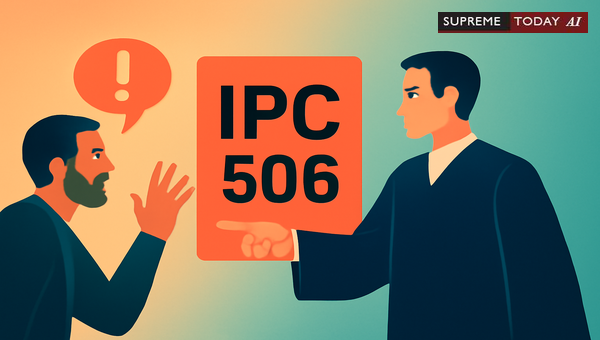



In Vijayakumar’s case, this Court has held thus: “6. As far as S.506 IPC is considered, the Apex Court in Manik Taneja and Anotherv. State of Karnatka and Another (2015 KHC 4046) considered the ingredients of the same. ... The mere allegation made by the second respondent that the petitioner had intimidated him is not sufficient to attract the offence under 506 IPC. There should be a real threat to cause death or grievous hurt to the victim to attract the above offenc....

Section 506 IPC is being quoted as below; "Section 506. Punishment for criminal intimidation. ... In view of the above, the criminal proceedings of the Case No.30028 of 2019, arising out of Case Crime No. 582 of 2010, under Sections 448, 504, 506 IPC, Police Station New Agra, District Agra pending in the court of CJM, Agra is hereby quashed. ... Para 13 of the judgement of Fiona Shrikhande (supra) is being quoted hereinbelow; "13. Section 504 IPC com....

and charge sheet was filed only under Sections 504, 506 IPC. ... true and charge sheet was filed only under Sections 504, 506 IPC. ... Before considering, whether it is a fit case to quash criminal proceedings, it would be relevant to mention some part of a recent judgment passed by Supreme Court in Mohammad Wajid and another vs. ... As such ingredients of Section 503 IPC as punishable under Section 506 IPC are not made out. 18. .......

In the present case, the petitioners were charged under Sections 506 and 34 of the IPC. The basic constituent of an offence under Section 506 of IPC is to punish a person for the offence of criminal intimidation, which lays down the cases where threat to death or grievous hurt be caused. ... Section 506 IPC reads as under: "Section 506. Punishment for criminal intimidation. ... The Hon'ble Supreme Court in Vikram ....

Now the next question for consideration is as to whether an offence under section 506 of Indian Penal Code is made out or not ? 38. The Supreme Court in the case of Vikram Johar vs. State of U. ... The Supreme Court in the case of Chitresh Kumar Chopra vs. ... The Supreme Court in the case of Gangula Mohan Reddy vs. State of A. ... Even if it is accepted for the sake of arguments that a threat to the life of Mukul ....

State of Karnataka, reported in (2015) 7 SCC 423, Hon’ble Supreme Court after noticing Section 506, which defines the criminal intimidation observed as under: “11. ... The Hon’ble Apex Court held that the allegations that accused has abused does not satisfy the ingredients of Section 506 of IPC. In the case on hand, the allegation against the appellant is that he hurled abuses and threatened the complainant of life. ... The mere platitudinous utterances signifying the....
In order to constitute the offence under Section 506 (ii) of IPC, the threat should be sufficient enough to cause alarm to the victim to cause death or grievous hurt. ... them under Section 506 of IPC alone. ... Section 506 of IPC reads as follows: “506. Punishment for criminal intimidation. ... —and if the threat be to cause death or grievous hurt, or to cause the destruction of any property by fire, or to cause an offence punish....

The Court further held:- “27. A bare perusal of Section 506 of the IPC makes it clear that a part of it relates to criminal intimidation. ... Section 506 of I.P.C., lays down:- “506. Punishment for criminal Intimidation. ... (MP & MLA Court) at Barasat and another before the Learned Chief Judicial Magistrate at Barasat under Sections 504/506/34 of the Indian Penal Code, 1860 being Complaint case no. 207 of 2017 dated 09.02.2017. .......

registered for the offences under Sections 342, 323, 504, 506 of the Indian Penal Code (for short ‘IPC’). ... State of Punjab14, records the principle of application of Section 506, IPC in the following terms:- “11. ... With the above submissions, while praying to quash the criminal proceedings against the petitioner- accused No.1, he relied upon a decision of the Hon’ble Supreme Court in B.V. Ram Kumar v. ... of such threat. ... In view of the facts....

Section 506 of I.P.C., lays down:- “506. Punishment for criminal Intimidation. ... State of Karnataka and Another, (2015) 7 SCC 423, this Court has again occasion to examine the ingredients of Sections 503 and 506. In the above case also, case was registered for the offence under Sections 353 and 506 I.P.C. ... For proving an offence under Section 506 IPC, what are ingredients which have to be proved by the prosecution? ... The #HL_....

As the intimidation was not serious and were general abuse without threat being real danger to life, charge under Section 506(ii) IPC is not made out against A1.

The learned appellate court also recorded findings by a well-reasoned judgment that consistent evidence of victim established and satisfied all the ingredients constituting offence U/s. 354 & 509 of the Indian Penal Code. The learned appellate court also recorded that the petitioner did not deserve the benefits under probation of offenders Act and did not find any infirmity in the order of sentence. The use of threat of life showing money and holding her hand with an intention to intimidate the victim in illegal relation also constitute the offence U/s. 506 of the Indian Penal Code....

Vicky had given them threat to see in future and Section 506 IPC was also added. In his disclosure statement he stated that Ravinder Punia brother of deceased Satbir and Amit were nursing grudge towards his gurubhai (gangster) Chhotu Bhat and were supporting Lawrence Punia who was rival of Chhotu Bhat. During investigation, a car bearing registration No.HR-25D-1033 parked nearby was mechanically examined on 18.01.2017 and one bullet was found in the car.

1. This appeal arises out of judgment and order dated 9 th January, 2008 passed by the High Court of Punjab and Haryana at Chandigarh in Criminal Appeal No. 212-DB of 1998 whereby the High Court has dismissed the appeal preferred by the appellant while affirming the sentence awarded by the trial court under Section 302 and 506, IPC to undergo life imprisonment and to pay a fine of Rs.500/- and also to undergo rigorous imprisonment for two years for the offence under Section 506, IPC.

506 of IPC Criminal intimidation If threat be to cause death or grievous hurt, etc. Voluntarily causing hurt Imprisonment for one year, or fine of 1,000 rupees, or both.


An indispensable Tool for Legal Professionals, Endorsed by Various High Court and Judicial Officers
Please visit our Training & Support
Center or Contact Us for assistance

India’s Legal research and Law Firm App, Download now!


For Daily Legal Updates, Join us on :






 Back to top