


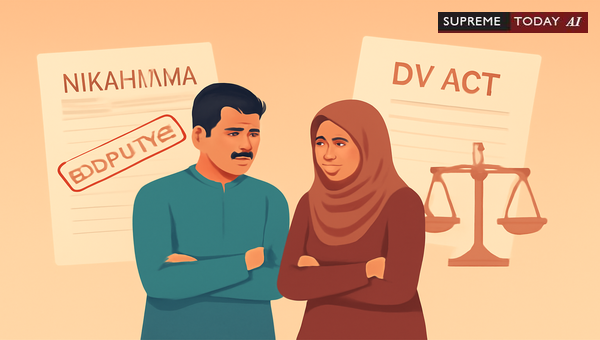
Disputed : Eligible for Maintenance?
In the complex world of Indian family law, many women face challenges when seeking maintenance under the (), especially when the —the Muslim marriage contract—is highly disputed. A common question arises: Maintenance not passed in Act when is highly disputed? If you're navigating such a situation, understanding the legal nuances can make all the difference. This post breaks down the law, key judgments, and practical insights to clarify that a disputed does not automatically bar relief.
Note: This is general information based on case law and statutes. It is not legal advice. Consult a qualified lawyer for your specific case.
What is a and Why is it Disputed?
A is the formal document recording a Muslim marriage under Islamic law, outlining terms like (dower) and rights. Disputes often arise over its authenticity, signatures, witnesses, or even existence, with husbands challenging it to deny marital status. However, under the , marriage validity isn't the sole gatekeeper for maintenance.
The defines a broadly under Section 2(f), including not just legally wedded wives but also women in who share a household. 2012 8 Supreme 639 This expansive scope protects women beyond strict proof of a valid .
Core Legal Principle: Disputes Don't Automatically Bar Maintenance
Main Legal Finding
Disputes regarding the validity of a do not automatically preclude maintenance under the , provided the relationship qualifies as domestic and is established. Courts focus on proof of violence and relationship existence, not just document validity. 2015 3 Supreme 569
Key points include:- The recognizes as domestic relationships. 2012 8 Supreme 639- validity is relevant evidence but not conclusive; courts consider cohabitation, conduct, and social recognition. 2015 3 Supreme 569- Mere disputes over the do not bar claims if other elements are proven. 2015 3 Supreme 569
In one ruling, the court emphasized: the validity or authenticity of the is not the sole criterion for establishing a ; the overall facts and circumstances, including cohabitation and conduct, are relevant. 2015 3 Supreme 569
Detailed Analysis: Relationship in the Nature of Marriage
Even without an undisputed , courts evaluate the totality of facts. For instance:- Cohabitation: Proof of living together as spouses.- Conduct: Mutual acknowledgment as husband-wife.- Social Recognition: Family or community acceptance.
The has clarified that even in the absence of a formal marriage, a relationship in the nature of marriage can entitle a woman to relief under the . 2019 0 Supreme(SC) 657
A combined reading of definitions reveals: an '' is a woman, who is, or has been, in a with the respondent and has been subjected to any act of . 2025 0 Supreme(Gau) 1128
Impact of Disputed on Claims
Courts have consistently held that challenging the doesn't end the inquiry. In a relevant case, judicial separation didn't terminate the matrimonial relationship, keeping the wife as an . 2015 3 Supreme 569
Further, the existence of a familial or shared household relationship suffices, regardless of residency status. One judgment noted: The existence of a familial relationship is sufficient to sustain proceedings under the Act, regardless of the respondent's residence status. (From case summary in other sources).
However, proof of remains crucial. Sections 18-23 allow reliefs like maintenance (Section 20) only if violence—economic, physical, emotional—is established. In a case where courts quashed orders for lack of violence proof: The prerequisite for passing an order... is the satisfaction of the Court that has taken place. 2017 0 Supreme(Raj) 1874
Insights from Additional Case Law
Several rulings reinforce flexible application:- Maintenance under can proceed even if parallel Section 125 claims exist, with adjustments possible. Courts have directed: adjust amount of maintenance granted under Section 125 Cr.P.C. with amount granted... under Act. (From -related snippet).- are valid if notice was served but respondent failed to contest.
The petitioner, inspite of notice, failed to appear or to contest the petition under the Act by way of pleadings or evidence.- No need to prove violence pre- enactment if ongoing. 2018 0 Supreme(Gau) 641
Conversely, misusing for non-violence issues, like partition enforcement, is discouraged: The scope of the Act is totally different and can only be used where the petitioner is a victim of . 2017 0 Supreme(All) 1249
Exceptions and Limitations
Maintenance may be denied if:- No exists (e.g., mere live-in without marriage-like intent). 2012 8 Supreme 639- Violence isn't proven, as in cases relying solely on separation without evidence. 2017 0 Supreme(Raj) 1874- Clear proof no marriage-like bond, beyond dispute.
Proceedings are civil-dominant but enforceable criminally for breaches. 2022 0 Supreme(Mad) 650 No strict limitation under applies. (From nature discussion).
Practical Recommendations
To strengthen claims:- Gather evidence beyond : photos, witnesses, bank statements showing shared life.- File under Section 12 promptly; courts aim for 60-day disposal. 2019 0 Supreme(All) 928- Highlight as continuing offense, avoiding limitation issues. 2018 0 Supreme(Gau) 641- Courts should evaluate totality: Disputing the alone will not be sufficient to deny maintenance if other elements... are established.
Conclusion and Key Takeaways
A highly disputed alone does not bar maintenance under the if and violence are proven on facts. 2015 3 Supreme 569 This protects vulnerable women, prioritizing substance over formalities.
Key Takeaways:- Focus on holistic proof of relationship and violence.- Leverage broad definitions. 2012 8 Supreme 639- Seek timely court intervention with strong evidence.
References include: 2013 8 Supreme 122, 2012 8 Supreme 639, 2015 3 Supreme 569, 2019 0 Supreme(SC) 657,
Empower yourself with knowledge—reach out to legal aid for personalized guidance.
#DVAct #NikahnamaDispute #WomensRights












