


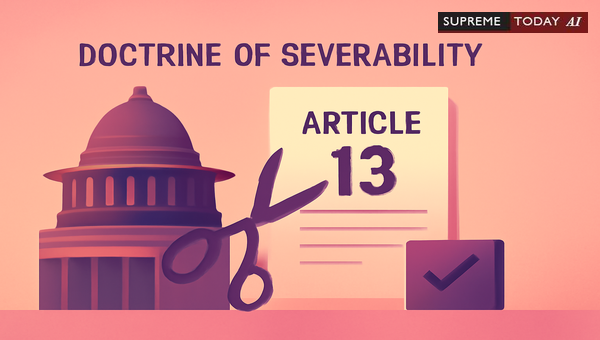
in Indian Law: A Comprehensive Guide
Have you ever wondered whether the is actually called severathity? This common misspelling often arises in legal discussions, but rest assured, the correct term is . This fundamental principle in Indian constitutional law plays a crucial role in preserving legislation by allowing courts to invalidate only unconstitutional parts while upholding the rest. In this blog post, we'll explore its meaning, tests, applications, and limitations, drawing from key judicial precedents and statutory contexts.
Whether you're a law student, legal professional, or curious citizen, understanding severability helps demystify how Indian courts balance legislative intent with constitutional supremacy. Let's dive in.
What is the ?
The empowers courts to strike down only the unconstitutional portions of a law, preserving the valid parts if they can stand independently. It operates on the that lawmakers would want the valid provisions to survive even if some parts are invalid. This principle is especially vital under of the Indian Constitution, which declares laws inconsistent with fundamental rights as void to the extent of such inconsistency. 2018 0 Supreme(Guj) 686
As outlined in key rulings, courts assess whether the legislature would have enacted the remaining provisions without the invalid ones and if those parts can function on their own. 2017 0 Supreme(HP) 1407
Core Test of Severability
The involves a two-pronged inquiry:- Legislative Intent: Would the legislature have passed the law without the invalid portion?- Independent Operation: Can the valid parts operate without the unconstitutional ones?
The test of severability assesses whether the legislature would have enacted the law without the invalid part and whether the remaining provisions can operate independently. 2017 0 Supreme(HP) 1407
This approach ensures minimal disruption to enacted laws, upholding the presumption of constitutionality.
Historical Foundations and Supreme Court Interpretations
Rooted in judicial wisdom, the doctrine gained prominence through landmark cases. In , the Supreme Court clarified that legislative intent can be gleaned from the statute's terms, allowing severance if parts are distinct. 2018 0 Supreme(Guj) 686
The Court emphasized: the doctrine rests on the presumption of the constitutionality of laws and is recognized under . 2018 0 Supreme(Guj) 686
Further, courts examine the true nature and scheme of the legislation, checking if invalid portions are inextricably linked with valid ones. If so, the entire law may fall; otherwise, severance applies. 2017 0 Supreme(HP) 1407 2018 0 Supreme(Guj) 686
Practical Applications Across Legal Domains
Beyond constitutional challenges, severability appears in diverse areas like preventive detention, wills, and administrative actions.
In Preventive Detention Laws
Under statutes like the , statutorily recognizes severability. Even if some grounds for detention (e.g., stale antecedents) lack live nexus, the order survives if other grounds suffice. There is no cavil of doubt that on the ground of vagueness, irrelevancy, absence of proximity with person etc cannot be a ground to set aside the entire order of detention. Thus, in our view, the is given statutory recognition and shape by inserting . 2021 0 Supreme(MP) 503
In one case, a detention order based partly on a incident (where the detenu was acquitted) was upheld by severing that ground, as remaining reasons maintained public order concerns during a pandemic. 2021 0 Supreme(MP) 503
Similarly, even if a ground of detention is found to be vague, nonexistent, not-relevant... even then the detention order cannot be declared to be an illegal one. 2018 0 Supreme(Kar) 389
In Wills and Succession
The , applies severability to effectuate a testator's intent as far as possible. supports partial enforcement of wills. of the Act provides that the testator’s intention to be effectuated as far as possible and it is not to be set aside because it cannot be given effect to the full extent. 2015 0 Supreme(MP) 636
Administrative and Disciplinary Contexts
In service matters, severability saves orders if independent charges sustain them. For instance, where multiple charges exist, invalidating testimony on some doesn't vitiate the rest. will hence come into play. 2013 0 Supreme(Del) 980
In military training cases, courts upheld withdrawals despite partial procedural flaws, applying and severability. 2019 0 Supreme(All) 381
Related Technique:
Closely allied is , where courts interpret provisions narrowly to avoid unconstitutionality without altering core essence. However, it can't rewrite the law. a law is a related judicial technique that can be used to save a law from being wholly struck down, but it cannot alter the law’s core essence. 2017 0 Supreme(HP) 1407
Limitations and Exceptions
Severability isn't absolute:- Inextricable Linkage: If invalid parts are integral, the whole law fails. 1950 0 Supreme(Bom) 78- Constitutional Amendments: It may not apply to bills under Article 368 if ratification is required. cannot be applied to a Bill making a constitutional amendment where any part thereof attracts the proviso to clause (2) of Article 368. 1991 0 Supreme(SC) 802- Fundamental Change: Severance can't distort the law's purpose.- Context-Specific: Depends on subject-matter and intent. 2018 0 Supreme(Guj) 686
When invalid provisions are inextricably mixed with valid ones, severability may not be possible.
Recommendations for Practice
- For Courts: Conduct meticulous analysis of structure and intent before severing.
- For Legislators: Draft clearly to aid judicial separation.
- For Litigants: Argue separability, highlighting independent viability of valid parts.
Conclusion and Key Takeaways
The safeguards democratic legislation by excising only tainted provisions, preserving the rest where possible. It's not severathity but a precise tool rooted in and judicial precedent. Key takeaways:- Applies the twin tests of intent and independence. 2017 0 Supreme(HP) 1407- Extends to detention, wills, and more.- Complements but has limits.
This post provides general information on Indian legal principles and is not specific legal advice. Consult a qualified lawyer for your situation.
References
- 2017 0 Supreme(HP) 1407: and legislative intent.
- 2018 0 Supreme(Guj) 686: basis and R.M.D. Chamarbaugwalla.
- 1950 0 Supreme(Bom) 78: Inextricable linkage analysis.
- 2021 0 Supreme(MP) 503: Statutory recognition in NSA.
- 1991 0 Supreme(SC) 802: Limits in constitutional amendments.















