


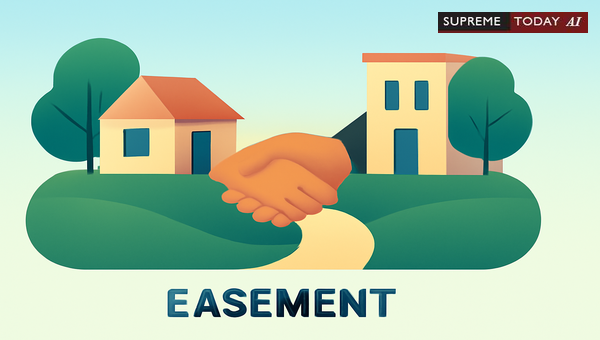
Understanding Dominant and in Indian Law
In property disputes, few concepts spark as much confusion as easements—those invisible rights that allow one piece of land to benefit from another. If you've ever wondered about pathways crossing your neighbor's yard or water channels running through adjacent properties, you're likely dealing with dominant and . These terms, central to the , define the relationship between benefiting and burdened lands. This post breaks it down, drawing from legal definitions, principles, and case insights to help you navigate claims.
Note: This article provides general information based on established legal principles and is not a substitute for professional legal advice. Consult a qualified lawyer for your specific situation.
What Are Dominant and ?
The question at the heart of many disputes is: Dominant and —what do they mean, and how do they interact under Indian law?
Under , an is defined as a right which the owner or occupier of certain land possesses, as such, for the beneficial enjoyment of that land, to do and continue to do something, or to prevent and continue to prevent something being done, in or upon, or in respect of, certain other land not his own 1998 0 Supreme(MP) 277 2021 0 Supreme(Mad) 3218 2019 0 Supreme(Chh) 378.
- : The land for the beneficial enjoyment of which the right exists. The owner or occupier is the . This is the property that benefits from the , such as gaining a right of way or water passage 2016 0 Supreme(All) 849 2014 0 Supreme(Chh) 93.
- : The land on which the liability is imposed. Its owner or occupier is the , who must tolerate the without undue interference 2016 0 Supreme(All) 849 2014 0 Supreme(Chh) 93.
These two must be —separate properties with different owners. A person generally cannot claim an over their own land 1975 0 Supreme(AP) 183 2017 0 Supreme(Mad) 1386.
Real-world examples illustrate this: In one case, the spanned 10 cents, situated in the middle of a 1.15-acre , surrounded on eastern, western, and southern sides. The defendants owned the servient land, while plaintiffs held the dominant portion 2025 0 Supreme(Ker) 264 2025 Supreme(Online)(Ker) 29933. Such configurations are common in rural or subdivided properties.
Key Legal Principles Governing Rights and Obligations
Easements balance the 's benefits with the 's rights. Here's how:
Rights of the : They can use the for their land's enjoyment, like a pathway or drainage. However, they must exercise this in a mode least burdensome to the , often confined to a determinate part under 2007 0 Supreme(MP) 1011 2004 0 Supreme(Raj) 428 2025 0 Supreme(Ker) 264.
Obligations of the : They must allow the use but can enjoy their land too, as long as it doesn't interfere. They aren't required to repair or improve for the 's benefit 2018 0 Supreme(Guj) 924. Notably, under , a may impose additional easements on their land, but only if it doesn't lessen the utility of the existing one—without consent otherwise 2024 0 Supreme(Mad) 2342 2024 Supreme(Online)(Mad) 79296.
Alteration and Extinction: The may alter enjoyment modes if no extra burden is placed on the servient land 2017 0 Supreme(Mad) 1386 1984 0 Supreme(Raj) 400. But permanent changes materially increasing the servient burden can extinguish the 1984 0 Supreme(Raj) 400 1957 0 Supreme(MP) 10. Changes in property extent typically don't affect existing easements unless explicitly modified 2022 0 Supreme(Ker) 624.
In suits for rights, pleadings must separately schedule dominant and servient heritages, often with commissioner reports clarifying positions—like one where the dominant was north of the servient, with a pathway from a southern road 2021 0 Supreme(Ker) 674.
Exceptions, Limitations, and Practical Insights
While the dominant-servient framework is foundational, exceptions apply:
: Some, like , may not strictly require a benefiting 2021 0 Supreme(Bom) 303.
Water and Drainage Rights: Natural water flow from servient to dominant land via channels doesn't require concrete drains. No concrete or pucca drains are ever required to be occurring, on the nor are required to be proven to be existing thereon, rather the running water, as, naturally rises...
.
Least Burdensome Exercise: Courts emphasize confining rights to specific servient parts at the 's request, if no detriment to the dominant 2022 Supreme(Online)(KER) 57050 2022 0 Supreme(Ker) 624. Easements presuppose two owners—one dominant, one servient—and must involve another's land 2011 0 Supreme(Mad) 2238.
A transferee cannot always claim prior rights if not properly transferred from the
.
Common Scenarios and Case Examples
Consider a small 10-cent plot (dominant) encircled by a larger servient estate—plaintiffs seek pathway or water rights, but courts scrutinize if usage burdens exceed the original grant 2025 0 Supreme(Ker) 264 2025 Supreme(Online)(Ker) 29933. Or, when servient owners try new constructions: They can, but not if it diminishes dominant utility without consent 2024 0 Supreme(Mad) 2342.
These principles ensure fairness: Both these rights can be claimed only in respect of land belonging to another. In the case of there may be dominant and 2011 0 Supreme(Mad) 2238.
Conclusion and Key Takeaways
Grasping dominant and is vital for asserting or defending rights. Typically, distinct ownership, minimal burden, and statutory compliance (like Sections 4, 9, and 22) govern outcomes. Key takeaways:
- Verify distinct heritages and evidence of use before claiming easements.
- Servient owners retain substantial rights—use land freely if not interfering.
- Watch for alterations that could extinguish rights.
- In disputes, commissioner reports and clear pleadings strengthen cases.
For your property matters, review circumstances, gather usage evidence, and consider servient defenses. References include 1998 0 Supreme(MP) 277 2003 0 Supreme(Raj) 782 2021 0 Supreme(Mad) 3218 2016 0 Supreme(Ker) 2 2013 0 Supreme(Mad) 996 2019 0 Supreme(Chh) 378 2007 0 Supreme(MP) 1011 2016 0 Supreme(Mad) 3431 1975 0 Supreme(AP) 183 1986 0 Supreme(Raj) 62 2011 0 Supreme(Mad) 354 2021 0 Supreme(Bom) 303 2004 0 Supreme(Raj) 428 2002 0 Supreme(P&H) 93 1957 0 Supreme(MP) 10 1988 0 Supreme(Kar) 70 1984 0 Supreme(Raj) 400 2017 0 Supreme(Mad) 1386 2018 0 Supreme(Guj) 924 2025 0 Supreme(Ker) 264 2025 Supreme(Online)(Ker) 29933
2024 0 Supreme(Mad) 2342 2024 Supreme(Online)(Mad) 79296 2021 0 Supreme(Ker) 674 2016 0 Supreme(All) 849 2014 0 Supreme(Chh) 93 2011 0 Supreme(Mad) 2238.
Stay informed, protect your rights, and consult experts for tailored guidance.
#EasementLaw #DominantHeritage #IndianPropertyLaw












