


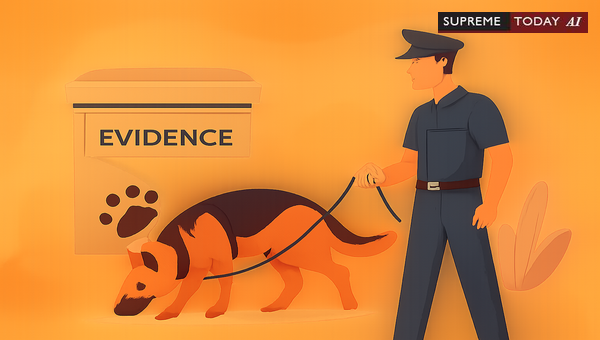
Evidence Value in Indian Courts: Key Insights
In high-stakes criminal investigations, police often deploy dog squads—trained sniffer or tracker dogs—to locate suspects, contraband, or crime scenes. But when these furry investigators 'testify' in court, how much weight does their evidence carry? The question Dog Squade Ki Evidence Value Kya Hai (What is the evidentiary value of evidence?) is crucial for anyone navigating Indian criminal law.
This blog explores the legal stance, judicial precedents, scientific limitations, and practical recommendations. While evidence is admissible for investigative purposes, courts treat it cautiously as substantive proof. Note: This is general information based on judicial trends and not specific legal advice. Consult a qualified lawyer for your case.
What is Evidence?
Dog squads, comprising trained police dogs and handlers, assist in tracking scents, identifying explosives, narcotics, or suspects. Their 'evidence' typically comes via the handler's report on the dog's behavior, such as pointing to a suspect or location.
However, unlike human witnesses, dogs cannot be cross-examined. Courts recognize this as a core frailty, making it unreliable standalone proof. As noted in key judgments, it's more an investigative tool than courtroom clincher. 2008 0 Supreme(SC) 484
Legal Position in Indian Courts
Indian courts consistently hold that evidence has . It can support investigations but cannot sustain a conviction alone. The and emphasize corroboration with independent evidence.
Main Legal Finding
Evidence from sniffer or tracker dogs is . Courts state: The law in this behalf, therefore, is settled that while the services of a sniffer dog may be taken for the purpose of investigation, its faculties cannot be taken as evidence for the purpose of establishing the guilt of an accused.2008 0 Supreme(SC) 484
Similarly: The evidence based on sniffer or tracker dogs has .2001 5 Supreme 38
Key points include:- : Recognized under the , but low weight.- : Must be backed by scientific, eyewitness, or documentary proof. 1969 0 Supreme(SC) 228 1977 0 Supreme(SC) 203- : Helpful for leads, not guilt establishment. 1969 0 Supreme(SC) 228 2014 0 Supreme(Guj) 103
Scientific and Jurisprudential Concerns
Dogs rely on instincts and training, prone to errors. Courts highlight:- : Reliance on the master's interpretation. The possibility of error on the part of the dog or its master is the first among them... The possibility of a misrepresentation or a wrong inference from the behaviour of the dog could not be ruled out.2001 5 Supreme 38- : Uncertainties in canine senses; no direct testimony. 2008 0 Supreme(SC) 484- : Dogs may exhibit volition or misdirection.
Without handler examination or expert validation, value plummets. The actual dog handler has not been examined nor any other person, who was expert of the has been examined...2017 0 Supreme(Guj) 151
Judicial Treatment and Notable Case Laws
Consistent Caution
Courts admit it for investigation but demand corroboration:- Abdul Rajak Murtaja Dafedar Case: Reinforces weak weight; needs supplementation. 2008 0 Supreme(SC) 484- Rulings: Dog evidence not conclusive. 2019 0 Supreme(HP) 109 2018 0 Supreme(HP) 697 1968 0 Supreme(Gau) 4
In practice:- Absence of handler testimony weakens it further. 2017 0 Supreme(Guj) 151- Distinguished from substantive proof: Useful for probes, not convictions. 1969 0 Supreme(SC) 228
Insights from Related Contexts
While core precedents focus on criminal tracking, tangential sources reveal evidentiary scrutiny in other scenarios. For instance, child witness testimonies sometimes mention casual dog interactions, like walks in parks with relatives, underscoring routine credibility checks over specialized evidence. 2025 Supreme(Online)(Del) 6897 2025 Supreme(Online)(Del) 3891
In these cases, courts prioritize witness reliability under , preliminary exams, and contradictions—mirroring skepticism. No direct use here, but it highlights broader evidence standards: testimonies must be consistent, not improvised.
Other references stress procedural rigor, like examining handlers akin to verifying child statements. Rumors or unverified claims (e.g., COVID misinformation) are dismissed without proof, paralleling canine evidence's need for validation. 2022 Supreme(Online)(CIC) 11653
Exceptions and Comparative Views
- India vs. Abroad: Canada and Scotland sometimes accept it more readily, but Indian courts remain conservative due to frailties.
- Rare Utility: May tip scales with strong corroboration, but never sole basis.
Even handwritten notes or victim diaries lack value without authentication—similar to unexamined dog reports. 2024 Supreme(Online)(Bom) 7257 2024 Supreme(Online)(Bom) 422
Recommendations for Stakeholders
- For Investigators: Use as lead generator; prioritize forensics/DNA. Corroborate rigorously.
- For Prosecutors: Examine handlers; provide scientific backing.
- For Defense: Challenge via cross-examination, error possibilities.
- For Courts: Treat as auxiliary; mandate independent proof.
Proper protocols—like handler testimony—could enhance reliability, but current jurisprudence limits it.
Key Takeaways
| Aspect | Status ||--------|--------|| Admissibility | Yes, limited || Conviction Basis | No, needs corroboration || Strength | Weak, investigative only || Key Frailties | No testimony, , science gaps |
In summary, evidence's value in Indian courts is low. It's a valuable investigative aid but not guilt-proof due to inherent weaknesses. Always pair with robust evidence. 2008 0 Supreme(SC) 484 2001 5 Supreme 38 1969 0 Supreme(SC) 228
References:1. 2008 0 Supreme(SC) 484: Settled law on investigative use only.2. 2001 5 Supreme 38: detailed.3. 1969 0 Supreme(SC) 228: Limited weight emphasized.4. 2017 0 Supreme(Guj) 151: Handler examination need.5. 2019 0 Supreme(HP) 109: Probe utility over proof.6. 2018 0 Supreme(HP) 697: Weak value.7. 1968 0 Supreme(Gau) 4: Independent proof stress.
. Stay informed—justice demands balanced evidence!
#DogSquadEvidence, #IndianCriminalLaw, #EvidenceValue















