Searching Case Laws & Precedent on Legal Query.....!
Analysing the retrieved Case Laws
Scanned Judgements…!



Searching Case Laws & Precedent on Legal Query.....!
Analysing the retrieved Case Laws
Scanned Judgements…!
Necessary Parties in Partition Suit - All coparceners and legal heirs, including females, are generally considered necessary parties to a suit for partition. Non-joinder of such parties renders the suit defective and potentially invalid. Courts have consistently held that all sharers must be impleaded to ensure proper adjudication. ["2022 0 Supreme(AP) 1474"], ["2022 0 Supreme(AP) 455"], ["2023 0 Supreme(Mad) 65"], ["2023 0 Supreme(AP) 1514"], ["2023 0 Supreme(Kar) 1093"]
Role of Female Heirs - Under Hindu law, females who are coparceners by birth have a right to claim partition, especially after amendments to the Hindu Succession Act (2005). Prior to this, female members could not seek partition unless the property was part of a coparcenary. Post-amendment, female heirs are recognized as necessary parties in partition suits, and their omission can invalidate the proceedings. ["2024 0 Supreme(Pat) 890"], ["2023 0 Supreme(Kar) 523"], ["2023 0 Supreme(Kar) 1093"]
Impact of Non-joinder - Failure to include necessary female parties, such as daughters or female coparceners, in a partition suit can lead to the suit being dismissed or declared defective. Courts emphasize that all persons with an interest in the property must be parties to prevent partial or incomplete adjudication. ["2022 0 Supreme(AP) 455"], ["2023 0 Supreme(Mad) 65"], ["2023 0 Supreme(Kar) 1093"]
Special Cases and Limitations - Certain properties, like self-acquired property of a female, may not be subject to partition under Hindu law, especially if the estate is not part of a coparcenary. Suit for partition of such property may be barred, and vague claims or improper pleadings can lead to dismissal. ["2024 0 Supreme(Pat) 650"]
Conclusion - In suits for partition, the female heirs who are coparceners or have legal rights to the property are necessary parties. Their omission can compromise the validity of the suit. Courts have consistently upheld that all sharers, including females with coparcenary rights, must be impleaded to ensure justice and proper adjudication. The legal framework, especially after amendments, recognizes females as essential parties in partition proceedings. ["2022 0 Supreme(AP) 1474"], ["2022 0 Supreme(AP) 455"], ["2023 0 Supreme(Mad) 65"], ["2023 0 Supreme(Kar) 1093"]
References:- ["2022 0 Supreme(AP) 1474"]- ["2022 0 Supreme(AP) 455"]- ["2023 0 Supreme(Mad) 65"]- ["2024 0 Supreme(Pat) 890"]- ["2023 0 Supreme(Kar) 523"]- ["2024 0 Supreme(Pat) 650"]- ["2023 0 Supreme(Kar) 1093"]
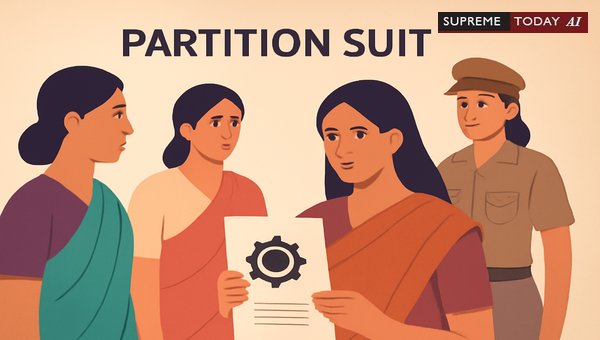
In property disputes, especially under Hindu law, can become complex when determining who must be included as parties. A common question arises: Every Interested Party is Necessary Party in Partition Suit? This is particularly relevant for females—daughters, sisters, or widows—who may hold shares or interests in ancestral or joint family property. Failing to include them can render the suit defective, leading to dismissal or ineffective decrees.
This blog post delves into the legal principles, key case laws, exceptions, and practical advice to help you navigate these issues. While this provides general insights based on established precedents, it is not legal advice—consult a qualified lawyer for your specific case.
In a suit for partition, the goal is to divide joint property among co-owners or effectively. Under the (CPC), particularly , all persons who have an interest in the subject matter are generally considered 2019 0 Supreme(Guj) 909. This ensures and avoids .
of such parties can be fatal to the suit, as effective partition cannot be effected without her presence1982 0 Supreme(Ori) 96 2018 0 Supreme(Raj) 1433 2022 0 Supreme(AP) 455. Courts emphasize that a must bind all interested parties to be enforceable.
Under Hindu law, females have evolved rights, especially post the 2005 amendment to the (), granting daughters by birth. Females who are entitled to a share on partition are recognized as , especially under Hindu law, where females are co-sharers or 2020 0 Supreme(Chh) 458 1957 0 Supreme(MP) 118.
Their interest may stem from:- Direct shares as .- Maintenance or marriage provisions2019 0 Supreme(Guj) 909.- Entitlement in ancestral property, which retains its character even after partial partitions 2024 0 Supreme(Kar) 613.
For instance, in a case involving a partition deed dated , the court held it invalid for excluding married daughters, affirming their equal shares under the amended Act. The court found that the partition deed dated was executed without including married daughters, thus not binding on them2024 0 Supreme(Kar) 613. Ancestral property remains so despite partitions, entitling daughters equally.
Courts consistently uphold the inclusion of interested females:- The interest of a female in the property, whether as a sharer or entitled to maintenance or marriage provisions, makes her a necessary party2019 0 Supreme(Guj) 909.- Under Hindu law, females are explicitly recognized as when they are entitled to a share or interest2020 0 Supreme(Chh) 458.
In another ruling, the said Sasikumar and Thamizharasi are also having shares in the Suit Properties, who are to the Suit. Hence, the Suit is bad of of 2024 0 Supreme(Mad) 1854. This highlights how excluding co-sharers dooms the suit.
The Supreme Court and High Courts allow flexibility: The court has the discretion to add a female as a necessary party at any stage if her interest is involved, to avoid 1977 0 Supreme(Ker) 247. Even in appeals, impleadment is possible. In one case, all the parties interested should have been impleaded as parties... necessary and proper party can be impleaded at any stage including in the appeal2018 0 Supreme(Mad) 1319.
Daughters' rights as are irrespective of birth date relative to the amendment: The daughter is a coparcener by birth, entitled to equal share in ancestral properties2024 0 Supreme(Mad) 1854. can be amended accordingly.
of in a partition suit is fatal. In the absence of , no effective order or decree can be passed2014 0 Supreme(Del) 1446. This principle echoes across cases, including recovery suits where principal debtors were omitted.
Not every female needs inclusion. Exceptions include:- A female who is not interested in the property or not entitled to any share is not a necessary party2012 0 Supreme(Del) 1536 1979 0 Supreme(Cal) 411.- A person claiming who does not have a direct interest or has not asserted a title1979 0 Supreme(Cal) 411.- Tenants or persons without a direct interest2017 0 Supreme(Ori) 299.
Agreement holders under sale contracts lack proprietary interest: ... does not create any interest in or charge on such property. Therefore, no interest... is created in favour of ’agreement holder’2014 0 Supreme(Kar) 1029. Mere claimants without blood ties or title are excluded.
In a joint purchase dispute, a sister was denied as a party since she waived prior rights: The sister of the parties had no claim to the property as she had not exercised her right... deemed to have been waived2014 0 Supreme(Cal) 815.
Every partition suit implies title declaration: Every suit for partition is a suit where a declaration of the title of a party is implied2019 0 Supreme(Cal) 153. Proving title is key, but only for those with genuine interests.
To safeguard your case:1. Identify all interested parties early, especially females with coparcenary or maintenance rights.2. Implead them via applications under CPC, even at appellate stages if needed 2018 0 Supreme(Mad) 1319.3. Oppose exclusions if a female's share is claimed, citing precedents like non-binding deeds excluding daughters 2024 0 Supreme(Kar) 613.4. File for addition if discovered later: Courts favor this to ensure justice.5. Document interests thoroughly—ancestral nature persists, bolstering female claims 2024 0 Supreme(Mad) 1854.
When representing clients, ensure that all females with a share or legal interest are impleaded as parties. This prevents fatal defects.
In summary, females who are entitled to a share, have a legal interest, or are or co-sharers in the property are in a suit for partition2020 0 Supreme(Chh) 458. Their omission risks the suit's validity, but courts can remedy via impleadment. Exceptions apply to those without stakes.
Key Takeaway: A female who has a share, interest, or entitlement in the property being partitioned is generally a necessary party in the suit, and her inclusion is essential for a complete and effective adjudication.
Stay informed on Hindu Succession Act amendments empowering daughters. For tailored guidance, seek professional legal counsel. Properly structured protect rights and ensure fair divisions.
(Word count: approx. 1050. References are to specific legal documents for illustrative purposes.)
#PartitionSuit, #HinduSuccession, #NecessaryParties


Thus, the plaintiff having filed the suit for partition, failed to array all the necessary parties to the suit. In fact, going by the pleadings, plaintiff is aware of non-impleadment of remaining sharers, who are necessary parties to the suit for partition. ... Notwithstanding the said contention raised in written statement, for the reasons best known, the plaintiff did....

Thus, the plaintiff having filed the suit for partition, failed to array all the necessary parties to the suit. In fact, going by the pleadings, plaintiff is aware of non-impleadment of remaining sharers, who are necessary parties to the suit for partition. ... Notwithstanding the said contention raised in written statement, for the reasons best known, the plaintiff did....

It is not only once, but in paras 5, 14, and in the cross-examination dated 17-10-2008, she has admitted that there was a partition on 20-06-2003. It must be observed that PW1 was not a party to the said partition. Among the plaintiffs, it was only plaintiff No.4 (PW.2) who was a party to it. ... The severance of status may take place from the date of filing of a suit; however, a decree is neces....

Therefore, the plea of non-joinder of necessary party by way of oral submission without adequate particulars in the pleading is not sustainable. ... The trial Court held that though it is argued that necessary parties are not impleaded and the suit suffers defect of partial partition, in the written statement, the first defendant has not placed before the Court the particulars of other necessary....

Defendant No.-4, namely, Chanda Kumari also filed written statement but she did not contest the suit at the time of hearing the case on merit and also the defendant no.-5 (2nd party namely), Sidheshwar Mahto neither appeared in suit nor contested the suit. 7. ... Under the Mitakshara law, there are certain persons entitled to claim partition and so far as female is concerned, there are c....

The said Sasikumar and Thamizharasi are also having shares in the Suit Properties, who are necessary parties to the Suit. Hence, the Suit is bad of non-joinder of necessary parties. Furthermore, plaintiffs concealed a house property of an extent of 108 sq. mtr. in Grama Natham R. ... The defendant sent Reply dated February 14, 2009 refusing to partition the Suit Propert....
Shanker and Others, 1984 (Supp) SCC 631 has held that in a suit for partition, the position of the plaintiff and the defendant can be interchangeable. Each party adopts the same position with the other parties. ... Whether the suit is bad for non-joinder of necessary parties? 5. To what relief?” ... In view of the above legal position, though the parties, who have not challenged the judgment and decree of....

What can be deciphered from the above is that although explanation to sub-Section (5) of Section 6 requires partition effected before 20.12.2004 to be registered, all valid oral partitions effected before the said date remain unaffected, but such oral partitions cannot be simply considered, the party ... Section 23 of the Hindu Succession Act as it stood before amendment in the year 2005 did not permit the female members to claim ....
The moot question before this Court is that whether a suit filed for partition of property inherited by sons from their mother which was the self acquired property of the mother could be the subject matter of partition as claimed by the wife and sons of one of such female and such suit would be maintainable ... such female. ... sons of a female Hindu. ... The present ca....
All the parties to the suit did not feel that they should be arrayed as party defendants. It is not known whether the sisters of the plaintiff and defendant Nos. 1 to 3 were within the knowledge of the present suit for partition. ... Therefore, since the right in coparcenery is by birth, it is not necessary that the father of the female coparcener should be living on the date of when the....

If the suit is dismissed, then the plaintiff has failed to prove his title to the property. In the present case, the writ petitioners did not claim any interest in the property short of title. Thus, every suit for partition is a suit where a declaration of the title of a party is implied. 8. Every suit for partition seeks a preliminary decree for determination of the shares of a party in the property.

Certain rights have already been accrued to the respondents with the passing of the preliminary decree by the Court below in their favour.” According to Order I, Rule 10(2) of CPC, it is clear that the impleading either as a plaintiff or a defendant is only when the suit is pending before the Court and when that stage had totally crossed, the impleading applicant cannot resort to the instant application appellate stage. As a person interested in suit property, she might be a proper p....

She therefore, according to him, was a necessary party to the suit for partition. Since the suit was decreed without hearing the sister the decree should be set aside.

Non-joinder of necessary parties in a partition suit is fatal.” In the absence of necessary parties, no effective order or decree can be passed and the plaintiff must bear the consequences of his adventure.

Ramesh and others, reported in 2008 KCCR 1350 where, it has been held that the court has discretion to grant leave under Order 22 Rule 10 of CPC to implead a person without a detailed enquiry and a transferee pendente lite can be added as a party if his interest is substantial and not merely peripheral. The petitioner has also relied on the judgment of the Apex Court in the case of Dhanalakshmi & others vs. P. Mohan and others, reported in AIR 2007 SC 1062 where in it is held that a ....


An indispensable Tool for Legal Professionals, Endorsed by Various High Court and Judicial Officers
Please visit our Training & Support
Center or Contact Us for assistance

Scan Me!
India’s Legal research and Law Firm App, Download now!


For Daily Legal Updates, Join us on :



 Back to top


