Searching Case Laws & Precedent on Legal Query.....!
Analysing the retrieved Case Laws
Scanned Judgements…!



Searching Case Laws & Precedent on Legal Query.....!
Analysing the retrieved Case Laws
Scanned Judgements…!
Main Point: The public prosecutor for CBI, being a Group A officer, cannot have his services terminated under Rule 5 of the CCS (Temporary Service) Rules, 1965, except by the President of India. This is because Rule 5(1) explicitly states that the services of a temporary government servant who is not in quasi-permanent service can only be terminated by the appointing authority or the President, and not by any other authority ["2024 Supreme(Online)(CAT) 9985"].
Main Point: Several cases affirm that termination under Rule 5(1) must be carried out by the competent authority, typically the President or the appointing authority. Orders passed by unauthorized authorities are null and void, and non-compliance with this requirement vitiates the termination process ["
Director, CBI vs S.P. Tanti - Delhi (2007)
"], [Director, CSIR-CIMFR [Central Institute of Mining and Fuel Research] VS Mayuresh Dash, S/o. Sri Rabindra Kumar Dash - Jharkhand](https://supremetoday.ai/doc/judgement/02000033748).Main Point: The classification of the post (e.g., Group A or Group B) influences the authority responsible for termination. For Group A officers like the public prosecutor in CBI, only the President can terminate services, reinforcing that service termination by any other authority is invalid ["2024 Supreme(Online)(CAT) 9985"].
Analysis and Conclusion: The consistent legal stance is that Rule 5(1) of CCS (TS) Rules, 1965, mandates that only the President or the designated appointing authority can terminate the services of a Group A officer or a quasi-permanent employee. Termination orders issued by unauthorized authorities are legally invalid, and such officers' services are protected from termination by subordinate authorities. Therefore, for a Group A officer like the CBI public prosecutor, his service cannot be lawfully terminated by any authority other than the President ["2024 Supreme(Online)(CAT) 9985"].
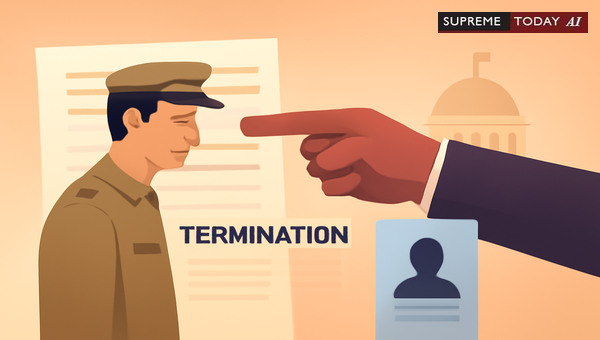
In the realm of government service, isn't always straightforward, especially for higher-ranking officials. Imagine a Public Prosecutor in the —a —facing sudden termination. Can this happen simply through an authority invoking , without the President's involvement? The question at hand is: The public prosecutor for CBI being a his services could not be terminated by an authority under Rule 5 of the CCS (Temporary service) Rules 1965 other than the President.
This issue strikes at the heart of constitutional safeguards for . Generally, such terminations by subordinate authorities may violate , which protects civil service members from arbitrary dismissal. Let's break it down step by step, drawing from judicial precedents and related cases.
The core principle is clear: Services of a , like a CBI Public Prosecutor, cannot be terminated solely by an authority under , other than the President, as this would infringe on Article 311 protections.
The and have consistently held that for , termination amounting to dismissal requires inquiry and Presidential approval. 1974 0 Supreme(SC) 257
Key Points:- Article 311 mandates no of without inquiry and approval.- Rule 5(1) allows termination of temporary servants by the with one month's notice, but this is limited for Group 'A' posts.- Judicial rulings emphasize that only the President, as the for Group 'A' officers, can sanction such actions if they engage Article 311. 2007 0 Supreme(Raj) 512
Article 311 of the Indian Constitution is a bulwark against arbitrary government action. It states that no civil servant holding a civil post shall be dismissed or removed except after an inquiry held in good faith. 1974 0 Supreme(SC) 257 For Group 'A' officers, whose posts are unequivocally civil in nature, this protection is robust. The Constitution holds that serve at the pleasure of the President, but Article 311 tempers this with . 1974 0 Supreme(SC) 257
In the CBI Public Prosecutor case, the court ruled the post a civil one, necessitating Article 311 compliance. Termination by a subordinate without Presidential nod was deemed invalid.
Rule 5(1) permits: Termination of temporary service... by a notice in writing given either by the Government servant to the or by the to the Government servant.2022 0 Supreme(HP) 703 However, courts interpret this narrowly for senior officers.
This interpretation prevents Rule 5 from bypassing constitutional mandates for high-level posts.
For a CBI Public Prosecutor—a Group 'A' civil post—termination under Rule 5 by anyone short of the President risks nullification. The court emphasized: The post of Public Prosecutor, being a Group A post, is a civil post, and its termination must be in accordance with Article 311.
Without inquiry and Presidential sanction, such orders are typically void.
While Group 'A' officers enjoy stringent protections, Rule 5 applies more freely to lower cadres or specific contexts:
These cases illustrate Rule 5's validity for non-Group 'A', temporary, or probationary roles but reinforce its limits for protected . 2024 0 Supreme(Del) 861 (noting Group classifications under CCS rules).
In summary, a Group 'A' CBI Public Prosecutor's services generally cannot be terminated under Rule 5(1) CCS (TS) Rules by subordinate authorities without the President's sanction, as this contravenes Article 311.
While exceptions exist for lower groups or probationers—as seen in CRPF and other rulings—the principle safeguards senior from caprice. 2007 0 Supreme(Raj) 512
Key Takeaways:- Group 'A' = Presidential oversight typically required.- Rule 5 suits temporary, lower posts but not civil dismissals.- Judicial veil-lifting checks motives.
This article provides general insights based on precedents and is not legal advice. Consult a qualified lawyer for specific cases.
References:1.
– CAT order on CBI Prosecutor termination.2. 1974 0 Supreme(SC) 257 – Article 311 protections.3. 2007 0 Supreme(Raj) 512 – Presidential power for Group 'A'.4. Additional cases: 2023 0 Supreme(J&K) 485, 2022 0 Supreme(HP) 703, 2018 0 Supreme(Raj) 912, etc. #Article311, #GroupATermination, #CCSRules


That his performance in on-job training was examined in terms of Rule 5(1) of the CCS (TS) Rules , 1965 and he was not found fit for permanent employment. Therefore, he was removed from the service under Rule 5 (1) of the CCS (Temporary Service ) Rules, 1965. 17. ... “ Under Rule 5 of the Central Civil #HL_S....

(vii) The CAT allowed the O.A. holding that the requirement of Rule 5(1) of the CCS(TS) Rules, 1965 could not be dispensed with. ... As per the revised Recruitment Rules, the post of public prosecutor in CBI now falls in Group A. ... In the cited case it was held that impugned notice of termination was given by an authority which was not the....
![Director, CSIR-CIMFR [Central Institute of Mining and Fuel Research] VS Mayuresh Dash, S/o. Sri Rabindra Kumar Dash - 2024 Supreme(Jhk) 43](https://supremetoday-s3.b-cdn.net/Jharkhand_3.png)
(iii) Whether the service of the respondent no.1 is to be protected in view of the fact that the service of the respondent has been terminated by relying upon the incorrect rule, i.e., CCS (Temporary Service) Rules, 1965 instead of CCS (CCA) Rules, 1965. ... of sub-rule (1) of rule 5 of the Central Civil Services#HL....

With regard to the issue of applicability of Rule 5 of the CCS (Temporary Service) Rules, 1965, to CRPF employees, it is stated that both the rules are applicable to the service of the respondent, as a temporary employee. ... It is also stated therein that the appellant-Department has not quoted wrong Rule in the notice dated 25.02.2012 or in the termination order 28.03.2012, as ....

Rule 5 of Central Civil Services (Temporary Service) Rules, 1965, reads as under:- “5. Termination of temporary service. ... Viewed from another angle, even Rule 5 of Central Civil Services (Temporary Service) Rules, 1965, has not been strictly complied with, in the facts o....

Rule 5 [Constitution of Central Civil Services - The Central Civil Services, Group ‘A’ or Group ‘B’ and Group ‘C’ and Group ‘D’ shall consist of the Services and grades of Services specified in the Schedule] of the CCS (CCA) Rules stipulates that the Central Civil Services would consist of all Service ... Part II of the Schedule to the #HL_STAR....

In terms of the Rule 16 of the CRPF Rules, 1955 read with Rule 5 (1)(a) of CCS (Temporary Service), Rules, 1965, the petitioner was in temporary service of the respondents and his services were liable to be discharged/ terminated by one month’s notice or pay in lieu thereof. ... It is in terms of Rule 16 of the CRPF Rules of 1....

notice in term of Rule 5 (i) of CCS (Temporary Service) Rules 1965. ... notice in term of Rule 5 (i) of CCS (Temporary Service) Rules 1965. ... show cause notice in term of Rule 5 (i) of CCS (Temporary Service) Rules 1965#HL_END....
The procedure prescribed in Rule 19 (i) of CCS (CCA) Rules, 1965 has not been followed; ii. The opinion of Public Prosecutor, High Court of Madras has not been taken into account while passing the order of removal from service; iii. ... As per sub-rule (2) of Rule 12 of CCS (CCA) Rules, 1965 any of the penalties specified in Rule#HL_E....
of Rule 11 of CCS (CCA) Rules is the President of the Institute. ... under Rule 14(3) of CCS (CCA) Rules. ... (CCA) Rules could „institute‟ the disciplinary proceedings in view of Rule 13(2) of CCS (CCA) Rules, and as such the approval of the clauses (i) to (iv) of Rule 11 of CCS (CCA) Rules. ... the Central Civil #HL_S....
It is moreso argued, that the petitioner could not be terminated as opportunity of being heard was not afforded to him which is not an ideal formality, the words opportunity of being heard do not have any constructive meaning, but it encompass all such requirements which are required to be followed by observing the rules of natural justice, petitioner was not heard as is revealed from the impugned order, no notice was served upon the petitioner before his termination, dismissal/termination from service without holding disciplinary proceeding is illegal, the words mentioned in the termination....

Retention of such a recruit would adversely affect the training and discipline of the recruits. Continuance in service therefore cannot be claimed as a matter of right. Petitioner was on probation, as such, his services were terminated under Rule 5 of the CCS (Temporary Services Rules), 1965 without any stigma. The Central Civil Services Rules permit termination of C.R.P.F personnel during training with 1 month pay and allowances.

"In pursuance of sub-rule (1) of Rule 5 of the Central Civil Service (Temporary Service) Rules, 1965, I, H.K. Concededly, the department treated the writ petitioner to be appointed against a temporary post and on probation for a period of two years. Exercising power under Sub-rule (1) of Rule 5 of the CCS (Temporary Service) Rules, 1965 his services were terminated on 4th September, 1997, but he was reinstated in service. 2. On 21st April, 1998 his services were terminated once again under Sub-rule (1) of Rule 5 of CCS (Temporary Service) Rules, 1965.
However, the said show cause notice was withdrawn on 17.06.2011. Subsequently, on 30.06.2011, the services of the respondent were terminated under Rule 5 (1) of the CCS (Temporary Service) Rules, 1965.

However, the said show cause notice was withdrawn on 17.06.2011. Subsequently, on 30.06.2011, the services of the respondent were terminated under Rule 5 (1) of the CCS (Temporary Service) Rules, 1965.


An indispensable Tool for Legal Professionals, Endorsed by Various High Court and Judicial Officers
Please visit our Training & Support
Center or Contact Us for assistance

Scan Me!
India’s Legal research and Law Firm App, Download now!


For Daily Legal Updates, Join us on :



 Back to top


