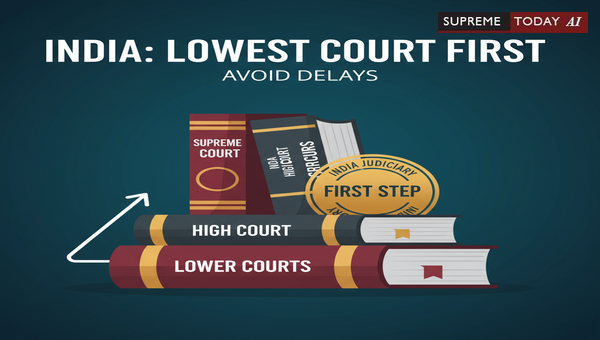
India Court Hierarchy: Lowest Court First Rule
In the complex landscape of the Indian judicial system, one fundamental principle stands out: you must first go to the lowest court and then approach the higher court. This rule, often overlooked by eager litigants seeking quick relief from higher benches, ensures an orderly flow of justice, prevents overburdening superior courts, and respects the hierarchical structure of courts. But what does this mean in practice? And why is it so critical?
Whether you're dealing with a civil dispute, criminal matter, or execution of a decree, bypassing the lowest competent court can lead to dismissal of your petition, unnecessary delays, and added costs. This blog post dives deep into the legal framework, key precedents, and practical advice to help you navigate India's court system effectively. Note: This is general information and not specific legal advice. Consult a qualified lawyer for your case.
Overview of the Principle: First Go to Lowest Court
The Indian judiciary operates on a strict hierarchical model, where parties are generally required to exhaust remedies at the lowest level before escalating to higher courts. This is enshrined in statutory provisions like the Code of Criminal Procedure (CrPC) and reinforced by numerous judicial precedents.
As outlined in legal guidelines, affected parties must approach the lowest criminal court, specifically the Judicial Magistrate, before seeking remedies from higher courts. This is particularly emphasized to prevent overwhelming higher courts, which are already burdened with numerous cases K. Selvaraj VS The Superintendent of Police, Pudukkottai - Madras (2007).
In civil matters, the same logic applies. For instance, in a case where a party bypassed the Village Court and directly approached the Additional Sub-District Council Court, the appellate court ruled this improper, holding that the plaintiff should have initiated proceedings in the Village Court Germanthangi VS F. Rokunga - Gauhati (2003).
This principle promotes efficiency: lower courts handle facts and evidence first, allowing appellate courts to focus on law and errors rather than acting as courts of first instance.
Hierarchical Court Structure in India
India's court system is pyramid-shaped, starting from local forums like Village Courts or Judicial Magistrates at the base, ascending to District Courts, High Courts, and the Supreme Court at the apex.
Key Requirements Across Case Types
Appellate courts are not meant to act as courts of first instance. They should analyze the findings of the trial court and only reverse those findings for valid reasons Devatha Venkataswamy @ Rangaiah VS Public Prosecutor, High Court of A. P. - Crimes (2003)VIVEK @ PAPPU VS STATE OF RAJASTHAN - Rajasthan (2017). This respects the trial court's role in assessing evidence.
Additional sources affirm this: The legal system mandates that a third party or litigant must first approach the lowest court or court of first instance, such as a Civil Judge (Senior Division), before moving to higher courts Saroj Thakur VS Indo Arya Central Transport Limited - Calcutta. In execution matters, the initial court where a decree is passed (trial or appellate court) is considered the court of first instance for execution purposes. The third party cannot bypass this hierarchy Saroj Thakur VS Indo Arya Central Transport Limited - Calcutta.
Case Law Examples Reinforcing the Rule
Judicial precedents consistently uphold this hierarchy:
In a notable ruling, the Apex Court clarified: All that Apex court meant was that the case should go in the first instance to the Tribunal and only then if the petitioner/applicant is aggrieved by the order of the Tribunal, he can approach the High Court R. D. Vishwakarma (Dr. ) VS U. O. I. & Ors. - 2013 Supreme(J&K) 134 - 2013 0 Supreme(J&K) 134. This underscores starting at the appropriate forum.
On writ jurisdiction, courts have held: For being entitled to invoke extra ordinary jurisdiction of the High Court under Article 226, a party is required to establish a legal right. The person like the petitioner, who has elected to first go to the civil court and then abandoned the application filed by him, cannot be at such a belated stage remitted to approach this Court Mohd. Yunus VS Urban Improvement Trust, Jodhpur & ors - 1999 Supreme(Raj) 388 - 1999 0 Supreme(Raj) 388.
In domestic violence contexts, while proceedings are often civil, the Supreme Court noted it did not go into the question of the manner in which affected parties could approach a higher Court for relief, implying standard hierarchy applies Bonela @ Kartheeka Raju, W/o Mokhalingarn VS Bonela Jayalaxmi, W/o late Chinnababuo (late) - 2021 Supreme(AP) 971 - 2021 0 Supreme(AP) 971.
Broader civil and administrative cases emphasize: In civil and administrative cases, the legal procedure emphasizes starting from the lowest competent court and proceeding to higher courts through appeals or revisions Divisional Controller VS Aminsha R. Fakir - GujaratLife Insurance Corporation Of India vs Yeshwant Singh Garewal - Madhya PradeshLife Insurance Corporation Of India vs Yeshwant Singh Garewal - Madhya PradeshLife Insurance Corporation Of India vs Yeshwant Singh Garewal - Madhya PradeshLife Insurance Corporation Of India vs Yeshwant Singh Garewal - Madhya Pradesh.
These examples show courts' reluctance to entertain premature petitions, often resulting in directions to return to lower forums.
Why Follow This Approach? Benefits and Risks of Bypassing
Adhering to the hierarchy offers several advantages:- Efficiency: Lower courts resolve most disputes, reducing backlog at higher levels.- Cost-Effective: Avoids multiple filings and appeals.- Better Outcomes: Trial courts provide detailed fact-finding, strengthening appellate arguments.
Risks of skipping steps include:- Dismissal: Petitions returned without hearing (e.g., improper direct approach to appellate forums Germanthangi VS F. Rokunga - Gauhati (2003)).- Delays: Time lost refiling at correct level.- Prejudice: Courts may view it as forum shopping.
In execution scenarios, starting correctly ensures smooth enforcement: The trial court's decision, whether in original or appellate jurisdiction, remains the primary forum for enforcement and execution of decrees Saroj Thakur VS Indo Arya Central Transport Limited - Calcutta.
Practical Recommendations for Litigants
To navigate this effectively:- Identify the Lowest Competent Court: Check jurisdiction based on suit value, location, and case type.- Exhaust Remedies: Obtain a reasoned order from the lower court before appealing.- Document Everything: Build a strong record for higher appeals.- Seek Exceptions Wisely: Rare cases (e.g., fundamental rights under Article 32/226) may allow direct High Court/Supreme Court access, but generally, hierarchy prevails.- Monitor Legal Changes: Procedural laws evolve; stay updated.
Inform clients: Ensure that all clients are informed about the necessity of approaching the lowest court first. Prepare to present cases in the appropriate lower courts before considering appeals (adapted from standard recommendations).
Conclusion: Streamline Your Legal Journey
The mantra first go to the lowest court and then approach the higher court is the cornerstone of India's judicial efficiency. By respecting this hierarchy, you honor the system's design, minimize risks, and position yourself for success. Cases like those cited K. Selvaraj VS The Superintendent of Police, Pudukkottai - Madras (2007)Germanthangi VS F. Rokunga - Gauhati (2003)MST. DUKHI PRADHANI VS SHYAM SUNDAR SAHU - Orissa (1985)Devatha Venkataswamy @ Rangaiah VS Public Prosecutor, High Court of A. P. - Crimes (2003)VIVEK @ PAPPU VS STATE OF RAJASTHAN - Rajasthan (2017)Saroj Thakur VS Indo Arya Central Transport Limited - Calcutta consistently affirm: start low, climb methodically.
Key Takeaways:- Always initiate at the court of first instance.- Appellate courts review, not retry, lower court decisions.- Bypassing leads to procedural hurdles.- Consult professionals to map your path.
This approach not only streamlines proceedings but upholds judicial discipline. For tailored guidance, reach out to a legal expert.
References: K. Selvaraj VS The Superintendent of Police, Pudukkottai - Madras (2007)Germanthangi VS F. Rokunga - Gauhati (2003)MST. DUKHI PRADHANI VS SHYAM SUNDAR SAHU - Orissa (1985)Devatha Venkataswamy @ Rangaiah VS Public Prosecutor, High Court of A. P. - Crimes (2003)VIVEK @ PAPPU VS STATE OF RAJASTHAN - Rajasthan (2017)Saroj Thakur VS Indo Arya Central Transport Limited - CalcuttaR. D. Vishwakarma (Dr. ) VS U. O. I. & Ors. - 2013 Supreme(J&K) 134 - 2013 0 Supreme(J&K) 134Mohd. Yunus VS Urban Improvement Trust, Jodhpur & ors - 1999 Supreme(Raj) 388 - 1999 0 Supreme(Raj) 388Bonela @ Kartheeka Raju, W/o Mokhalingarn VS Bonela Jayalaxmi, W/o late Chinnababuo (late) - 2021 Supreme(AP) 971 - 2021 0 Supreme(AP) 971Divisional Controller VS Aminsha R. Fakir - GujaratLife Insurance Corporation Of India vs Yeshwant Singh Garewal - Madhya PradeshLife Insurance Corporation Of India vs Yeshwant Singh Garewal - Madhya PradeshLife Insurance Corporation Of India vs Yeshwant Singh Garewal - Madhya PradeshLife Insurance Corporation Of India vs Yeshwant Singh Garewal - Madhya Pradesh
#IndianJudiciary #CourtHierarchy #LegalProcess