


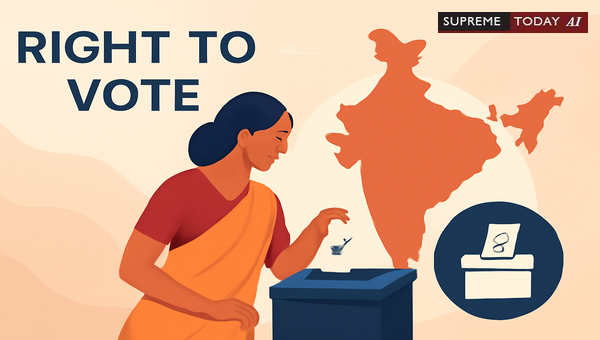
Is a in India?
In the world's largest democracy, the act of casting a vote is more than a civic duty—it's the cornerstone of people's sovereignty. But is the truly a enshrined in the Indian Constitution, or is it something less absolute? This question often arises in electoral disputes, challenges to voting restrictions, and debates over democratic participation. Whether the is a has been meticulously examined by the through landmark judgments.
This blog post delves into the legal nuances, drawing from key Supreme Court rulings and statutory frameworks. Note: This is general information based on judicial precedents and not specific legal advice. Consult a qualified lawyer for personalized guidance.
Overview of the in India
The Indian Constitution establishes elections to the and on the basis of under . This provision recognizes the as a , but its status as a —protected under —remains debated. 2021 0 Supreme(Ker) 379
Historically, courts have clarified that while constitutionally acknowledged, the is primarily a governed by the (RP Act). This Act details qualifications, disqualifications, and the mechanics of voting. 2021 0 Supreme(Ker) 379 2006 7 Supreme 44
Constitutional vs. : Key Supreme Court Rulings
In , the Supreme Court affirmed that the is a , distinguishing it from a mere statutory creation. The Court emphasized its role in upholding democracy. 2021 0 Supreme(Ker) 379
However, earlier precedents like described the as not a but a , subject to the limitations imposed by the statute. 2021 0 Supreme(Ker) 379 2016 3 Supreme 298
This distinction is crucial: The is constitutional in recognition but statutory in exercise. The Legislature holds the power to regulate it, as seen in cases involving co-operative society elections where the right to form societies is constitutional, but voting is statutory and must follow procedural rules. 2025 0 Supreme(Kar) 526
Distinction Between and
The Supreme Court draws a fine line between the and the :- The itself is not fundamental.- The act of casting a vote is an expression of opinion under (), making it fundamental in that context. 2021 0 Supreme(Guj) 698
As observed, Casting of vote in favour of one or the other candidate tantamounts to expression of voters opinion and the exercise of the said voting right marks the accomplishment of freedom of expression of the voter, attracting of the Constitution. 2007 0 Supreme(Mad) 161
This nuance ensures that while voters can express themselves freely through ballots, the eligibility to vote remains regulable.
Limitations and Regulations on Voting Rights
The is not absolute. Statutory provisions impose reasonable restrictions:- Prisoners' Voting Ban: bars persons confined in prisons or police custody from voting. This has been upheld as constitutional. The Court noted, is not a ; it is only a ... of 1951 explicitly states, 'No person shall vote at any election, if he is confined in a prison … or is in the lawful custody of the police.' 2014 0 Supreme(Del) 402 2006 7 Supreme 44 1991 0 Supreme(Pat) 159- Disqualifications: Convictions under certain offenses lead to , validated by the . Parliament's competence under was affirmed. 2014 0 Supreme(Del) 402
Other regulations include for Rajya Sabha elections to curb , upheld as not violating the . 2023 0 Supreme(SC) 711
Modern Challenges: EVMs and Electoral Integrity
Contemporary issues like (EVMs) test the robustness of voting rights. In recent judgments, the Supreme Court rejected calls to revert to paper ballots, emphasizing EVMs' security with VVPAT (). The Court stated, Unless substantial evidence is presented against EVMs, current system will have to persist with enhancements – Regressive measures to revert to paper ballots... 2024 4 Supreme 129
Directions were issued for verifying 5% of EVMs' burnt memory post-results upon candidate request, balancing transparency without undermining the process. This upholds the statutory framework while protecting the constitutional essence of voting. 2024 4 Supreme 129
In local elections, like panchayat polls, irregularities must fall under specific statutory grounds (e.g., ) to challenge results. It is just a a right created by the statute providing for such an election. 1998 0 Supreme(P&H) 1116
Practical Implications for Voters and Legal Practitioners
Understanding this classification affects:- : Challenges are limited to statutory grounds, not broader fundamental rights claims.- Voter Inclusion: Disputes over voter lists in co-operatives or panchayats require procedural compliance. 2025 0 Supreme(Kar) 526 1998 0 Supreme(P&H) 1116- Policy Reforms: Debates on prisoner voting or EVM verification highlight the need for legislative evolution without constitutional overreach.
Legal practitioners should emphasize the constitutional basis under while navigating RP Act constraints. Recent EVM protocols enhance trust, as EVMs are simple, secure and user-friendly. 2024 4 Supreme 129
Conclusion and Key Takeaways
The in India is a under , vital to democracy, but not a . It operates within a statutory framework via the RP Act, 1951, subject to regulations like prisoner bans and EVM protocols. This balance prevents absolutism while safeguarding expression under .
Key Takeaways:- Not Fundamental: Statutory creature, regulable by law. 2021 0 Supreme(Ker) 379- Protected Yet Limited: Essential for democracy, but exclusions upheld. 2014 0 Supreme(Del) 402- Evolving Safeguards: EVM-VVPAT ensures integrity. 2024 4 Supreme 129- Litigation Tip: Focus on statutory violations, not constitutional overclaims.
References include: 2021 0 Supreme(Guj) 698 2021 0 Supreme(Ker) 379 2006 7 Supreme 44 2019 0 Supreme(Bom) 1435 1991 0 Supreme(Pat) 159 2024 4 Supreme 129 2014 0 Supreme(Del) 402
Stay informed on electoral laws to exercise your rights effectively in India's vibrant democracy.
#VotingRightsIndia, #FundamentalRights, #IndianConstitution












