Searching Case Laws & Precedent on Legal Query.....!
Analysing the retrieved Case Laws
Scanned Judgements…!



Searching Case Laws & Precedent on Legal Query.....!
Analysing the retrieved Case Laws
Scanned Judgements…!
Endorsement of Cases by Civil Judges - A Civil Judge (Senior Division) can transfer or endorse cases to a Civil Judge (Junior Division) within their jurisdiction, especially when the Junior Division Court does not exist or lacks jurisdiction, provided the territorial and pecuniary jurisdiction is conferred lawfully ["2024 0 Supreme(Gau) 1474"], ["2024 0 Supreme(Gau) 1280"].
Jurisdiction and Transfer Authority - Civil Judge (Senior Division) has the authority to proceed with cases if jurisdiction is properly conferred. They are also empowered to return cases to the appropriate Junior Division Court if jurisdictional limits are exceeded or if the case should be filed there, as per the Arunachal Pradesh Civil Courts Act, 2021 ["2024 0 Supreme(Gau) 1474"], ["2024 0 Supreme(Gau) 1280"], ["2024 0 Supreme(Gau) 579"].
Appeal and Transfer Procedures - Appeals from Junior Division decisions lie to the Senior Division Court, and transfers between divisions are governed by statutory provisions, including transfers under the Civil Courts Act and administrative orders. Courts cannot dismiss appeals solely on procedural grounds if jurisdiction is proper ["2024 0 Supreme(Gau) 579"], ["2024 0 Supreme(Cal) 579"].
Jurisdiction in Absence of Junior Division Court - If no Civil Judge (Junior Division) exists, the Senior Division Court may proceed with cases within the jurisdiction conferred by law, but should ideally transfer cases to the Junior Division Court once established ["2024 0 Supreme(Gau) 1474"].
Promotion and Seniority - Promotions from Junior to Senior Division are based on qualifying service, merit, and seniority rules. The Senior Division Court's jurisdiction over promotion disputes is recognized, and past service in other states may not be automatically counted unless explicitly permitted by rules ["2024 0 Supreme(Mad) 694"], ["2023 0 Supreme(Del) 1283"].
Transfer of Cases and Promotions - Courts have the authority to transfer cases and promotions within their jurisdiction, considering merit and legal provisions. Promotions depend on service records, seniority, and eligibility, with courts emphasizing adherence to statutory rules ["2023 0 Supreme(Del) 1283"], ["2024 0 Supreme(Mad) 694"].
Analysis and Conclusion:A Civil Judge (Senior Division) can endorse, transfer, or proceed with cases within their jurisdiction, including cases initially filed in or transferred from a Civil Judge (Junior Division), provided jurisdictional limits are respected and proper legal procedures are followed. The law permits the Senior Division to act in cases where Junior Division courts are absent or when jurisdictional thresholds are met. Furthermore, appeals and promotions are also regulated within this framework, emphasizing adherence to statutory provisions and merit-based considerations. Therefore, under proper jurisdictional authority and legal provisions, a Civil Judge (Senior Division) can endorse or transfer cases to a Civil Judge (Junior Division).
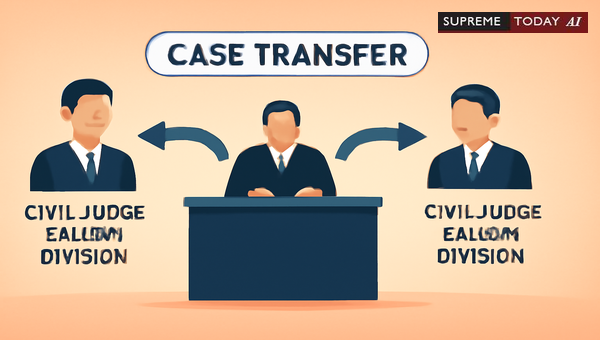
In the structured world of Indian civil courts, understanding the hierarchy between and is crucial for litigants, lawyers, and judicial officers alike. A common question arises: Can the Judgment of Civil Judge Senior Division be Set Aside by Civil Judge Junior Division? This issue touches on jurisdictional limits, case transfers, and the proper channels for case management under statutes like the .
This blog post delves into the legal framework, key judicial precedents, and practical implications. Note that this is general information based on established principles and should not be considered specific legal advice—consult a qualified lawyer for your case.
Civil Judges in India operate within a clear pecuniary and hierarchical structure. typically handles higher-value cases, while deals with lower-value matters. The outlines their jurisdictions, emphasizing that movements between these courts require formal processes.
Generally, a does not have inherent authority to independently endorse or transfer a case to a within the same jurisdiction. Such actions must come from a competent authority, like the or . This prevents irregular procedural shortcuts and upholds judicial integrity. 1966 0 Supreme(Guj) 68
As established in precedents, A Joint Civil Judge either Senior Division or Junior Division can only dispose of such matters as are referred to him either by the of the Court to which he is joint or by the of the district in which such Court is situate. 1966 0 Supreme(Guj) 68
This principle implies that a Junior Division judge cannot unilaterally set aside or interfere with a Senior Division judgment without proper referral, as it would bypass the hierarchy.
Transfers between Civil Judges are governed by rules like and . These require orders from higher authorities, not unilateral endorsements.
In one ruling, when a suit filed in Senior Division lacks and is transferred to Junior Division, the Senior Judge must treat it as a new suit upon any return or retry. The court held that the should have retried the suit as if it was a new suit instituted before him by the filing of the plaint. The court held that the was not entitled to proceed from the point at which the suit was transferred or withdrawn from the Court of the . 1999 0 Supreme(Guj) 97
Similarly, The court held that section 24 of the Civil Procedure Code applies to all transfers of suits, including those made under . The court held that the transferee Court may either re-try the suit or proceed from the point at which it was transferred or withdrawn. However, the court held that in the present case, the should have retried the suit as if it was a new suit. 1985 0 Supreme(Bom) 324
These cases affirm that Senior Division judges lack independent power to transfer or endorse cases downward. Consequently, a Junior Division judge cannot set aside a Senior's judgment without a formal transfer order from the , as acting otherwise would be procedurally invalid.
Setting aside a judgment typically falls under for or appeals to higher courts. A Junior Division judge stepping into a Senior's case without authorization risks . The scheme under the mandates adherence to referrals, ensuring no subordinate court overrides a superior without due process. 1999 0 Supreme(Guj) 97 1985 0 Supreme(Bom) 324
While unilateral transfers are impermissible, exceptions exist through prescribed channels:- Formal Referral: Under Rule 189 Civil Manual or Section 24 CPC, ordered by District or .- Pecuniary Adjustments: If a case exceeds Junior Division limits, it moves up via competent authority. 2025 0 Supreme(Pat) 142
Other sources highlight the rigid hierarchy:- Promotions and cadre movements underscore separation; e.g., promotions from Junior to Senior Division require , not ad hoc shifts. 2025 5 Supreme 152- High Courts invest selectively, up to specified limits for Senior (Rs. 12,000) and Junior (Rs. 6,000) Divisions, reinforcing defined roles. 2022 0 Supreme(Bom) 770
In , courts must verify decree existence; executing a non-existent or improperly transferred decree violates principles. The execution of a non-existent decree violates judicial principles, requiring courts to act within their jurisdiction per civil procedure rules. 2025 0 Supreme(Gau) 1250
Re-designations or adverse remarks cannot alter jurisdiction without inquiry, treating downgrades as major penalties. 2013 0 Supreme(P&H) 1067
To avoid challenges:- Judges: Refrain from independent endorsements; seek orders.- Litigants: File in the lowest competent court per ; appeal irregularities to higher forums. 2001 0 Supreme(P&H) 573- Lawyers: Ensure compliance with where applicable, especially sans . 2022 0 Supreme(Bom) 770
Uniform practices, like LDCE for promotions, incentivize merit while preserving hierarchy. 2025 5 Supreme 152
In summary, a typically cannot set aside a Senior Division judgment independently. Transfers or interferences require formal referral by the or under the and CPC. Unilateral actions are irregular and unsustainable. 1999 0 Supreme(Guj) 97 1985 0 Supreme(Bom) 324 1966 0 Supreme(Guj) 68
Key Takeaways:- Hierarchy is sacrosanct; no inherent transfer power for Senior Judges.- Always route through competent authority for case movements.- Precedents demand treating transferred cases as new suits where required.- Adhere to procedures to prevent jurisdictional errors.
For tailored advice, approach legal experts familiar with your jurisdiction. Stay informed on evolving judicial norms to navigate civil courts effectively.
#CivilCourtHierarchy, #JudicialTransfer, #IndianCivilLaw


However, if there is no Civil Judge (Junior Division), there would not be a bar for the learned Civil Judge (Senior Division) to proceed with the matter if the territorial jurisdiction is conferred on the Civil Judge (Senior Division) in accordance with law. 37. .....

Appeals from - [Civil Judge (Senior Division) and Civil Judge (Junior Division)]: (1) Save as aforesaid, an appeal from a decree or order of a [Civil Judge (Senior Division)] shall be: (a) to the District Judge where the value of the original suit in which ... of ....

the Courts of Civil Judge Junior Division, the courts of Civil Judge Senior Division, the Courts of Additional District Judge or the Courts of District Judge, as the case may be, as per their territorial and pecuniary jurisdiction. ... Pradesh Civil Courts Act, 20....

Thereafter, Section 23 of the ‘Act of 1887’ deals with exercise by Civil Judge (Senior Division) or Civil Judge (Junior Division) of jurisdiction of District Court in certain proceedings. Further, Section 23 (2) (d) of the ‘Act of 1887’ provides for pecuniary jurisdiction for appeal. ... Disposal of proceedings refer....

Judge (Junior Division) to Civil Judge (Senior Division) so that there is an incentive for merit in the cadre of Civil Judge (Junior Division)? ... Judge (Junior Division) to Civil Judge (Seni....

No. 16 in the cadre of Civil Judge (Junior Division) and consequently, his seniority is to be restored in the promotional post of Civil Judge (Senior Division). ... During the year 2015, 115 Civil Judges (Junior Division) were granted promotion to the post of Civil Judge#....

However, if there is no Civil Judge (Junior Division), there would not be a bar for the learned Civil Judge (Senior Division) to proceed with the matter if the territorial jurisdiction is conferred on the Civil Judge (Senior Division) in accordance with law. 37. .....

The facts germane to the present case are that the petitioner joined the HCS on 27th June, 2012 as a Civil Judge (Junior Division). ... He pointed out that the ACPS Committee for promotion to Civil Judge (Senior Division) of the High Court of Delhi in its meeting held on 10th August, 2015 considered the matter with regard to grant of ....
The facts germane to the present case are that the petitioner joined the HCS on 27th June, 2012 as a Civil Judge (Junior Division). ... He pointed out that the ACPS Committee for promotion to Civil Judge (Senior Division) of the High Court of Delhi in its meeting held on 10th August, 2015 considered the matter with regard to grant of ....
(J)Case No.02/2015 pending before the learned Court of the Civil Judge, (Junior Division) at Titabor, does not arise. ... The present proceedings have been initiated challenging the order dated 21.12.2024 passed by the learned Civil Judge (Junior Division) at Titabar, Jorhat (hereinafter referred to as, “the learned Executing Court”) ....

(3) The High Court may, whenever it thinks fir, withdraw such jurisdiction from any Civil Judge so invested.” - (1) The High Court may invest any Civil Judge with the jurisdiction of a Court of Small Causes for the trial of suits cognizable by such courts upto such amount as it may deem proper, not exceeding in the case of a Civil Judge (Senior Division) [twelve thousand rupees] and in the case of a Civil Judge (Junior Division) [Six thousand rupees]. (2) A Civil Judge (Senior Divisi....

As per the said Schedule, the cadres have been designated. A Judge of Civil Judge Junior Division is designated as "Civil Judge Junior Division." As per Rule 4, the appointing authority of the Judges, including Civil Judge Junior Division, is the Governor and for promotions to the cadre of Senior Division is the High Court.

I. Civil Judges (Senior Division) exercising jurisdiction in the cases above the value of Rs. 2 Lacs. The notification dated 28.11.1995 determining the nature of suits, which can be entertained by each class of Officers, reads as under:- In terms of Section 26 of the above, this Court has determined the jurisdiction of the Courts of Civil Judge (Senior Division) and Civil Judge (Junior Division).

The recommendation was that they should be called “Civil Judge” in place of “Civil Judge (Junior Division)” and “Senior Civil Judge” in place of “Civil Judge (Senior Division)”. (2) The Commission recommended appropriate nomenclatures to be given to the Judicial Officers. While it recommended that the Chief Judicial Magistrate should be in the cadre of Civil Judge (Senior Division), in respect of Chief Metropolitan Magistrate, it recommended that it should be placed in the ....

By virtue of the provisions of Section 15 of the Code, every suit shall be instituted in the court of the lowest grade competent to try it. I am of the opinion that this revision is totally devoid of any merit and the application moved by the defendants before the trial Court has been rightly dismissed. Thus the suit could be instituted in the court of Civil Judge (Senior Division) and he had the jurisdiction to try the same either himself or assign the same to any Civil Judge (Senio....


An indispensable Tool for Legal Professionals, Endorsed by Various High Court and Judicial Officers
Please visit our Training & Support
Center or Contact Us for assistance

Scan Me!
India’s Legal research and Law Firm App, Download now!


For Daily Legal Updates, Join us on :



 Back to top


