


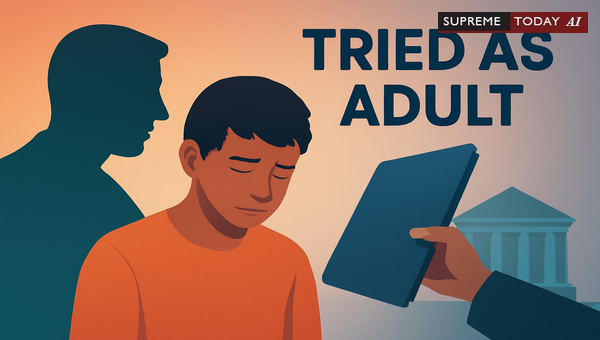
When Can Juveniles Be Tried as Adults in India?
In the Indian justice system, the question To be Tried as Adult often arises in cases involving young offenders, particularly those aged 16-18 accused of serious crimes. Parents, legal professionals, and the public frequently wonder: under what conditions can a juvenile be transferred from the juvenile justice system to face trial as an adult? This blog post explores the legal framework, procedures, and judicial interpretations under the (JJ Act), emphasizing that such trials are not automatic but require strict procedural safeguards. Note: This is general information and not specific legal advice. Consult a qualified lawyer for personalized guidance.
The Legal Framework: JJ Act 2015 and Key Provisions
The JJ Act 2015 marks a shift from the earlier , by allowing juveniles aged 16-18 accused of to potentially be tried as adults, but only after rigorous evaluation. mandates a by the (JJB) for such cases. This assessment evaluates the juvenile's mental and physical capacity, ability to understand the consequences of the offence, and the circumstances surrounding it. 2019 0 Supreme(Raj) 3181
further requires the to decide post-assessment whether to try the juvenile as an adult. The word may in (1) has been interpreted as mandatory (akin to shall) to protect juvenile rights. 2024 0 Supreme(Raj) 1094 Without this process, trial as an adult is invalid.
As highlighted in judicial precedents, From the scheme of Sections 14, 15 and 19 referred to above it is clear that the Legislature felt that before the juvenile is tried as an adult a very detailed study must be done and the procedure laid down has to be followed. Even if a child commits a heinous offence, he is not automatically to be tried as an adult. 2022 0 Supreme(Bom) 561 2020 1 Supreme 193
The : A Mandatory Step
No juvenile can bypass the JJB's . Key factors include:- Mental and physical capacity: Assessed often with expert input from psychologists or psycho-social experts.- Understanding of consequences: Does the juvenile comprehend the gravity of their actions?- Circumstances of the offence: Social background, peer influence, etc.
, reinforces this. Failure to conduct it properly leads to quashing proceedings. 2014 3 Supreme 220 2019 0 Supreme(Raj) 3181
In one case, courts noted procedural lapses: He ought not to have been tried as an adult. Even otherwise, if he deserves to be tried as an adult, the procedure followed by the Court below to treat him as adult for the purpose of trial is not in consonance with the Act and Rules framed thereunder. 2023 0 Supreme(Mad) 1081
Recent directives underscore the need for experts: In the absence of expert psychologist or psycho-social expert, it would not be possible to assess the mental or psychological faculty of mind of that particular juvenile objectively... this Court thus directs the State Government to... appoint a panel of at least six expert psychologist/psycho-social experts in each Commissioners Division. 2019 0 Supreme(All) 946
Judicial Interpretations and Case Law
Courts have consistently ruled against automatic adult trials based on age or offence gravity alone. The preliminary order under is not final; a detailed inquiry under (1)(i) is required. 2024 0 Supreme(Raj) 1094
In 2019 0 Supreme(Raj) 3181, the Supreme Court invalidated a trial for skipping assessment, stressing individual evaluation over rigid thresholds. Similarly, 2014 3 Supreme 220 invokes international standards, noting juveniles vary in emotional and intellectual maturity.
Another ruling clarifies heinous offence definition: As per '' means offences in which minimum punishment is seven years or more. Offences without this minimum are treated as serious, not triggering adult trial. 2022 0 Supreme(Bom) 561
Bail considerations differ too. For 16-18-year-olds in heinous cases, bail under applies even post-transfer, rejecting adult norms. Seriousness of offence alleged cannot be made a ground for rejecting bail under Act of 2015. 2019 0 Supreme(Pat) 665
Rule of parity doesn't apply uniformly: A 17.5-year-old near majority differs from a 13-year-old with disabilities. 2020 0 Supreme(All) 951
International Standards Reinforcing Safeguards
The UN Convention on the Rights of the Child (CRC) and Beijing Rules advocate individualized assessments, not age-based adult trials. Indian courts align with this: International conventions like the CRC and the Beijing Rules advocate for a nuanced approach, emphasizing individualized assessment rather than a fixed age threshold. 2014 3 Supreme 220
Exceptions, Limitations, and Practical Implications
Trial as an adult may proceed if:- Assessment confirms capacity to understand consequences.
01700075821
- Procedures under Sections 15 and 19 are followed meticulously.However:- Age alone (e.g., 16+) isn't sufficient.- No automatic transfer for heinous crimes without evaluation. 2020 1 Supreme 193
In practice, violations lead to acquittals or quashed proceedings. For instance, appeals may result in sentence modifications for premature release if infractions occurred. 2023 0 Supreme(Mad) 1081
Bail remains available during assessment or post-transfer, prioritizing rehabilitation. 2019 0 Supreme(Pat) 665
Recommendations for Stakeholders
To uphold justice:- Strict adherence to Sections 15 and 19; seek expert opinions routinely.- Standardize assessments via guidelines.- Integrate international best practices.- Appoint more psychologists, as directed in 2019 0 Supreme(All) 946.
Legislators should clarify ambiguities, like the fourth category of offences. 2022 0 Supreme(Bom) 561
Conclusion: Prioritizing Due Process and Rehabilitation
Juveniles can only be tried as adults after a comprehensive, documented under the JJ Act 2015. Skipping safeguards violates rights and statutory intent. The focus remains on reform over punishment, ensuring maturity—not just age—guides decisions. 2024 0 Supreme(Raj) 1094 2014 3 Supreme 220
Key Takeaways:- Mandatory JJB assessment for 16-18-year-olds in .- Individual capacity evaluation trumps offence gravity.- Procedural lapses invalidate adult trials.- Bail and rehabilitation principles persist.
Stay informed on evolving juvenile justice—fair processes protect society and youth alike.
#JuvenileJustice, #TriedAsAdult, #JJAct2015















