


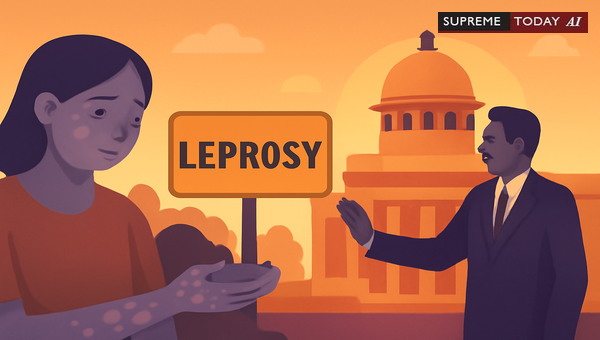
: Current Status and Repeals in India
Leprosy, once shrouded in fear and stigma, has seen dramatic shifts in medical understanding and legal treatment over the past century. Enacted during British colonial rule, the Lepers Act of 1898 aimed to segregate and treat those afflicted with the disease, particularly with infectious forms. But what is the current status of the ? Is it still enforceable, or has it faded into obsolescence alongside outdated prejudices?
This blog post dives into the repeal of this antiquated law across India, judicial recommendations for reform, and evolving rights for those affected by leprosy. Drawing from key court judgments and legislative trends, we'll explore why the Act no longer holds sway in most jurisdictions and what that means today.
Overview of the Lepers Act, 1898
The Lepers Act, 1898 () was designed to provide for the and medical treatment of suffering from the infectious type of the disease. It reflected the era's limited knowledge, treating leprosy as highly contagious and justifying isolation. However, with modern science proving leprosy fully curable through and not as infectious as once thought, the Act's foundations have crumbled.
No central document confirms its enforceability at a national level today. Instead, evidence points to widespread repeal, aligning with India's of equality under and dignity under .
Widespread Repeals by States and Union Territories
The most direct insight comes from legal analyses confirming that many State Governments and Union Territories have explicitly repealed the Lepers Act, 1898, and subsequent similar State Acts2008 7 Supreme 109. This repeal responds to recommendations from the appointed by the , reflecting changed concept and knowledge gained about the disease of leprosy 2008 7 Supreme 109.
Recent observations reinforce this: Nandakumar submits that because leprosy is now fully curable, the which provides for has since been repealed
. The Court highlighted the Act's obsolescence in discussions on land rights for leprosy colonies, urging evolution of frameworks to prevent given the disease's curability.
Additionally, post-abolition, the Central Government has shifted care to schemes like the
. While not universal, the phrasing many States and UTs suggests persistence in limited, unspecified areas, necessitating local verification.
Key Repeal Highlights:
- State-Level Actions: Numerous states have struck down the Act and analogous laws, eliminating provisions.
- Medical Basis: Curability eliminates the need for forced isolation
.
- No National Enforcement: Absent central affirmation of ongoing force.
Judicial Perspectives and Recommendations for Reform
Courts have not only noted repeals but urged broader legislative review. In a case upholding leprosy-based disqualifications for municipal councillors under of a related Act (deemed constitutional under ), the court observed: keeping in view the present thinking and researches carried on leprosy as also on tuberculosis, and with professional input, the Legislature may seriously consider whether it is still necessary to retain such provisions in the statutes 2008 7 Supreme 109.
This trend extends to landmark rulings:- Striking down voting disqualifications for lepers as violative of 1967 0 Supreme(Kar) 37.- Affirming dignity rights under for children of lepers 1998 0 Supreme(All) 300.
These decisions signal a judicial shift from discriminatory frameworks, consistent with the Act's repeal.
Modern Contexts: Land Rights and Beyond
The 's analysis in leprosy colony land disputes underscores the Act's irrelevance: provisions for are obsolete due to the curability of leprosy, prompting calls for ownership rights via measures like the and Report No. 256
. The Court directed notices for further action, emphasizing protection against .
Historical references, such as land grants to leper colonies near sacred sites (e.g., Darbar Sahib), highlight ongoing socio-legal challenges but affirm no under old regimes 1934 0 Supreme(Lah) 110. Meanwhile, protections in other laws, like , appear in unrelated but analogous statutes, insulating officials but not reviving leprosy-specific 2019 0 Supreme(J&K) 292.
Less directly, interpretations in prison laws reference the Act tangentially for definitional purposes, like District Magistrate under Section 2(5), but confirm its contextual antiquity 1908 0 Supreme(Mad) 230.
Exceptions, Limitations, and Verification Needs
While repeals dominate, exceptions may linger in some jurisdictions pending action. Disqualifications in other statutes (e.g., public office) have been upheld as rational but flagged for review 2008 7 Supreme 109. Practitioners must check local records:
- Verify State/UT Status: Consult gazettes or legislative databases.
- No Universal Repeal Confirmed: Phrasing implies pockets of persistence.
Recommendations for Legal Practitioners and Advocates
- Conduct Jurisdiction-Specific Checks: Use state legislative portals.
- Advocate Full Repeal: Cite medical advancements, equality, and judgments like those striking begging criminalization on discriminatory grounds (analogous to leprosy stigma).
- Push for Rights Reforms: Support land rights, dignity protections, and elimination of residual disqualifications.
Legal professionals should generally verify via primary sources, as statuses evolve.
Conclusion and Key Takeaways
The Lepers Act, 1898, stands largely repealed across many Indian states and Union Territories, rendered obsolete by scientific progress and constitutional imperatives. Judicial voices, from repeal affirmations 2008 7 Supreme 109 to obsolescence declarations
, pave the way for inclusive policies.
Key Takeaways:- Repealed in most areas; check locally.- Courts recommend scrapping related discriminatory provisions.- Focus shifts to rights, care, and anti- measures.- Reflects India's journey from stigma to equality.
This post provides general information based on available judgments and is not legal advice. Consult a qualified lawyer for specific cases.
#LepersAct1898 #LeprosyLawIndia #LegalRepeal















