


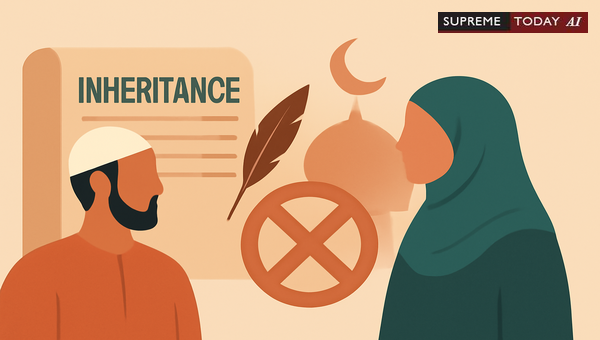
Muslim Conversion: Eligible for in India?
In today's diverse society, religious conversion is a personal choice that can profoundly impact legal rights, especially in matters of family and property. A common question arises: Whether a Muslim who is converted is eligible to get ? This query touches on the intersection of , Indian personal laws, and constitutional protections. If a Muslim converts to Hinduism or another faith, do they retain from Muslim relatives?
This blog post delves into the legal principles, drawing from authoritative texts and case analyses. While this provides general insights, it is not legal advice—consult a qualified lawyer for your specific situation.
Main Legal Finding
Generally, a Muslim who converts to another religion loses the legal right to inherit under Islamic law. (renouncing Islam) results in exclusion from , a doctrine rooted in and recognized in India. As per key legal documents, an apostate is treated similarly to a non-Muslim, barring them from inheriting from Muslim ancestors
.
This principle ensures inheritance remains tied to religious identity at the time of the ancestor's death.
Key Points on and
- Under Islamic law, an apostate is excluded from inheritance from Muslim relatives
.
- Muslim law does not recognize adoption; rights stem from blood relations and religious identity
1972 0 Supreme(SC) 444.
- India's protects , but is religion-specific—apostates fall outside its purview 2025 2 Supreme 624.
- Post-conversion, the individual is governed by their new religion's laws, extinguishing Muslim inheritance claims
03200000550
. - In India (not Dar-ul-Islam), apostate properties don't to the state, but under Muslim law are lost
.
- Conversion severs ties for Muslim ancestral property
K. L. Parakh, Dr. VS Income-tax Officer - (1981)
.
These points highlight how religious identity dictates eligibility.
Detailed Analysis: Islamic Law on and Inheritance
explicitly bars apostates. A pivotal reference states: an apostate from Islam and an original non-Muslim are equally viewed from the stand point of Islam so that if a deceased Muslim leaves behind him 3 heirs, one of whom is a non-Muslim, the second an apostate and the third a Muslim... the first two would be excluded from
. This underscores the strict exclusion.
Religious Identity Determines Applicable Law
opens at death, governed by the heir's religion then. A converted Muslim, now Hindu, follows Hindu law but loses Muslim claims
03200000550
. Similarly, conversion from Hinduism affects rights, reinforcing religion-based 1972 0 Supreme(SC) 444.In among Muslims, courts apply strictly, as seen in cases emphasizing shares and under 2022 0 Supreme(Raj) 2561. This aligns with the religion-specific framework.
Constitutional Context in India
safeguards religious freedom and personal laws, yet inheritance does not take place beyond the periphery of religion—a converted Muslim cannot claim under Muslim law 2025 2 Supreme 624.
Conversion Processes and Implications
Conversion to Islam requires genuine faith, no ceremonies needed: he who develops faith in Mahomedanism and converted from one religion to Islam can be said to be a converted Muslim 2014 0 Supreme(AP) 1174. Courts assess sincerity minimally.
Conversely, for inheritance, the reverse—leaving Islam—triggers loss. Cases on community status post-conversion note it doesn't automatically transfer, e.g., a Hindu converting to Islam via marriage doesn't gain Backward Class Muslim status unless specified 2013 0 Supreme(Mad) 1016 2014 0 Supreme(Mad) 815. This mirrors how severs legal ties without automatic gains elsewhere.
In Sri Lankan contexts (influencing similar jurisprudence), Muslim follows specific ordinances, excluding outsiders
ISMAIL LEBBE v. HANIFFA
SINNA MARIKAIR v. THANGARATNAM
. Indian courts echo this in partition suits under Muslim law 2022 0 Supreme(Raj) 2561.Non-Recognition of Adoption and Strict Kinship
Muslim law limits inheritance to , ignoring adoption
. Religious change disrupts this, as kinship is religion-bound 1972 0 Supreme(SC) 444.
Exceptions and Limitations
India's secular status means no automatic for apostates—properties remain personal, but Muslim rights vanish
. Heirs under the new faith may claim differently, but not from Muslim ancestors under Sharia.
No broad exceptions exist; disputes hinge on proven conversion and timing.
Practical Recommendations
- Verify religion at death for claims.
- Seek advice if conversion occurred—inheritance under original law typically ends.
- In litigation, highlight current religious identity and personal law.
- Policymakers could clarify conversion impacts to reduce disputes.
For partitions, follow CPC procedures like commissioner reports for equitable shares 2022 0 Supreme(Raj) 2561.
Conclusion and Key Takeaways
In summary, a Muslim converting to another faith generally becomes ineligible for under Muslim law, backed by jurisprudence
, texts 2025 2 Supreme 624, and Indian principles. Inheritance is intrinsically linked to faith— severs it.
Key Takeaways:- Apostates lose Muslim .- New faith's laws apply post-conversion.- Consult professionals; laws evolve.
This analysis draws from established sources for educational purposes. For tailored guidance, engage a legal expert familiar with personal laws.
References:1.
: exclusion.2.
: No adoption in Muslim law.3. 2025 2 Supreme 624: Religion-bound inheritance.4. 1972 0 Supreme(SC) 444: Conversion impacts.5.
03200000550
,K. L. Parakh, Dr. VS Income-tax Officer - (1981)
: Post-conversion governance.Stay informed on evolving personal laws shaping family legacies.
#MuslimInheritance, #ReligiousConversionLaw, #SuccessionRights















