


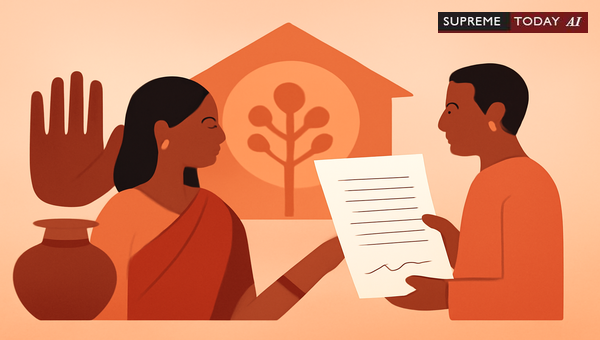
Partition Rights: Wives & Daughters in Hindu Law Explained
Introduction
In Hindu joint families, the division of property through partition has long been a contentious issue, especially regarding shares for wives and daughters. A common question arises: What is the Law of Partition of Tribal Male Amongst Wives and Daughters? While 'tribal male' may refer to specific customary contexts, the principles largely align with Hindu law governing property and succession. Traditionally male-dominated, these rules have evolved significantly with legislative reforms promoting gender equality.
This blog delves into the legal framework, key principles from the , and the pivotal amendment. We'll examine how are treated, the rights of female heirs, relevant case law, and provisions like . Note: This is general information, not specific legal advice. Consult a qualified lawyer for personalized guidance.
Overview of and Property
Under traditional Hindu law, a consists of male members who acquire rights by birth in ancestral property. Their shares remain indeterminate until partition, fluctuating with births and deaths. 2023 0 Supreme(Del) 1257 As explained, : Traditionally, only male members could be coparceners, acquiring rights by birth. The share of a coparcener is indeterminate until a partition occurs, and it can fluctuate with births and deaths within the family.
A , however, includes females, but their rights were historically limited to maintenance, not ownership. 2023 0 Supreme(Del) 1257 Properties in a are managed collectively until partition severs the unity of possession.
The HSA, , marked a shift. treats properties from as self-acquired, entitling female heirs to defined shares. 2021 0 Supreme(Mad) 186 The amendment was transformative, granting daughters rights equal to sons, fundamentally altering male-centric inheritance. 2023 0 Supreme(Del) 1257
Key Legal Principles on and Gender Equality
Nature and Validity of
formalize the division of joint property. They can be registered or oral, but validity requires fairness. It is open to the parties to effect an amicable partition and no instrument in writing is necessary for the said purpose. However, unless and until there has been a valid and effective partition, the right of the parties subsists. 2009 0 Supreme(Mad) 1585
Unequal allocations, especially disadvantaging females, invite challenges for or . Deeds significantly undermining female rights may be canceled post- amendment. 2021 3 Supreme 660 1964 0 Supreme(SC) 289
Rights of Wives and Daughters
Wives traditionally received maintenance shares, but post-HSA, they are . Daughters, once excluded from , now claim equal shares. 2023 0 Supreme(Del) 1257
A key exception is , women's absolute property. Joint families can allocate to daughters during partition. In one case, A can validly designate property as for daughters, and such property cannot be included in the holdings of the father under the . 2023 0 Supreme(Mad) 3403 The court upheld a deed allotting to daughters, excluding it from the father's ceiling limits, emphasizing pre-Act validity.
Historically, females were excluded: Besides, only males can be coparceners, and all females are excluded from the , because the test of coparcenership is the right to enforce a partition and no female has that right though females like wives and mothers may be allotted shares when a partition takes place. 1985 0 Supreme(Kar) 530
Challenging Unequal Partitions
If a deed gives disproportionately small shares to wives or daughters, it may be contested. Evidence of inequality or coercion is crucial. Oral partitions must be proven; defendants failed in one instance where it seemed designed to deprive the plaintiff. 2009 0 Supreme(Mad) 1585 The court granted the plaintiff her 1/3rd share, noting deletion of HSA Section 23 removed dwelling house partition barriers.
Registered deeds are hard to cancel: It is not understood as to how a registered partition deed, which determines the rights of the partition, can be cancelled at all. 2019 0 Supreme(Mad) 2885
Relevant Case Law
Kandasamy Case
The court upheld a 1/3 share for the plaintiff, ruling partition-derived properties as self-acquired, equally distributable among heirs including females. 2021 0 Supreme(Mad) 186
Sharad vs. Bapusaheb
A partition among males excluding females was invalid if unequal, affirming female entitlements. 2022 0 Supreme(Bom) 850
and Land Reforms
In a Tamil Nadu case, daughters' from a deed was protected: The court interpreted the provisions... shares allotted to daughters as should not be included in the father's holdings. 2023 0 Supreme(Mad) 3403
Oral Partition Failures
Defendants' oral partition plea to deny a daughter's share was rejected as unreasonable. 2009 0 Supreme(Mad) 1585
Traditional Exclusions
Older cases reinforced male-only but noted allotted shares for females upon partition. 1985 0 Supreme(Kar) 529 The court emphasized the distinction between and partition, holding that the legal incidents of both are separate and distinct.
Additional Insights from Hindu Succession Reforms
The Act placed widows as , enabling partition demands, though initially for limited estates. 2014 0 Supreme(Bom) 2447 Post-, daughters' birthrights match sons', promoting equality.
under Section 108 also aid for missing members, without needing court declarations post-. 2014 0 Supreme(Bom) 2447
Conclusion and Key Takeaways
Hindu partition law has progressed from excluding wives and daughters to granting equal rights via the HSA amendment. Unequal deeds can be challenged with evidence, while offers protected female allocations. 2023 0 Supreme(Mad) 3403 2023 0 Supreme(Del) 1257
Key Takeaways:- Daughters are now coparceners by birth; expect equal shares.- Wives qualify as for self-acquired partition properties.- Document inequalities or coercion to contest deeds.- provisions safeguard female interests.- Oral partitions require strong proof.
For affected families, legal consultation is essential to navigate these nuances. Stay informed on evolving gender-equal inheritance rights.
References:- 2023 0 Supreme(Del) 1257 2021 0 Supreme(Mad) 186 2022 0 Supreme(Kar) 1422 2021 3 Supreme 660 1964 0 Supreme(SC) 289 2022 0 Supreme(Bom) 850 2023 0 Supreme(Mad) 3403 2019 0 Supreme(Mad) 2885 2014 0 Supreme(Bom) 2447 2009 0 Supreme(Mad) 1585 1985 0 Supreme(Kar) 530 1985 0 Supreme(Kar) 529
#HinduPartitionLaw, #WomensInheritanceRights, #CoparcenaryRights












