


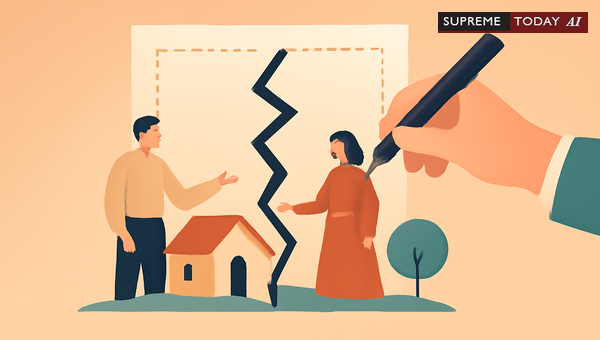
Effects of No Metes & Bounds Division After Partition
In property disputes among co-owners or joint family members, partition suits are common. But what happens if a court passes a preliminary or final partition decree, yet the property isn't physically divided by ? Many wonder: Effects of Non Division of Property by after Partition—does this mean the property remains undivided legally?
This blog post breaks down the legal principles, drawing from key judgments and statutory insights. Note: This is general information based on Indian case law, primarily under Hindu law and civil procedure. It is not specific legal advice; consult a qualified lawyer for your situation.
Understanding Partition: Beyond Physical Division
Partition fundamentally redistributes rights among co-owners or coparceners, terminating and vesting shares in severalty 2023 0 Supreme(Cal) 798 2021 0 Supreme(Ker) 846. It doesn't always require immediate physical division.
- : Declares shares and severs joint status.
- : Often involves division via a commissioner, but this is procedural 2011 0 Supreme(Del) 456 2018 0 Supreme(Del) 1343.
Actual physical division by is typically a subsequent step, not a prerequisite for legal . As held in several cases, disruption of can occur through declarations or acts indicating separation, even without physical partition
2022 0 Supreme(Raj) 880.
Legal Without Physical Division
Courts have consistently ruled that defining shares suffices to end , creating status. In , the clarified: a clear intention to separate, coupled with defined shares, severs joint status, regardless of physical division
.
Once shares are specified—via or mutual agreement—parties hold as . A mere separation of shares or interest, without physical division, results in holding, which is legally recognized and sufficient to effect in 2018 0 Supreme(Del) 1343 2025 2 Supreme 624.
This principle is echoed in other rulings. For instance, Such partition irrespective of whether it is accompanied or followed by division of properties by covers both a division of right and division of property. A disruption of by a definite and unequivocal indication to separate implies separation in interest and in right, although not immediately followed by a de facto actual division of the subject-matter 2020 0 Supreme(Kar) 1884 2015 0 Supreme(Pat) 689 2013 0 Supreme(Bom) 999.
Role of Preliminary vs. Final Decrees
A declares shares and attains finality, binding parties. It cannot be reopened lightly, and courts must proceed to a for if feasible 2024 0 Supreme(P&H) 1341. The suit continues to be pending until partition, that is division by , takes place by passing a 2024 0 Supreme(P&H) 1341.
However, absence of final physical division doesn't undo . In family disputes, courts appoint commissioners to assess divisibility. If divisible, they direct division, including walls or structures: As per the report of the , the property is divisible by . ... is permitted to engage the services of some contractor for effecting the partition by including the erection of a wall 2024 0 Supreme(Del) 432.
Implications for Co-Owners and Property Rights
Until physical division:- Co-owners are with defined shares.- Rights stem from the declaration, not physical lines.- Undivided shares can be sold/transferred, but possession handover awaits division 2009 0 Supreme(SC) 1583.
In ongoing suits, injunctions against co-owners are rare, but status quo may be maintained to prevent interference: Injunctions cannot be granted against co-owners in partition suits; however, maintaining is reasonable to prevent interference during ongoing disputes 2025 0 Supreme(Telangana) 480.
Transfers of demarcated portions by co-owners can even bypass formal partition needs: If the exclusive owner or all the co-owners of a property transfer different demarcated portions of the property to different persons, there arises no further need of partition by 2025 Supreme(Online)(Cal) 3317.
Exceptions: When Physical Division Isn't Feasible
Not all properties suit :- If division destroys value, courts order sale and proceeds distribution 2021 0 Supreme(Ker) 846.- doesn't mandate a 'positive finding' of indivisibility; it suffices if it 'appears' so 2024 0 Supreme(Telangana) 240.- Shareholders get preemption rights: buy at valuation before auction 2024 0 Supreme(Telangana) 240.
In one case, parties enjoyed land jointly without , yet shares were acknowledged: Defendants further stated that their branch have been jointly enjoying Acs.7 – 09 ½ gts., without any partition by 2025 0 Supreme(Telangana) 480.
Practical Examples from Case Law
- Family Sentiment vs. Sale: Plaintiff opted for physical division over sale due to aunt's attachment; allocated specific parts 2024 0 Supreme(Del) 432.
- No Demarcation, No Exclusive Title: Without , no specific portion title, but shares persist 2025 Supreme(Online)(Cal) 3317.
- Gift Deeds and Shares: 1/3rd undivided share via gift doesn't allow ousting others; no meant joint access 2016 0 Supreme(Del) 1929.
Under Hindu law, a wife's partition claim against a living husband is barred, but coparceners can sever via intent 2020 0 Supreme(Chh) 458.
Recommendations for Co-Owners
- Document shares via decrees or agreements to establish .
- If physical division lags, confirm legal status as .
- For disputes, seek commissioner reports early.
- Formalize via court to avert litigation.
Conclusion and Key Takeaways
Non-division by post-partition doesn't mean undivided property. Defining shares severs joint status, creating —physical division is desirable but not essential 2018 0 Supreme(Guj) 935
.
Key Takeaways:- happens at share definition, not .- status allows share dealings.- Courts prioritize feasibility; sale if indivisible.- Always verify with precedents like Kalyani v. Narayanan.
For tailored advice, contact a property law expert. Stay informed on evolving jurisprudence.
References (select citations):1. 2023 0 Supreme(Cal) 798 - via defined shares.2. 2021 0 Supreme(Ker) 846 - Procedural nature of physical division.3.
- Intention severs joint status. #PropertyPartition, #MetesAndBounds, #JointFamilyLaw












