Searching Case Laws & Precedent on Legal Query.....!
Analysing the retrieved Case Laws
Scanned Judgements…!



Searching Case Laws & Precedent on Legal Query.....!
Analysing the retrieved Case Laws
Scanned Judgements…!
The legal framework and guidelines (e.g., Rule 4 of the Juvenile Rules, 2020, and guidelines issued under Section 39 of the POCSO Act) reinforce the necessity of prior notice and hearing of the juvenile or victim before disposing of juvenile declaration applications or related proceedings.
Analysis and Conclusion:
References:- ["2022 Supreme(Online)(Chh) 1671"]- ["2024 0 Supreme(Jhk) 502"]
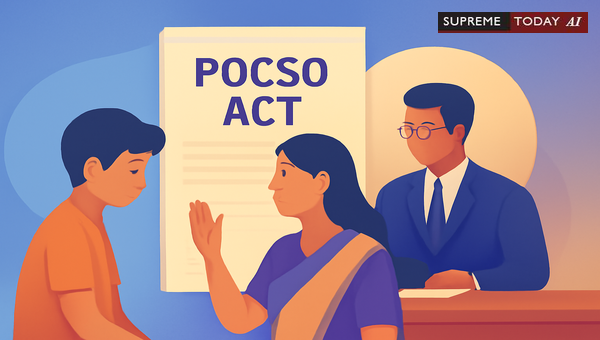
In the sensitive realm of Protection of Children from Sexual Offences (POCSO) cases, is paramount, especially when determining if an accused is a juvenile. A critical question arises: in POCSO case complainant must be heard prior to disposing application. This issue touches on victim rights, , and statutory mandates under the and (). Courts have repeatedly emphasized the victim's voice to prevent miscarriages of justice.
This blog delves into the legal framework, key judgments, and practical implications, drawing from authoritative sources to provide clarity for legal professionals, victims' families, and advocates.
Generally, in POCSO cases, the procedure mandates that the complainant's statement or version must be recorded and considered at the appropriate stage. The hearing or recording of the complainant's statement is crucial before finalizing a or . The law stresses that the victim's views should be heard prior to disposing of such applications, ensuring the victim's input shapes the court's decision. 2022 0 Supreme(Gau) 1047
This principle upholds fairness, as bypassing the victim could undermine the process, particularly when age disputes arise.
These points align with , which mandates courts to seek evidence like the victim's statement for age findings. 2021 8 Supreme 181
Under the and , the victim's statement is vital in proceedings. Courts must record and consider it to ensure comprehensive evidence evaluation. For example, in an order dated , the noted concerns over multiple victim statements recorded by authorities, stressing that the victim’s statement, along with medical and documentary evidence, forms the basis for determining her age and the juvenile status. 2022 0 Supreme(Gau) 1047
The in Jarnail Singh held that , including the victim's statement, must be diligent, with decisions based on evidence like victim views before disposal. 2024 0 Supreme(Pat) 663
Statutory guidelines, such as , require courts to determine age based on available evidence. In P. Yuvaprakash, the clarified that the victim's views are essential before final juvenility orders, especially in disputes. 2024 0 Supreme(Pat) 663
Related cases reinforce this. In one judgment, the court directed that the Court must examine the material available before it and on appreciation of evidence adduced by the parties in each case, should determine the age of victim/accused. 2022 0 Supreme(Chh) 400 This includes victim input where relevant.
Moreover, , mandates procedures for victim in POCSO offences, applicable analogously. 2023 0 Supreme(Gau) 766 Courts are duty-bound to resolve age questions affecting jurisdiction first.
Rooted in , hearing the victim prevents incomplete determinations. An order dated emphasized that the victim’s views and evidence are fundamental to the process. 2013 5 Supreme 232
In appeals, failure to prove victim age as a child under POCSO can bar presumptions, highlighting proof's importance—including statements. 2024 0 Supreme(Pat) 1089 The prosecution must establish the victim's age as a child under the to invoke statutory presumptions.
Several cases illustrate procedural safeguards:
These rulings collectively affirm victim involvement where age ties to case gravity, balancing juvenile protections with offence seriousness. 2026 Supreme(Online)(Ker) 7206
While victim hearing is advocated, nuances exist. If the victim's statement is already recorded with sufficient documentary/medical evidence, courts may proceed if views are considered. 2023 5 Supreme 160 However, in contested cases, explicit hearing is critical. Presumptions under Section 94(2) are rebuttable, requiring evidence review. 2022 0 Supreme(Chh) 400
In POCSO cases, the complainant's views typically must be heard or considered before disposing applications. This safeguards victim rights and ensures evidence-based decisions, as affirmed by and High Court precedents. 2018 0 Supreme(Del) 1890
Key Takeaways:- Victim statements are integral to age/juvenility processes.- Courts risk procedural flaws by ignoring them.- Always prioritize statutory procedures for just outcomes.
This post provides general information based on legal precedents and is not specific legal advice. Consult a qualified lawyer for case-specific guidance.


At trial ... (i) Children have the right to be heard in any judicial and administrative proceedings affecting them. They must be given a reasonable opportunity to express their views all matters affecting him and these must be taken into account. ... and who has been convicted for offence under the provisions of the POCSO Act, but by virtue of sub-rule (15) of R.4 of the Rules of 2020 and by virtue of the guidelines issued by the Central Government under S.39 of the POCSO Act, issuance of prio....

-IV-cum-Special Judge POCSO, Ranchi in POCSO Case No. 59 of 2022 in connection with Angara P.S. Case No. 84 of 2021, whereby the prayer for declaring the petitioner juvenile, had been rejected. 2. ... The learned lower Court has not appreciated the evidence on record in proper perspective while rejecting the application of the petitioner to declare him juvenile. ... During trial, an application was moved on behalf of the accused Mukesh Kumar Singh be....

Since the offences involved int his case includes a href="./.. ... At this stage, the learned counsel for the petitioner prayed for a direction to the Juvenile Justice Board to dispose of this case in a time bound manner. Sections 4 r/w 3(a), 6 r/w 5(l), 5(m), 5(n) of Protection of Children from Sexual Offences (POCSO) Act. 2. ... The learned Counsel for the 2nd respondent/defacto complainant also submitted that the dispute between the defacto complainant and the 4. ....

juvenile or child or a juvenile in conflict with law within a period of thirty days from the date of making of the application for that purpose. ... Heard learned A.P.P. for the State. ... (4) An appellate court, however, must bear in mind that in case of acquittal, there is double presumption in favour of the accused. ... From the aforesaid observation made by the Hon’ble Supreme Court, it can be said that an appellate court must bear in mind in a case#HL_....
The petitioner is challenging the impugned order dated 21.6.2022 passed by the learned Additional Sessions Judge, FTSC (POCSO), Kawardha, District Kabirdham in Special Sessions Case No. 68/2022 whereby the learned trial Court has rejected the application of the petitioner for sending the case to the ... The Court must examine the material available before it and on appreciation of evidence adduced by the parties in each case, should determine the age of victim/accused. ... The trial Co....

Preliminary assessment of mental and Physical capacity of juvenile to commit heinous offence must be concluded expeditiously. 30. ... So also accused is a juvenile aged in between 17 and 18 years as per the evidence placed on record. Unless the accused knew about the caste of the victim, this provision as amended in the year 2016 has no application. ... Learned trial Court i.e., Children’s Court after having heard the arguments and after evaluation of the evidence placed on record by the prosecution, fo....

Case No. 34(9) of 2020 under Section 376(1) IPC read with Section 3(j) (ii) 5, 6, of the POCSO Act, 2012 rejecting the bail application filed under Section 12 of the said Juvenile Justice(Care and Protection) Act on behalf of the Child in Conflict with Law (hereinafter referred to as CCL) Shri. ... The learned Special Judge (POCSO) on examination of the CCL and on perusal of the birth certificate came to a finding that he is a minor of about 17 years of age and accordingly, vide order dated 14.09.2020 t....

This is an application challenging the order dated 08.05.2023 passed by the Special Judge (POCSO), Bomdila whereby the application filed on behalf of the accused for determination of the age of the victim in connection with POCSO case no. 11/2022 arising out of Seppa Women PS case no. 12/2022 under section ... However, the learned Special Judge, Bomdila has rejected the application by the order dated 08.05.2023 without following the relevant provisions under the #HL_S....

It is on the aforesaid statement of the prosecutrix that the case was converted from one under Sections 354, 506 IPC and Section 7/8 of the POCSO Act to one under Sections 354A, 506, 376D IPC and Section 3/4 of the POCSO Act. ... At the time of incident, the revisionist was a minor and he made an application to the Juvenile Justice Board that he may be declared a juvenile/a child in conflict with law and dealt with as such. ... It was further held that releasing the revisionist on bail....
Prosecution Case in Brief 3. As per the prosecution’s case, while the complainant party was sowing in the field, the accused party attacked them with a sharp-edged weapon and also resorted to fire. ... Justice (Care and Protection of Children) Act, 2015] and disposing of the matter within three months from the date of the first production of the child before the Juvenile Justice Board. ... The Additional District Judge [Juvenile Justice (Care and Protection of Children) Act, 2015] (#HL....

However, Section 34 (2) of the POCSO Act, stipulates that if any question regarding the age of a person arises, it shall be determined by the Special Court after satisfying itself about the age of such person recording reasons for such determination. Abare perusal of Section 34 (1) of the POCSO Act makes it clear that in case of commission of an offence under the POCSO Act, by a child, he shall be dealt with under the provisions of the Juvenile Justice Act, 2015. In view of the provisions stipulated under subsection (1) of Section 34 of the POCSO Act, any offence ....

(3) No order made by the Special Court shall be deemed to be invalid merely by any subsequent proof that age of a person as determined by it under sub-section (2) was not the correct age of that person.” A bare perusal of Section 34(1) of the POCSO Act makes it clear that in case of commission of an offence under the POCSO Act, by a child, he shall be dealt with under the provisions of the Juvenile Justice Act, 2015. However, Section 34(2) of the POCSO Act, stipulates that if any question regarding the age of a person arises, it shall be determined by the Special Court afte....

In order to sustain the prosecution under POCSO Act, the victim must be a “child” within the meaning of Section 2(1)(d) of the POCSO Act, meaning thereby the victim must be below the age of 18 years despite gender. The alleged offence took place on 11-3-2014, meaning thereby on the date of occurrence the victim was barely 10 years of age. In order to comply this basic requirement, the prosecution has tendered victim’s bona fide certificate (Exh.79) and birth certificate (Exh.80) showing that her date of birth was 25-4-2004. 9. The accused is charged for the offences under t....

After completion of the investigation charge sheet was filed against the applicant and the case was committed for trial to the Sessions Court. During the trial, an application has been moved on behalf of the applicant under section 94 of the Juvenile Justice (Care and Protection of Children) Act (in short 'the Act') claiming that the applicant was juvenile at the time of incident, therefore, his case be sent to the Juvenile Justice Board for hearing.

He has already undergone sentence for about 5 years. Therefore, the sentence imposed upon him in POCSO Special Case No.512 of 2013 by the learned trial court needs to be set aside and the record needs to be placed before the Juvenile Justice Board for passing appropriate orders under the Juvenile Justice (Care and Protection of Children) Act. The Appeal is disposed of with following directions : i) Sentence awarded by the learned trial court on appellant Sarang Malhari Pawar in POCSO Special Case No.512 of 2013 is quashed and set aside.


An indispensable Tool for Legal Professionals, Endorsed by Various High Court and Judicial Officers
Please visit our Training & Support
Center or Contact Us for assistance

Scan Me!
India’s Legal research and Law Firm App, Download now!


For Daily Legal Updates, Join us on :



 Back to top


