


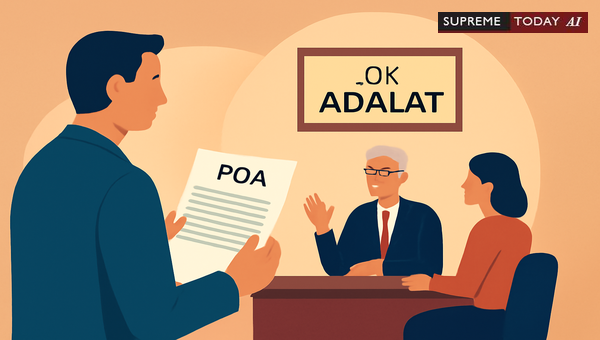
Can a Holder Participate in Lok Adalat? Essential Legal Insights
Lok Adalat, a cornerstone of India's system, promotes speedy justice through . But what if you're unable to attend personally? Can your (PoA) holder step in on your behalf? This is a common query for individuals and businesses navigating disputes. Whether a Holder can Participate in Lok Adalat hinges on strict procedural rules and judicial interpretations. Generally, PoA holders face significant limitations and cannot act as advocates or pleaders without explicit authorization.
In this post, we break down the legal framework, key judgments, exceptions, and practical recommendations. Note: This is general information based on precedents and statutes; consult a qualified lawyer for advice tailored to your situation.
Understanding and Lok Adalat Basics
A authorizes an agent (PoA holder) to act for the principal in specified matters, such as signing documents or managing transactions. However, court proceedings demand a clear distinction between and (enrolled lawyers).
Lok Adalat operates under the , emphasizing voluntary, mutual consent for settlements. Awards are final and binding, akin to decrees. Participation typically requires parties themselves or their authorized advocates, not just any PoA holder. Courts scrutinize PoA involvement to prevent misuse or fraud.
Main Legal Finding: PoA Holders Generally Cannot Participate as Representatives
A holder generally cannot participate in Lok Adalat as a representative or advocate on behalf of the principal unless explicitly authorized and permitted under applicable procedural and statutory rules. The framework prioritizes parties or enrolled advocates for active roles like , , or examining witnesses. PoA holders are limited to agent roles. (PoA holders cannot plead or argue in court proceedings unless specifically permitted) 2019 0 Supreme(Guj) 972 2022 8 Supreme 366
Key Limitations from Judicial Precedents
- Role as Recognized Agent Only: PoA holders can perform specific acts but lack automatic rights to courtroom advocacy. (The holder can act only as an agent) 2013 0 Supreme(Kar) 906
- No or : and consistently rule against PoA holders acting as pleaders. (PoA holders cannot plead or argue in criminal or proceedings unless specifically permitted) 1999 3 Supreme 308 2019 0 Supreme(Guj) 972
- Verification Essential: Lok Adalats must check PoA scope, especially for compromises. (Lok Adalat Members have to verify whether the contains any clause enabling the holder to enter into compromise) 2014 0 Supreme(AP) 1248
In one case, a was set aside as void because it involved a PoA holder representing a deceased party without verification, amounting to fraud. The court stressed: The trial court and Lok Adalat failed to ascertain the legality of the compromise and the authority of the G.P.A holder representing the deceased. 2025 Supreme(Online)(Kar) 17912
Detailed Analysis of Participation Rules
Procedural Framework Under Legal Services Authorities Act
Lok Adalat settlements rely on genuine agreements with signatures from parties or authorized persons. (The award or settlement must be based on a genuine agreement between the parties or their authorized representatives, with signatures or signatures of authorized persons directly involved) 2023 0 Supreme(All) 1778 2008 4 Supreme 528
mandates conciliation, but PoA holders' roles are restricted. In insurance claim repudiations, awards were remanded for procedural lapses, underscoring mandatory verification. (The court set aside the Award and remanded the matter to the for fresh adjudication, emphasizing the mandatory nature of under ) 2023 0 Supreme(P&H) 914
Scrutiny in Specific Judgments
- In 2021 0 Supreme(AP) 556, a Lok Adalat awarded a share to a PoA holder who represented the plaintiff, but the court questioned authority: the court questioned whether the PoA holder had proper authority.
- 2022 8 Supreme 366 reinforces: a PoA holder cannot plead or argue in court, including Lok Adalat, unless permitted under procedural rules and authorized as a legal advocate.
- Fraud cases highlight risks: A compromise via PoA without the principal's knowledge was deemed and . (compromise made in Lok Adalat on behalf of the party without her knowledge on the basis of not signed by her – amounts to fraud) 2010 0 Supreme(MP) 621
Another instance involved a suit defended by a PoA holder leading to Lok Adalat compromise, later challenged for lacking genuineness.
Exceptions: When PoA Holders May Participate
While restrictions are stringent, limited exceptions exist:- Explicit Authorization as Advocate: If the PoA holder is an enrolled advocate with prior court permission. 2008 4 Supreme 528- Specific Settlement Authority: PoA explicitly allowing negotiation/settlement, verified by Lok Adalat. (A PoA holder may participate if specifically authorized to act as a legal representative or advocate, which requires prior permission) 2008 4 Supreme 528- Coupled with Interest: Irrevocable PoAs for specific purposes like construction or sales may allow limited actions, but not advocacy. 2013 0 Supreme(Kar) 906
Courts permit in capacities as for non- tasks, but signatures alone are insufficient without verification. 2021 0 Supreme(AP) 556 2023 0 Supreme(UK) 611
Practical Recommendations for Parties
To avoid challenges:- Draft Comprehensive PoA: Explicitly include authority for Lok Adalat participation, settlements, and legal representation.- Seek Prior Approval: Obtain court/Lok Adalat permission; ensure holder is enrolled if acting as advocate.- Verify at Every Step: Present original PoA; courts must confirm scope to prevent null awards.- Prefer Enrolled Advocates: For robust representation, appoint lawyers over general PoA holders.
Parties should distinguish agents from advocates: The distinction between a recognized agent under civil procedure and a legal advocate is crucial. 2022 8 Supreme 366
Conclusion and Key Takeaways
In summary, PoA holders typically cannot actively participate in Lok Adalat as advocates or pleaders unless explicitly authorized, enrolled, and court-approved. Their role remains agent-like, with heavy emphasis on verification to uphold settlement integrity. Missteps can lead to awards being set aside as or void.
Key Takeaways:- PoA participation is limited; active roles require advocate status.- Always verify PoA scope for compromises. 2014 0 Supreme(AP) 1248- Judicial precedents prioritize procedural compliance. 2019 0 Supreme(Guj) 972 2006 7 Supreme 153- Consult professionals to navigate these nuances effectively.
Stay informed on evolving laws, and for personalized guidance, reach out to legal experts. Lok Adalat offers efficient justice—ensure your representation aligns with the rules.
#LokAdalat #PowerOfAttorney #IndianLaw












