Searching Case Laws & Precedent on Legal Query.....!
Analysing the retrieved Case Laws
Scanned Judgements…!



Searching Case Laws & Precedent on Legal Query.....!
Analysing the retrieved Case Laws
Scanned Judgements…!
Several cases resulted in quashing of FIRs or proceedings where the allegations did not meet the criteria of the Act, especially when offences like Section 395 IPC are not included in the Schedule ["2022 0 Supreme(Guj) 251"], ["2024 0 Supreme(Guj) 136"].
Analysis and Conclusion
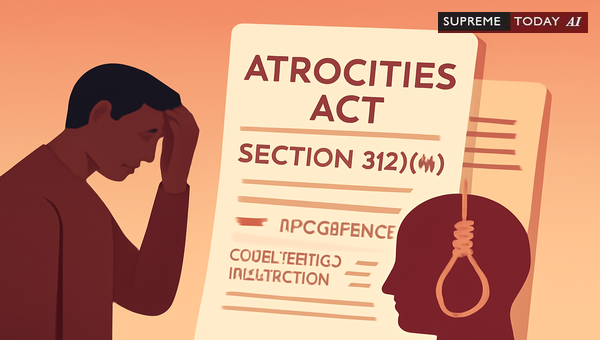
In India's legal landscape, the —commonly known as the —plays a crucial role in protecting marginalized communities from caste-based discrimination and violence. A frequent question arises: Is applicable in cases of an offence under the ? This provision enhances punishment for certain offences when committed against SC/ST members with specific intent. However, its application is not automatic and hinges on strict evidentiary thresholds. This post breaks down the requirements, judicial interpretations, and practical considerations, drawing from key judgments.
Note: This article provides general information based on legal precedents and is not a substitute for professional legal advice. Consult a qualified lawyer for case-specific guidance.
Section 3(2)(v) prescribes enhanced punishment—whoever, not being a member of a Scheduled Caste or Scheduled Tribe, commits any offence under the punishable with imprisonment for a term of 10 years or more against a SC/ST person, or abets or conspires to commit such an offence—shall be punishable with imprisonment for life and fine.
The core issue is its interplay with offences. Courts have consistently held that mere commission of an offence against an SC/ST victim does not invoke this section. Key requirement: . The prosecution must prove the accused knew the victim's caste and acted with intent to exploit that status. 2023 8 Supreme 59
To attract , the prosecution must establish that the offence under the was committed against a person belonging to a Scheduled Caste or Scheduled Tribe, and that the accused acted with the knowledge that the victim belonged to that community. 2023 8 Supreme 59
Without this nexus, the charge fails. In one case, an accused was acquitted under Section 3(2)(v) despite convictions for kidnapping and rape, as there was no evidence of caste knowledge or intent. 2016 0 Supreme(Guj) 736
Therefore, we find that the accused is wrongly convicted for offence under Section 3(2)(v) of the Atrocity Act... only as an afterthought, allegations under the Atrocity Act are said to have been levelled against the accused. 2016 0 Supreme(Guj) 736
Courts emphasize the accused's awareness. Casual or incidental knowledge does not suffice; it must drive the offence.
The act must be on the ground that the victim belongs to SC/ST. In cases under Section 306, prosecutors must show or aid, not mere harsh words or presence. 2021 6 Supreme 216
In cases of under , the prosecution must prove that the accused actively instigated or aided the deceased in committing suicide. Mere presence or a casual relationship is insufficient. 2021 6 Supreme 216
Lack of , private incidents, or delayed FIRs often lead to quashing. For instance, an FIR under and was quashed due to no and absent witnesses. 2024 0 Supreme(Guj) 2218
The absence of during the alleged incident and lack of led to the quashing of the FIR under the Atrocity Act and . 2024 0 Supreme(Guj) 2218
Similarly, in a trespass and abuse case, acquittal was upheld for want of proof under . 2022 0 Supreme(Guj) 1246
and offences have distinct ingredients, allowing separate investigations and trials. under both does not violate (). 2014 6 Supreme 209
Offences under the and the may be investigated and tried separately, as the ingredients of the offences are distinct. 2014 6 Supreme 209
of offences under both the and the does not constitute if the ingredients of the offences are different. 2014 6 Supreme 209
In a petition, proceedings under were not pressed, focusing solely on , which lacked derogatory remarks in third-party presence. 2025 Supreme(Online)(Guj) 12576
Judicial scrutiny is rigorous. In acquittal appeals, courts uphold trial findings absent perversity. For example:
Land Dispute Case: Charges under , 504, 506(2), 114 and failed due to disputed ownership and no criteria met. The appellate court was reluctant to interfere. 2022 0 Supreme(Guj) 1246
Abuse in : No despite broad daylight incident led to dismissal. 2022 0 Supreme(Guj) 39
: Insults over promotions do not qualify as atrocities, as they fall outside Section 3. 2014 0 Supreme(AP) 822
Disputes pertain to do not fall within purview of . 2014 0 Supreme(AP) 822
These cases illustrate that provisions, including 3(2)(v), demand precise facts aligning with statutory intent.
When defending or prosecuting:
Prosecution should bolster cases with corroborative evidence to prevent acquittals on technical grounds.
Applying to offences requires robust proof of caste-based intent and knowledge—typically absent in routine disputes. Courts quash or acquit charges failing these tests, upholding justice while preventing misuse. Key takeaways:
This framework ensures the Act shields genuine victims without overreach. Stay informed on evolving jurisprudence, and always seek tailored legal counsel.
Word count approximation: 950. Sources cited are for illustrative purposes from public judgments.
#AtrocitiesAct, #SCSTAct, #IPCOffences


Further, the offence under Section 395 of the IPC does not get covered in the Schedule under Section 3(2)(va) of the Atrocity Act. Hence, no case would be made out even under the Atrocity Act, nor the same would be falling under the IPC. ... Application no.5638 of 2018 is filed for quashing the FIR bearing CR no.I- 185/2017 under Sections 395, 323, 504, 506(2), 427 of the #HL_STA....

Section 3(1) of the Atrocity Act provides the punishment of offence of Atrocities and defines the separate offence Section 3(1) (i) to 3(1) (xv) as no averment clearly reflects which offence committed under the Atrocity Act. ... No.93 of 2013 registered with Valia Police Station, Bharuch, on 03.09.2013 for the offence punishable under Section 354 of the IPC and Section ....

It appears that the allegations with regard to atrocity came to be added against the applicant herein on 23.10.2018 invoking Section-3(10) of the Atrocity Act. 3. ... The same would also not maintainable qua the Sections-504 and 506(2) of I.P.C. and Section-3(1)(r)(s) of the Atrocities Act. 6. Placing reliance on the same, Mr. ... Kapadia, learned advocate further submitted that the offence as arising out of the sa....
At the outset, it is required to be noted that, present petitioners have not pressed for this application insofar as the offence punishable under the IPC. Thus, this application is confined to the offence punishable under the Atrocity Act. 2. ... To be noted that presence of third party in whose presence if such derogatory remarks are made is also missing in the present case and therefore, also necessary ingredients to satisfy the #....
No.II-178/2019 registered with Kamalabaug Police Station, Porbandar for the offences under Section 504 of the Indian Penal Code ("IPC" for short) and under Sections 3(1)(R)(S) of the Prevention of Scheduled Castes & Scheduled Tribes ("Atrocity Act" for short). 3. ... In view of the principles laid down by the Hon'ble Apex Court in the aforesaid judgments, I am of the opinion that the impugned FIR does not make out any case of an offence having been c....
Further, the offence under Section 395 of the IPC does not get covered in the Schedule under Section 3(2)(va) of the Atrocity Act. Hence, no case would be made out even under the Atrocity Act, nor the same would be falling under the IPC. ... The Sections which have been invoked are Sections 3(1)(r) and 3(2)(va) of the Atrocity Act#HL_....
But when the offence complained are both under IPC and any of the offence enumerated in Section 3 of the Act the investigation is being made by a competent police officer in accordance with the provisions of the Code cannot be quashed for non-investigation of the offence under Section 3 of the Act by ... proceeded confined to the offences under Section 3 of the Atrocity Act. ... the offences under....
“the trial Court”) in Special (Atrocity) Case No. 140 of 2007 for the offences punishable under Sections 504, 506(2) of the Indian Penal Code and under Section 3(1)(x) of the Scheduled Castes and the Scheduled Tribes (Prevention of Atrocities) Act, 1989 (hereinafter be referred to as “the Atrocity Act ... As held by the Supreme Court, the offence must be such so as to attract the offence under Section 3#H....
323, 504, 506(1) of the IPC, u/s 3(1)(10) of the Scheduled Caste, Scheduled Tribe (Prevention of Atrocities) Act (in short “the Act”) as well as all other consequential proceedings arising out of the aforesaid FIR qua the petitioner herein. ... So far as offence under the Atrocity Act is concerned, learned advocate for the complainant would submit that offence alleged to have been made out against the petitioner as the petitioner has used derogatory ....

By means of this application, the applicant who is involved in Case Crime No. 0276 of 2022, under sections 419, 420 I.P.C. and section 60(1) Excise Act, P.S. ... 2. He will not tamper with the witnesses. 3. He will not indulge in any illegal activities during the bail period. ... He next submits that whether the Aromatic Cardamom Tincture is a kind of liquor or medicine and in this regard he moved an application through RTI and in reply to....
1. Present Criminal Appeal has been preferred by the appellant-State of Gujarat under Section 378 of the Criminal Procedure Code, 1973 against the judgment and order dated 11.02.2011 passed by the learned Additional Sessions Judge, Deesa in Special (Atrocity) Case No. 10 of 2010 acquitting the respondent Nos. 1 to 3-original accused Nos. 1 to 3 from the offence punishable under sections 447, 504, 506(2) and 114 of Indian Penal Code and under section 3(1)(10) of Scheduled Caste and Scheduled Tribes (Prevention of Atrocity) Act (hereinafter referred to as “the Atrocity” Act).
After completing the investigation chargesheet was filed. The Additional Sessions Judge, after appreciating the evidence on record, acquitted the respondents herein -original accused from the charges levelled against them. The opponent accused faced the trial in Special Atrocity Case No. 42 of 2004 for the offence punishable under sections 323, 504, 506(2) and 114 of Indian Penal Code and under section 135 of Bombay Police Act and section 3(1)(10) Atrocity Act. 2.2.
Therefore, we find that the accused is wrongly convicted for offence under Section 3(2)(v) of the Atrocity Act. Therefore, in our opinion, this Criminal Appeal is required to be partly allowed. Therefore, the contention raised by learned advocate for the appellant that no offence under the Atrocity Act is committed by the accused is required to be accepted and it can be said that only as an afterthought, allegations under the Atrocity Act are said to have been levelled against the accused.

7. As per Section 2(a) of the Act, atrocity means an offence punishable under Section 3. According to Oxford English Reference Dictionary, atrocity means an extremely wicked cruel act especially one involved physical violence or injury. As per the provisions of the Act, an act or omission on the part of a person, who does not belong to Scheduled Caste or Scheduled Tribe, will fall within the definition of atrocity if the same is punishable under Section 3.


An indispensable Tool for Legal Professionals, Endorsed by Various High Court and Judicial Officers
Please visit our Training & Support
Center or Contact Us for assistance

Scan Me!
India’s Legal research and Law Firm App, Download now!


For Daily Legal Updates, Join us on :



 Back to top


