


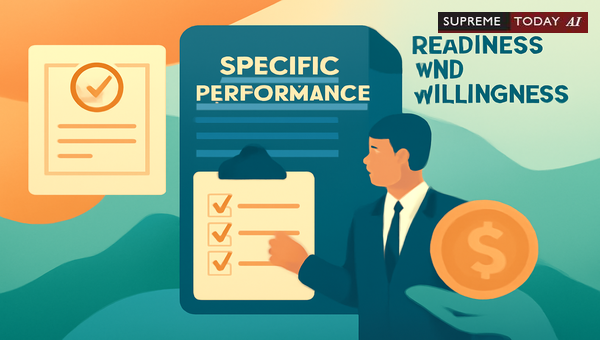
Proving & for
In the realm of contract law, securing can be a powerful remedy when monetary damages fall short. However, courts impose strict requirements on plaintiffs seeking this . A common question arises: How to Prove and in Suit for ? This blog post breaks down the legal principles, evidence needed, and real-world case insights to guide you through this critical aspect of litigation under Indian law.
is not granted lightly. As per , the plaintiff must plead and prove that they have performed their part of the contract or have always been ready and willing to do so. Failure here acts as a . Let's explore the nuances. 2010 0 Supreme(SC) 1118 2022 0 Supreme(SC) 565
Understanding vs.
Courts distinguish between and to ensure genuine entitlement. primarily concerns financial capacity—the ability to fulfill monetary obligations like paying the purchase price. , on the other hand, reflects the party's conduct and intention to perform. Both must be backed by evidence, not mere assertions. 2010 0 Supreme(SC) 1118 2022 0 Supreme(SC) 565
For instance, A party claiming has to show and establish that he had performed the contract and is ready and willing to perform the contract. This principle underscores that oral claims alone won't suffice. 2018 0 Supreme(Cal) 99 2017 0 Supreme(Cal) 623
Key Evidence Required
Mere pleadings are insufficient; documentary proof is essential. Here's what typically strengthens a claim:
- Financial Documents: Bank statements, loan sanctions, fixed deposit receipts, or proof of funds availability demonstrate . 2010 0 Supreme(SC) 1118 1995 0 Supreme(SC) 1312
- Correspondence and Notices: Legal notices demanding performance, emails, or letters approaching the defendant for execution show . 2022 0 Supreme(SC) 565
- Payment Records: Receipts for advances paid or partial payments indicate proactive conduct. 2000 6 Supreme 251
- Affidavits or Testimonies: Sworn statements from financiers or witnesses corroborating capacity.
The onus lies squarely on the plaintiff to prove and from contract inception to the hearing date. Lack of such evidence often leads to dismissal. 2010 0 Supreme(SC) 1118 2022 0 Supreme(SC) 565
Role of Conduct in Proving
Conduct speaks louder than words. Courts scrutinize actions before and after filing the suit:
- Approaching the vendor for sale deed execution.
- Efforts to arrange funds or clear encumbrances.
- Consistent demands for performance despite delays.
In one case, the plaintiff's failure to produce satisfactory evidence to prove his and —coupled with long unexplained delay—resulted in denial of . The court noted, the long unexplained delay and silence on the part of the plaintiff... would not entitle him to a decree. , and inaction signaled incapacity. 2025 0 Supreme(AP) 156
Conversely, positive conduct like timely advances or notices can tip the scales, even if direct financial proof is sparse—but judicial discretion applies. 2022 0 Supreme(SC) 565
Continuous Proof: From Inception to Hearing
Proof must span the entire relevant period. Courts examine:
- Behavior at contract signing.
- Actions during the performance window.
- Post-breach efforts up to trial.
Unexplained delays undermine claims. For example, a nine-month delay in filing suit raised doubts about commitment. Similarly, failure to pay balance by stipulated date led to refund of advance with interest, as the plaintiff's inaction and lack of and were fatal. 2025 0 Supreme(AP) 156 2018 0 Supreme(Cal) 99
Integrating Case Law Insights
Real cases illustrate pitfalls:
- Financial Breach as Bar: In a procurement dispute, the plaintiff's failure to pay suppliers despite receiving funds constituted breach, barring . Courts held agreements determinable and denied injunctions due to . 2018 0 Supreme(Cal) 99
- Genuineness Tied to : Where defendants were ex-parte but a third party contested, the plaintiff's inability to prove the sale agreement's validity—and thus —doomed the suit. Collusion suspicions further weakened the claim. 2020 0 Supreme(Mad) 31
- Documentary Gaps: Without bank proofs or conduct evidence, assertions of capacity fail. The need for documentary proof of financial capacity to establish is repeatedly emphasized. 1995 0 Supreme(SC) 1312 2000 6 Supreme 251
These examples highlight that courts demand concrete substantiation, not suppositions. 2025 0 Supreme(Gau) 430
Exceptions and Judicial Discretion
While strict, exceptions exist:
- Defendant's Fault: If the defendant prevents performance (e.g., via legal hurdles), courts may relax proof requirements. 2010 0 Supreme(SC) 1118
- Conduct Over Direct Evidence: Strong behavioral indicators sometimes compensate for missing financial docs, per discretion. 2022 0 Supreme(SC) 565
- Time Not Always Essence: In non-commercial immovable property sales, delays may be excused if explained—but silence invites adverse inference. 1998 0 Supreme(AP) 550
Practical Recommendations
To bolster your suit:
- Plead Specifically: Detail facts of capacity and conduct in the plaint.
- Gather Documents Early: Secure bank records, GPF statements, or financier letters.
- Document Conduct: Send notices, record interactions, pay advances promptly.
- Address Delays: Explain lapses to counter unwillingness inferences.
- Seek Expert Pleading: Engage counsel to frame issues robustly.
Note: This is general information based on precedents and not specific legal advice. Consult a qualified lawyer for your case.
Conclusion and Key Takeaways
Proving and is the cornerstone of claims. By presenting robust evidence of financial capacity and consistent conduct, plaintiffs can navigate Section 16(c)'s bar successfully. Key takeaways:
- Evidence Trumps Assertions: Always substantiate with documents. 2010 0 Supreme(SC) 1118
- Conduct Matters: Actions must align with intentions. 2022 0 Supreme(SC) 565
- Continuity is Crucial: Prove from start to suit. 2025 0 Supreme(Gau) 430
- Avoid Delays: Timeliness reinforces genuineness. 2025 0 Supreme(AP) 156
Stay proactive, document diligently, and let precedents guide you. For tailored strategies, professional legal consultation is essential.
References
- 2010 0 Supreme(SC) 1118: Core principles on , , and proof.
- 2022 0 Supreme(SC) 565: Emphasis on conduct and continuous evidence.
- 1995 0 Supreme(SC) 1312: Documentary proof for financial .
- 2000 6 Supreme 251: Evidence and conduct essentials.
- 2025 0 Supreme(AP) 156: Impact of delay and inaction.
- 2020 0 Supreme(Mad) 31: Proving agreement validity alongside .
- 2018 0 Supreme(Cal) 99 & 2017 0 Supreme(Cal) 623: Establishing performance and .
- 2025 0 Supreme(Gau) 430: .















