


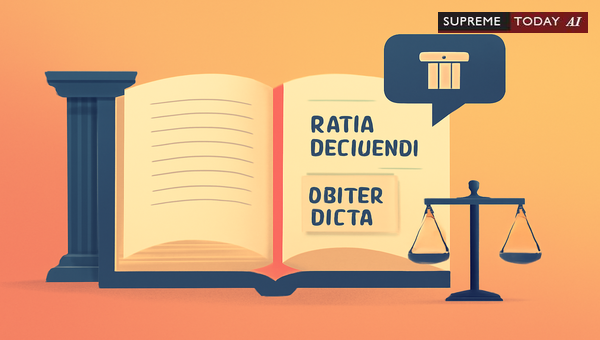
Explained: Binding Legal Precedent
In the intricate world of legal reasoning, few concepts are as foundational as . If you've ever wondered, What is ?, you're not alone. This Latin phrase, translating to the reason for deciding, lies at the heart of how courts establish binding precedents that shape future cases. Whether you're a law student, practicing attorney, or simply curious about the judiciary, understanding is crucial for navigating case law effectively.
This comprehensive guide breaks down its definition, characteristics, determination process, and real-world applications. We'll draw from established legal principles and judicial insights to provide clarity, while emphasizing that this is general information—not specific legal advice. Always consult a qualified professional for your circumstances. (Word count approx. 950)
What is ? Definition and Core Meaning
refers to the underlying principle or rule of law upon which a court's decision is based. It is distinct from the final order of the court, which may not necessarily follow the directly 2020 0 Supreme(Bom) 1466 2021 0 Supreme(Bom) 371. In essence, it's the legal reasoning that forms the binding core of a judgment.
For example, courts have long clarified: Even otherwise, what is , its principles and applicability, is now well settled. A word, a clause or a sentence occurring in a judgment divorced from its context, as containing a full exposition of the law on a question when the question did not even fall to be answered in the judgment cannot be said to be . 2020 0 Supreme(Pat) 123
This distinction ensures that only the essential legal rule binds future courts, promoting consistency without rigidity.
Key Characteristics of
The has distinct features that set it apart in judicial hierarchy:
- : It serves as a for future cases, meaning lower courts must follow it in similar circumstances 2015 0 Supreme(Ker) 1012 2001 0 Supreme(Cal) 246.
- Distinction from : Unlike —judges' non-essential remarks that lack binding authority—the ratio is authoritative 1998 0 Supreme(Cal) 263 2022 0 Supreme(Ker) 661. Courts reiterate: refers to the legal principle or rule that forms the basis of a court's decision. It is distinguished from , which are remarks or observations not essential to the judgment and therefore not binding 2023 0 Supreme(Bom) 1343.
This differentiation is vital, as obiter may persuade but never compels adherence.
How to Determine the : A Step-by-Step Process
Identifying the ratio isn't always straightforward. Typically, it involves two key steps:
- Identify All Facts: Consider all facts as perceived by the judge.
- Pinpoint Material Facts: Determine which facts the judge deemed material to the decision 2015 0 Supreme(Ker) 677.
In complex cases, the ratio may encompass multiple principles, particularly with multiple judgments or dissenting opinions 2021 0 Supreme(Bom) 890.
Judicial precedents underscore this: Of course, what is relevant is the . This principle binds under , making declarations authoritative for all courts, provided the ratio—not stray remarks—is applied 2019 0 Supreme(Kar) 2220 2018 0 Supreme(Ker) 51 2018 0 Supreme(Ker) 7 2013 0 Supreme(Ker) 550.
The Importance of in Legal Precedent and
is crucial for maintaining consistency in law. It provides a framework for adjudicating similar cases, forming the authoritative aspect cited in subsequent judgments 1994 0 Supreme(Cal) 361 2015 3 Supreme 369.
Under the doctrine of (stand by decided matters), it ensures predictability. For instance:
- ratios bind High Courts and subordinates, except in rare oversights where larger bench decisions are unnoticed 2019 0 Supreme(Kar) 2220.
- In promotion quota cases, courts apply ratios flexibly: Courts have emphasized that ratios are often fixed to serve the larger interests of public service rather than ensuring perfect mathematical proportionality. Unless the ratio is so unreasonable as to amount to discrimination, it cannot be easily challenged or struck down 2025 0 Supreme(Ker) 430.
Examples abound:- Pre-2010, a 3:1 ratio for direct recruits vs. promotees in Water Resources was amended to 1:1, upheld as statutory 2023 0 Supreme(Ker) 956.- Vineeta Sharma's ratio on daughters' rights applies prospectively in some contexts, not retrospectively before 2023 0 Supreme(Kar) 790 2023 0 Supreme(Kar) 489.
These illustrate how ratios adapt across administrative law, family disputes, and more.
Real-World Applications: From Promotions to Constitutional Matters
extends beyond pure precedent into practical domains:
- Statutory Ratios: Rules specifying 1:1 or 25:75 for appointments are upheld unless unreasonable 2024 0 Supreme(Ker) 607.
- Retrospective Changes: Amendments override prior ratios; e.g., new provisions supersede old judicial ratios 2024 0 Supreme(Ori) 13.
- Case-Specific Contexts: In religious or constitutional cases, courts reference prior ratios: On this aspect, the propositions of law has already been clarified in the ratio of the following decisions... 2025 0 Supreme(Ori) 107 2023 0 Supreme(Mad) 1694.
The Prem Nath Kapur ratio on appropriation, approved by a Constitution Bench, exemplifies enduring authority 2024 0 Supreme(Ker) 339.
Limitations persist: Non-core observations remain dicta 2023 0 Supreme(Bom) 1343.
Conclusion: Mastering for Legal Success
is the bedrock of judicial consistency, binding future decisions while distinguishing from persuasive dicta. By focusing on material facts and judicial reasoning, practitioners can leverage it effectively.
Key Takeaways
- : Binding reason for a decision 2020 0 Supreme(Bom) 1466.
- Distinct from 1998 0 Supreme(Cal) 263.
- Determined via facts and reasoning 2015 0 Supreme(Ker) 677.
- Essential for under Art. 141 2019 0 Supreme(Kar) 2220.
Recommendations
When analyzing case law, prioritize the ratio to strengthen arguments. This enhances credibility in briefs, appeals, or consultations.
Disclaimer: This post offers general insights based on precedents. Legal outcomes vary; seek tailored advice from a licensed attorney.
References: Incorporated inline from sources including 2020 0 Supreme(Bom) 1466, 2021 0 Supreme(Bom) 371, 2015 0 Supreme(Ker) 1012, 2001 0 Supreme(Cal) 246, 2015 0 Supreme(Ker) 677, 1998 0 Supreme(Cal) 263, 2021 0 Supreme(Bom) 890, 1994 0 Supreme(Cal) 361, 2015 3 Supreme 369, 2020 0 Supreme(Pat) 123, 2025 0 Supreme(Ker) 430, 2023 0 Supreme(Ker) 956, 2024 0 Supreme(Ker) 607, 2023 0 Supreme(Kar) 790, 2024 0 Supreme(Ker) 339, 2024 0 Supreme(Ori) 13, 2023 0 Supreme(Kar) 489, 2023 0 Supreme(Bom) 1343, 2023 0 Supreme(Mad) 1694, 2025 0 Supreme(Ori) 107, 2019 0 Supreme(Kar) 2220, 2018 0 Supreme(Ker) 51, 2018 0 Supreme(Ker) 7, 2013 0 Supreme(Ker) 550.
#RatioDecidendi, #LegalPrecedent, #StareDecisis












