


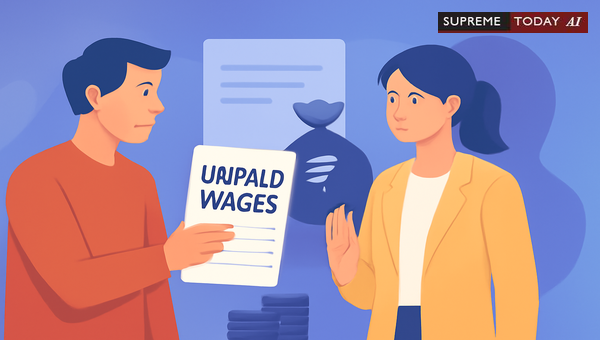
Claiming Unpaid Wages: Top Legal Remedies in India
Imagine working diligently for months, only to find your hard-earned wages withheld by your employer. This frustrating scenario leaves many employees wondering: What is the appropriate remedy for an employee to claim unpaid wages? In India, labor laws provide structured pathways to recover dues, but navigating them requires understanding the right statutes and procedures. This post breaks down the key legal frameworks, remedies, and practical tips to help employees assert their rights effectively.
Important Disclaimer: This article offers general information based on legal precedents and is not a substitute for professional legal advice. Consult a qualified lawyer for advice tailored to your situation.
Understanding the Legal Framework for Unpaid Wages
India's labor laws distinguish between different types of wage disputes, directing employees to specific remedies. The primary statutes include the , , and . Each serves distinct purposes, and choosing the correct one is crucial.
: Not the Primary Remedy
The Minimum Wages Act focuses on fixing minimum wage rates rather than resolving individual disputes. The remedy for an employee claiming unpaid wages is not through a complaint under the Minimum Wages Act but rather through the Industrial Disputes Act or other relevant authorities. The Minimum Wages Act primarily allows for the fixing of wage rates, not adjudicating on wage disputes 2022 0 Supreme(Ker) 101.
Attempting a claim here may lead to dismissal for lack of , pushing employees toward more suitable forums.
: Ideal for Straightforward Claims
For direct unpaid wages, is a go-to remedy. Employees can file an application before the prescribed authority, which may direct payment and treat non-compliance as a fine recoverable from a . Employees can file an application under for recovery of unpaid wages. The authority under this Act can direct the employer to pay the due wages, and the amount can be recovered as if it were a fine imposed by a 2015 0 Supreme(J&K) 637 1982 0 Supreme(J&K) 27.
However, is limited. In one case involving an unaided educational institution, the lacked authority under this Act for certain claims, emphasizing exclusions for managerial or high-wage supervisory roles 2021 0 Supreme(Ker) 549. has no to deal with a case under the Payment of Wages Act - does not have the to hear and decide the claims in terms of 2021 0 Supreme(Ker) 549.
: For Complex Disputes
When claims involve settlements, awards, or disputed amounts, shines. Under (1), recover money due from an employer under a settlement or award via the . For disputed sums, (2) allows computation by the court. Employees can approach the under for recovery of unpaid wages. This section allows for the recovery of money due to a workman from an employer under a settlement or award 2017 0 Supreme(Mad) 4249. If the amount due is disputed, the employee may need to file a claim under (2), which allows for the computation of the amount due by the 2000 7 Supreme 545.
Claims must satisfy jurisdictional parameters, such as . If these jurisdictional parameters are satisfied, then a workman will be entitled to make claims for wages under Section 33-C(2) before the concerned, in respect of any statutory claim of wages or for any claims of wages regulated by the terms and conditions of the contract for personal service 2021 0 Supreme(Ker) 549.
Key Considerations in and Procedure
Overlaps: Labour Courts handle claims under both the Payment of Wages Act and Industrial Disputes Act, but selection depends on case specifics like settlements 2022 0 Supreme(Mad) 1829 1982 0 Supreme(J&K) 27.
Evidence Requirements: Prove employment and lack of alternative income during the claim period. Employees must demonstrate that they were not gainfully employed during the period for which they claim , as this will affect their entitlement 2016 0 Supreme(Bom) 120.
Timeliness: Statutory limits apply; file promptly 2017 0 Supreme(Mad) 4249.
Principle: Delinquent employees cannot claim as a right, especially post-misconduct findings 1998 0 Supreme(MP) 923. No delinquent employee could claim as of right in disregard of the principle of 'No work No wages' as it would amount to rewarding him for an otherwise proved misconduct in many cases 1998 0 Supreme(MP) 923.
Tribunals' scope is limited; they cannot adjust past dues beyond specified periods under sections like 33(2)(b) 2015 0 Supreme(Bom) 722. If the employee has any claim against the employer, either towards past wages and any other dues that do not form part of the wages, he needs to file appropriate proceedings to recover the same 2015 0 Supreme(Bom) 722.
Insights from Related Cases and International Perspectives
Non-payment can constitute a fundamental breach, potentially leading to claims. In a Malaysian case under the , delayed salaries justified such a claim, awarding unpaid and totaling RM122,933
. The court established that a failure to pay salary constitutes a , allowing for claims when the employer fails to fulfill contractual obligations.
In the US, state laws may be preempted by for minimum wage/overtime, avoiding dual claims 2021 Supreme(US)(ca5) 79. These highlight global principles of prompt wage payment.
Indian courts reinforce that contracts of personal service are not specifically enforceable; remedies lie in damages or statutory claims, not reinstatement alone 1973 0 Supreme(AP) 90.
Mediation, Settlements, and Exclusions
Mediation Option: Settle via mediation; accepted settlements may bar further claims 2021 0 Supreme(Del) 859.
Exclusion: Employer-employee disputes aren't consumer issues 2010 0 Supreme(Pat) 1025.
Practical Recommendations for Employees
Assess Your Claim: Use Payment of Wages Act for simple delays; Industrial Disputes Act for disputes tied to awards.
Gather Evidence: Contracts, payslips, communication proving dues and unemployment.
File Timely: Adhere to limitation periods.
Seek Professional Help: Labour lawyers can navigate forums.
Conclusion and Key Takeaways
Claiming unpaid wages typically involves the Payment of Wages Act or Industrial Disputes Act, with Labour Courts as key forums. Success hinges on , evidence, and timeliness. While laws protect workmen, principles like temper entitlements.
Key Takeaways:- Prioritize statutory remedies over others.- Prove non-employment for .- Avoid Consumer Forums.
Stay informed, act swiftly, and protect your rights. For personalized guidance, reach out to a labor law expert.
(Word count: approx. 1050)
#UnpaidWages, #LabourLawIndia, #EmployeeRights















