


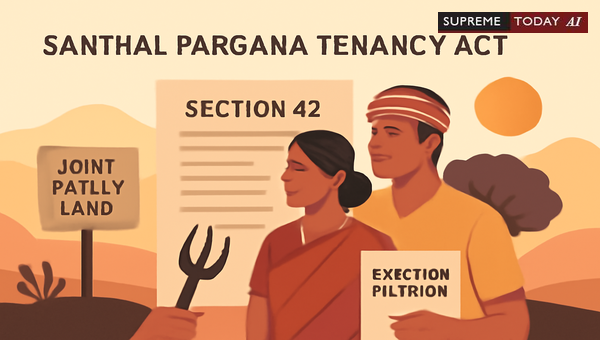
Can a Family Member File a Petition Under Against Another Relative?
In rural and tribal areas of Jharkhand, land disputes within families can be particularly contentious, especially when it comes to jointly owned family property. A common question arises: whether under Sec 42 of whether a member of a family can file petition under said Sec 42 against another member from same family when lands are belonging to family jointly. This issue touches on , , and the unique protections under the (). While the Act safeguards , family dynamics add layers of complexity. This post breaks down the legal framework, judicial views, and practical considerations—note: this is general information, not legal advice; consult a qualified lawyer for your specific case.
Understanding the and Section 42
The , enacted in , regulates land tenures in the Santhal Pargana region to protect indigenous tribes like the Santhals from exploitation. It emphasizes of tenancy lands and outlines strict procedures for eviction and possession.
Section 42 specifically addresses eviction and restoration of possession. Key aspects include:- : Lands under tenancy cannot be alienated without legal procedures.- Eviction grounds: Requires proof of prior possession and compliance with formalities. 2017 0 Supreme(Jhk) 1815
The Act recognizes but prioritizes documentary evidence for claims. Mere family ties or oral assertions often fall short in court.
Ownership: Recognition and Challenges
Joint ownership in tribal contexts often stems from inheritance, customary practices, or collective possession. The doesn't explicitly define , but courts interpret it through possession and records.
- Family rights: Members may inherit , but partition or transfer needs documentation like . 2017 0 Supreme(Jhk) 1815
- : Rights may pass to survivors, subject to tenancy terms and inheritance laws.
Related tenancy laws, like the , highlight restrictions. For instance, surrenders and settlements that circumvent transfer bans are void: A surrender and settlement which constitute one transaction and are adopted as a device to circumvent are void. 1967 0 Supreme(Pat) 61
In ceiling limit cases, joint family holdings are assessed collectively: whether petitioner Tunda could be said to hold land more than 15 acres in area, only because he was a member of a joint family (consisting of his father and his two brothers) which holds in all 251/2 acres of land. 1991 Supreme(Online)(MP) 1
Can a Family Member Invoke Section 42 Against Another?
Generally, yes, a family member may file under Section 42 if they can prove dispossession from joint land. However, success hinges on:
1. Proof of Possession
Possession is paramount. Claimants must show continuous, lawful possession via documents (e.g., title deeds, rent receipts). 2017 0 Supreme(Jhk) 1815 Courts dismiss undocumented claims: mere possession without documentation is insufficient to sustain rights under the Act.
In restoration petitions: The private respondents filed a petition under for restoration of aforesaid lands. 2023 0 Supreme(Jhk) 259
2. Joint Ownership Implications
Joint land doesn't bar intra-family petitions, but all members' rights are considered. A petitioner must demonstrate their specific share or prior possession. Family unit definitions in similar laws (e.g., ceiling acts) treat families as units: fixes ceiling area of land for one family consisting of not more than 5 members. 1981 0 Supreme(Pat) 171
3. Eviction and Procedural Safeguards
Eviction requires strict proof. In family disputes, courts scrutinize motives, ensuring no circumvention of transfer rules. rights can't be settled via writs alone: Land right title and interest over the of the Basauri raiyat cannot be determined under . 2003 0 Supreme(Jhk) 855
Judicial Interpretations and Key Case Insights
Courts stress documentation in Section 42 matters. The primary case underscores: The necessity of substantiating possession claims with relevant documents... The of land rights without proper legal procedures. 2017 0 Supreme(Jhk) 1815
Supporting precedents:- Joint family nucleus: Burden lies on claimants to prove joint property via ; presumptions don't apply without evidence. 2013 0 Supreme(Bom) 2519- Partition validity: Deemed partitions in ceiling laws must comply; family units include spouses and minors. 2013 0 Supreme(Bom) 1349- Tantric rights analogy: Family-held rights (e.g., ) are family-specific, not easily alienated. 2014 0 Supreme(Ker) 342
In Santhal-specific writs: References to Section 42 confirm its role in possession restoration, but not quashing without merit.
These rulings collectively affirm: Family membership alone doesn't preclude petitions, but evidence is king.
Practical Implications for Families
Facing a dispute?- Document everything: Secure inheritance certificates, partition deeds, or occupancy records.- Avoid sham transactions: Collusive deals risk invalidation, as in Chota Nagpur cases. 1967 0 Supreme(Pat) 61- Seek partition first: Before eviction suits, formalize shares.- Additional hands in agriculture: Even joint ownership may justify claims for operational needs. 2010 0 Supreme(P&H) 3366
Failure to prove claims leads to dismissal, impacting all family rights.
Key Takeaways and Recommendations
- Joint land petitions under Section 42 are possible between family members, but demand robust proof of possession. 2017 0 Supreme(Jhk) 1815
- Documentation trumps relations: Courts prioritize records over family bonds.
- protects all: Ensures tribal land stays within communities.
- Consult experts: Engage lawyers familiar with Jharkhand tenancy laws early.
In summary, while family harmony is ideal, the empowers legitimate claims under Section 42—provided they're backed by evidence. For tailored advice, reach out to a local legal professional. Stay informed, document diligently, and resolve disputes lawfully.
Disclaimer: This article provides general insights based on statutes and judgments; laws evolve, and outcomes vary by facts. Not a substitute for professional legal counsel.
#SanthalParganaTenancy, #LandLawIndia, #FamilyLandRights












