


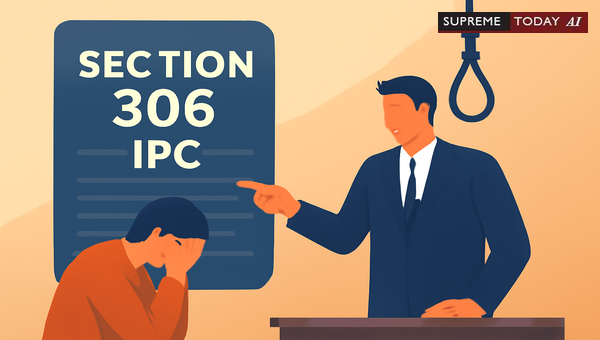
: Does It Apply While Discharging Official Duties?
In the realm of Indian criminal law, public servants often face scrutiny when their official actions are linked to tragic outcomes like suicide. A common question arises: Does Section 306 of the IPC attract liability while discharging official duty? This query frequently surfaces in cases where routine administrative or enforcement actions are alleged to have driven someone to suicide. Understanding this is crucial for legal professionals, public officials, and citizens alike.
This blog post delves into the legal nuances, drawing from established precedents and principles. We'll explore why mere official acts typically do not invoke without proof of . Note: This is general information and not specific legal advice. Consult a qualified lawyer for your situation.
What is ?
deals with the . It punishes anyone who abets the commission of suicide, with imprisonment up to 10 years and a fine. The core ingredients include:
- : Active encouragement or incitement to commit suicide.
- : Agreement to aid or facilitate the act.
- : Deliberate assistance in the suicide.
pertains to , requiring proof of , , or in the act of suicide. Merely having a relationship between official acts and the alleged abetment is insufficient without clear evidence of or overt acts.
2007 0 Supreme(Del) 704
Courts emphasize that a alone between an action and suicide is not enough. There must be direct evidence of provocation or encouragement. This distinction is vital when official duties are involved.
Official Duties and : The
Public servants perform a wide array of duties—from inspections and enforcement to decision-making—that can sometimes lead to distress for others. However, acts performed in the discharge of official duties generally do not attract unless accompanied by evidence of deliberate .
Key Legal Tests
Routine vs. Malicious Acts: Everyday official functions, even if harsh or unpopular, do not qualify as abetment. Routine official acts, even if connected to the person's role, are not automatically considered abetment.
Proof of Required: The key element is . An act under must involve active encouragement or incitement to commit suicide, not just a causal relationship or a routine official act.
No Automatic Liability: The legal position emphasizes that a mere relationship between the official act and the alleged act of suicide does not suffice; there must be clear proof of or active involvement in encouraging the act of suicide.
2007 0 Supreme(Del) 704
In essence, discharging official duties provides a shield unless malice or overt provocation is proven. This protects public administration from frivolous litigation.
Relevant Case Laws and Judicial Insights
Indian courts have consistently upheld this view through landmark rulings. Let's examine pivotal cases:
Core Precedents on Official Acts
Courts have clarified: Official acts performed in discharge of duty, without evidence of , do not attract . For instance, if an official act is unconnected with the intent to instigate suicide, the section cannot be invoked.
2007 0 Supreme(Del) 704
Additionally, under , complaints must be filed before a Magistrate with direct linkage to , not just official capacity. 2023 4 Supreme 650
Quashing FIRs Lacking
In cases where allegations are vague, courts quash proceedings. Quashing of FIR under is permissible when allegations do not substantiate a , particularly if parties reach a compromise aiming to restore peace. 2023 0 Supreme(P&H) 2644
One ruling noted: The noted precedents that quashing for heinous crimes is generally not permissible when considering public interest. However, the specific facts of this case did not substantiate the charge under due to vague allegations lacking concrete attribution. 2023 0 Supreme(P&H) 2644
This underscores that without specific evidence tying official acts to , charges fail.
Contrasting Contexts: When Section 306 Applies
While official duties often escape liability, personal conduct may not. For example, in domestic cruelty cases, This feels that the conduct of appellant was such, which had forced his wife, the deceased, to commit suicide. Cruelty, as defined under does not amount to only but it also attracts . 2004 0 Supreme(P&H) 1047
Here, the convicted under as essential ingredients for () were absent, but abetment via cruelty was established. This highlights the need for case-specific analysis—official vs. personal malice.
Related Offenses and Discharge Petitions
Public servants may face related charges like obstruction under , but these require distinct proofs. In one case, The determination of whether the essential ingredients of the offenses under are made out can only be decided after a full-fledged trial. 2023 0 Supreme(Telangana) 678
Similarly, for (), sanction under is needed if acts relate to official duties. 2018 0 Supreme(Raj) 1280
These illustrate broader protections for officials, paralleling Section 306 principles.
Defenses and Practical Recommendations
If facing a Section 306 charge as a public servant:
- Highlight Lack of : Emphasize no active encouragement; focus on routine duties.
- Seek Discharge or Quashing: Argue no , as in compromise scenarios. 2023 0 Supreme(P&H) 2644
- Demand Sanction if Applicable: For official acts, invoke protections.
- Gather Evidence: Prove actions were standard protocol without malice.
When defending a client, emphasize the lack of proof of and the routine nature of the official act. If the act was part of official duty without any intent to provoke suicide, is unlikely to apply.
Conclusion and Key Takeaways
Key Takeaway: Discharging official duties alone does not invoke unless accompanied by evidence of or active encouragement to commit suicide.
Public servants can perform their roles confidently, knowing courts protect bona fide actions. However, crossing into deliberate provocation invites liability. Always ensure complaints or FIRs establish clearly for charges to sustain.
For those navigating such cases, professional legal counsel is essential. Stay informed, act ethically, and remember: justice balances duty with accountability.
This post is for informational purposes only and does not constitute legal advice.
#Section306IPC, #AbetmentSuicide, #OfficialDuty















