




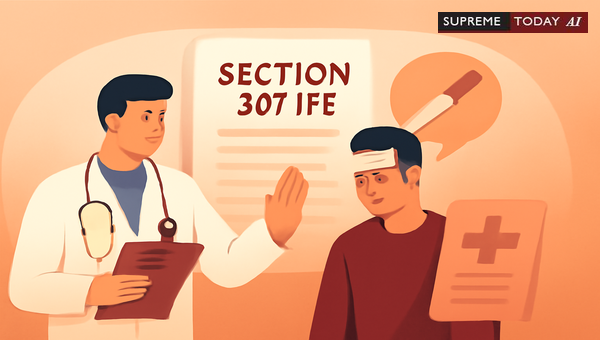
307 IPC: What If the Doctor Says No Injury Was ?
Facing charges under —attempt to murder—can be daunting. But what happens if, during the trial, the doctor testifies that there was no injury ? This scenario raises critical questions for the accused: If during trial doctor says that there was no injury , what can accused do in a case of 307 IPC?
This blog post breaks down the legal implications, drawing from established case law, medical evidence standards, and strategic defense options. Note: This is general information based on legal precedents and not specific legal advice. Consult a qualified lawyer for your case.
Understanding : The Basics
deals with . To secure a conviction, the prosecution must prove three key elements:1. The accused performed an act.2. The act was done with the that it was likely to cause death or sufficient to cause death in the ordinary course of nature.3. The act showed a disregard for human life.
The nature of the injury is important, but it's not the sole determinant. Courts emphasize intention over the actual outcome of the injury. As held in legal precedents, The essence of an offence under is not solely based on the nature of the injury but rather on the of the accused regarding the potential for death 2006 0 Supreme(P&H) 3519 2009 0 Supreme(Chh) 323.
Even simple or minor injuries won't automatically rule out Section 307 if intent to kill is proven: The circumstances that the injury inflicted by the accused was simple or minor will not by itself rule out application of . The determinative question is ... and not nature of the injury 2025 0 Supreme(Raj) 2134.
Impact of Medical Testimony: Doctor's Opinion on ''
Medical evidence is pivotal in Section 307 cases. When a doctor opines that an injury is not , it can significantly undermine the prosecution's case. Courts have dismissed Section 307 charges in such instances, even with grievous injuries.
Defining ''
An injury is deemed '' if it could cause death without prompt treatment, based on its nature, location, and weapon used. An injury which can put life in immediate danger of death would be an injury which can be termed as '' and therefore, when a doctor describes an injury as '', he means an injury which endangers life in terms of this clause 2017 0 Supreme(All) 1289.
Conversely, if the doctor states otherwise: There is no opinion of doctor that any injury was dangerous for life. If no injury had been indicated as , it cannot be inferred that there was a situation to cause death 2020 0 Supreme(Jhk) 719. This directly weakens claims of life-threatening intent.
In one case, despite an injury on the neck, it wasn't sufficient: Although, the injury was found on the neck but that fact is not sufficient to establish... that the injury is ... it cannot be said that the injury inflicted to the injured was life-threatening
.
Intention vs. Injury Nature
Courts look beyond medical reports to factors like:- Weapon used and manner of assault.- Vital body parts targeted.- Circumstantial evidence.
The court also considers other factors such as the nature of the weapon used, the manner of its use, and the context of the incident. Even if the injury is not , if the act was committed with the intention to kill, the charge may still stand 2009 0 Supreme(Chh) 324 1989 0 Supreme(P&H) 489.
However, lack of a '' opinion often tips the scale: In , the stressed that the nature of the injury, whether it is inflicted on vital parts of the body, and the medical report are guiding factors 2020 0 Supreme(MP) 191.
Another precedent notes: During examination, the doctor did not opined that injury was serious or or grievous in nature 2014 0 Supreme(All) 216, leading to challenges in sustaining higher charges.
Strategic Options for the Accused
If the doctor's testimony favors you, leverage it aggressively. Here's a step-by-step defense approach:
Challenge the Prosecution's Case on Injury Severity: Highlight the medical opinion directly. Argue the injuries don't meet the '' threshold, pushing for lesser charges like or .
Dispute Intent to Kill: Emphasize lack of evidence for murderous intent. The defense should also argue that the prosecution has not sufficiently established the intent to kill, which is a necessary component for a conviction under .
Present Counter-Evidence: Call independent experts or cross-examine the doctor thoroughly. In one case, Doctor denied that injury no.1 was not in ordinary course 2013 0 Supreme(Bom) 1241, bolstering the defense.
Use Case Law: Reference precedents where non-life-threatening injuries led to acquittals or downgrades, such as when the court dismissed charges under because the injuries were not deemed 1996 0 Supreme(P&H) 524 2020 0 Supreme(MP) 191.
Highlight Contextual Factors: No eye-witnesses, unrecovered weapons, or inconsistent prosecution stories can further weaken the case: none of the witnesses has supported the case of the prosecution and no one is the eye witness... nor the iron rod which has been used as weapon... has been recovered 2018 0 Supreme(Jhk) 2674.
Medical authorities clarify: Injuries must be assessed holistically—location, severity, weapon—but without a '' tag, prosecution under 307 falters 2025 Supreme(Online)(HP) 4714 2025 Supreme(Online)(HP) 5846 2024 0 Supreme(HP) 330 2025 0 Supreme(Guj) 1610 2024 0 Supreme(Jhk) 584 2023 0 Supreme(P&H) 3006 2024 0 Supreme(Raj) 211 2025 Supreme(Online)(Ker) 45879.
Relevant Case Law Insights
- : Injury nature and medical reports guide Section 307 applicability 2020 0 Supreme(MP) 191.
- Grievous vs. dangerous distinction: The distinction between grievous and dangerous injuries is critical. An injury classified as grievous may not necessarily imply an unless it is also deemed 2011 0 Supreme(Pat) 603 2013 0 Supreme(P&H) 779.
- Even with dangerous weapons, no life-danger opinion shifts burden: Supports defenses arguing lesser intent 2025 0 Supreme(Raj) 2134.
Key Takeaways and Conclusion
In a trial, a doctor's testimony that no injury was is a powerful tool for the accused. It challenges the prosecution's narrative on both injury severity and intent, often leading to acquittals or reduced charges.
Key Takeaways:- Medical opinion is crucial but must align with intent proof.- Defense strategies: Challenge testimony, dispute intent, present alternatives.- Holistic court view: Weapon, manner, circumstances matter, but lack of life-threat often prevails.
While intention remains king, favorable medical evidence can derail Section 307 charges. Always seek professional legal counsel tailored to your facts. Stay informed, act strategically, and protect your rights.
#IPC307, #Section307IPC, #LegalDefenseIndia












