Searching Case Laws & Precedent on Legal Query.....!
Analysing the retrieved Case Laws
Scanned Judgements…!



Searching Case Laws & Precedent on Legal Query.....!
Analysing the retrieved Case Laws
Scanned Judgements…!
E. K. Nayanar VS M. A Kuttappan - Crimes
"], ["SAJI Vs STATE OF KERALA - Kerala"].E. K. Nayanar VS M. A Kuttappan - Crimes
"], ["SAJI Vs STATE OF KERALA - Kerala"].The Act also restricts anticipatory bail in cases involving offences under Sections 17 and 18, which relate to serious offences of atrocities and require material evidence of involvement ["1991 0 Supreme(MP) 139"], ["
Ramdayal VS State of Madhay Pradesh - Crimes
"], ["1991 0 Supreme(MP) 136"].Analysis and Conclusion:
E. K. Nayanar VS M. A Kuttappan - Crimes
"], ["SAJI Vs STATE OF KERALA - Kerala"].E. K. Nayanar VS M. A Kuttappan - Crimes
"], ["SAJI Vs STATE OF KERALA - Kerala"].Ramdayal VS State of Madhay Pradesh - Crimes
"], ["1991 0 Supreme(MP) 136"].References:- ["
E. K. Nayanar VS M. A Kuttappan - Crimes
"]- ["SAJI Vs STATE OF KERALA - Kerala"]- ["2024 Supreme(Online)(KAR) 20862"]- ["2024 Supreme(Online)(Kar) 36412"]- ["2016 0 Supreme(Raj) 1249"]- ["SAJI Vs STATE OF KERALA - Kerala"]- ["SAJI Vs STATE OF KERALA - Kerala"]- ["1991 0 Supreme(MP) 139"]- ["Ramdayal VS State of Madhay Pradesh - Crimes
"]- ["1991 0 Supreme(MP) 136"]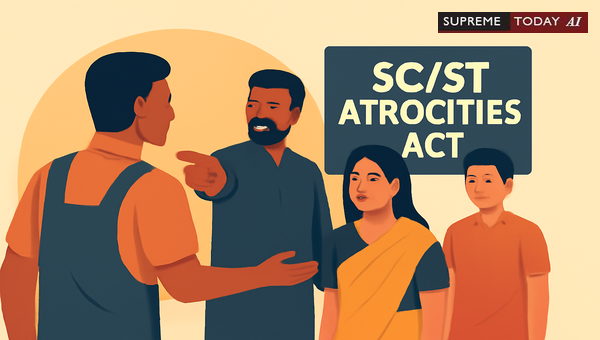
In today's litigious society, civil disputes often lead parties to seek amicable settlements. But what if one party belongs to a Scheduled Caste (SC) or Scheduled Tribe (ST)? A common concern arises: Does approaching a person from the SC/ST community to settle a case constitute an offence under the ()?
This question frequently surfaces in property, tenancy, or contractual disagreements. Misunderstandings can escalate, with accusations of caste-based atrocities. This blog post breaks down the legal position based on judicial precedents, clarifying when such an approach is permissible and when it crosses the line.
Approaching a person belonging to the SC/ST caste and asking them to settle a case does not, in itself, attract an offence under the , unless accompanied by intent to insult, humiliate, threaten, or commit an atrocity motivated by caste. The Act targets caste-based discrimination, not routine interactions. 2017 0 Supreme(SC) 850
Courts consistently hold that the key element is —the guilty mind or specific intent related to caste. Mere conciliatory efforts in civil matters fall outside the Act's ambit. 2023 0 Supreme(Ker) 469 2024 0 Supreme(Pat) 1037
These principles prevent misuse of the Act in everyday conflicts.
Enacted to safeguard SC/ST communities from atrocities, the Act punishes acts like intentional insult or humiliation due to caste. The and emphasize: offences under the require or motive, and mere approach to settle disputes does not attract the offence. 2017 0 Supreme(SC) 850
Without this intent, no violation occurs. For instance, insulting or intimidating acts must be targeted at the victim because of their caste, with intent to humiliate. 2023 0 Supreme(Ker) 469
If the interaction involves:- Casteist slurs, threats, or abuses.- Public humiliation intended to outrage modesty.- Awareness of caste status used to intimidate.
Then, it may trigger , 3(1)(s), or others. Conversely, a polite request to settle, even mentioning caste neutrally, is fine. The Court notes: mere calling or approaching without such intent does not constitute an offence. 2024 0 Supreme(Pat) 1037
In one case, mere membership in SC/ST without humiliation intent was deemed insufficient: For an offence under the , there must be intent to humiliate based on caste identity; mere membership in a Scheduled Caste is insufficient. 2025 0 Supreme(All) 34
Many cases involve civil rows mislabeled as atrocities. Courts quash such FIRs if no caste link exists. Civil disputes converted into criminal cases without caste-based motive do not qualify under the Act. 2017 0 Supreme(SC) 852
For example, in a property tussle, approaching for settlement sans threats isn't punishable. Proceedings fail without evidence of . 2023 0 Supreme(Ker) 469 2023 0 Supreme(All) 1979
Supporting this, another ruling states: The mere fact that the victim happened to be a girl belonging to a Scheduled Caste does not attract the provisions of the Act. 2015 0 Supreme(Raj) 1399
Humiliation must occur in . Private chambers or homes don't count: something happened in the chambers of the first informant does not attract the offence alleged... under Sec.3(1)(s). 2019 Supreme(Online)(KER) 18757
Further: Unless such abuse or humiliation or insult or threat made in the , offence under of SC/ST (PA) Act, cannot be inferred. 2018 0 Supreme(Mad) 3336
Independent witnesses are vital; unsupported claims lead to acquittal. 2019 0 Supreme(Kar) 301
In bail matters, missing averments like non-SC/ST status of accused bar Act application. 2019 0 Supreme(Guj) 86
In summary, approaching an SC/ST person to settle a case is generally not an offence under the absent to insult or humiliate. This protects genuine dispute resolutions while upholding the Act's purpose.
Key Takeaways:- Intent and public humiliation are .- Civil approaches without malice are safe.- Evidence of caste motive is mandatory.
Disclaimer: This post provides general information based on precedents and is not legal advice. Laws evolve, and outcomes depend on facts. Consult a qualified lawyer for your situation.
References:1. 2017 0 Supreme(SC) 850: Intent required for offences.2. 2023 0 Supreme(Ker) 469: Targeted humiliation due to caste.3. 2024 0 Supreme(Pat) 1037: with casteist intent.4. 2017 0 Supreme(SC) 852, 2023 0 Supreme(All) 1979: Civil disputes excluded.5. Additional cases like 2025 0 Supreme(All) 34, 2015 0 Supreme(Raj) 1399, 2018 0 Supreme(Mad) 3336.
#SCSTAct, #AtrocitiesAct, #LegalInsights



Autrocity is defined in section 2(a) of the Act as an offence punishable under section 3 of the said Act. Subsection (1) to sub-section (xv) of section 3 catalogues the attrocities and penalty is provided there under for such attrocities. ... I will now take up the contention of the petitioner that to attract subsection (x) of section 3 of Act 33/1989 the person insulted must be present at the time when the words were uttered or otherwise no #HL_STAR....

Attrocities) Act.” ... , is not sufficient to attract an offence punishable under section 3(1)(X) of the Scheduled Scheduled Tribes (Prevention of Attrocities) Act (Prevention of Attrocities) Act, it is not possible, according to him, when it is attack by (Prevention of Attrocities) Act will not be span style="font-family

4 No.41/17 in respect of the same offence

To attract the provisions of Section 3(2)(v) of the Act, the sine qua non is that the victim should be a person who belongs to a Scheduled Caste or a Scheduled Tribe and that the offence under the Indian Penal Code is committed against him on the basis that such a person belongs to a Scheduled Caste ... The mere fact that the victim happened to be a girl belonging to a Scheduled Caste does not attract the provisions of the #HL_START....

(Prevention of Attrocities) Act and it is submitted that he does not press this application as regards to the cognizance taken for the offence under Sections 447. 323, 324/34, IPC and his grievance is only in respect of the Section 3/4 of the SC and ST (Prevention of Attrocities) Act on the ground that ... The petitioners are admittedly belonged to the Scheduled Caste community as it is evident from the caste certificate as well as the statements made on oath by the p....

/Scheduled Tribe (Prevention of Attrocities) Act. ... Initially investigation was conducted and final report was filed and in that final report, no allegation was raised of the petitioners having committed the offence punishable under Section 3(1)(x) of the Scheduled Caste/Scheduled Tribe (Prevention of Attrocities) Act. ... Later, further report was filed incorporating the allegation under Section 3(1)(x) of the Scheduled Caste/Scheduled Tribe (Prevention of #HL_STAR....

offence committed and punishable under Section 3 (i) (xii) of the Schedule Caste and Schedule Tribe (Prevention of Attrocities Act), 1989. ... 376 of the Indian Penal Code and Section 3 (i) (xii) of the Schedule Caste and Schedule Tribe Prevention of Attrocities Act, 1989. ... Learned counsel for the appellant has drawn the attention of this Court towards Section 3 (i) (xii) of the Schedule Caste and Schedule Tribe (Prevention of Attrocitie....
and Schedule Tribe (Prevention of Attrocities) Act, 1989. ... committed and punishable under Section 3 (i) (xii) of the Schedule Caste and Schedule Tribe (Prevention of Attrocities Act), that there is no material on record to constitute an offence under ... under Section 376 of the Indian Penal Code or Section 3 (i) (xii) of the Schedule Caste and Schedule Tribe (Prevention of Attrocities) Act, (Prevention of Attroci....

-A covers a case where a person by "words, either spoken or written, or by signs or by visible representations" promotes or attempts to promote such feeling. ... This appeal has been preferred by the said convicted person under Section 19 of the TADA. ... 2. The case against the appellant in short is the following. ... What remains is the offence under Section 25(1B) of the Indian Arms Act, PW-1 was the Superintendent of Police of Hyderabad City Zone (CID) during the relevant time. .......
PoA Act inasmuch as the alleged offence did not taken place in public view. ... The learned counsel for the petitioner submits that something happened in the chambers of the first informant does not attract the offence alleged against the petitioner under the SC/ST ... An FIR has been registered against him alleging commission of offences punishable under Sec.341 of IPC and under Sec.3(1)(s) of the Scheduled Casts and Scheduled Tribes (Prevention of Attrocities) Act ... ....

1. Heard learned counsel for the applicant, learned counsel for the opposite party No. 2 and learned A.G.A. 2. Learned counsel for the opposite party No. 2 has refused to file counter affidavit to the instant application under Section 482 Cr.P.C . and given his consent to decide the same on merits. Likewise learned A.G.A. has no objection to decide the instant application on merits as well. For an offence under the SC/ST Act, there must be intent to humiliate based on caste identity; mere membership in a Scheduled Caste is insufficient.

In light of the deliberations held above, we have no hesitation in coming to the conclusion that the prosecution has failed to establish existence of necessary ingredients to attract commissioning of offence under Section 3(2)(v) of the SC/ST Act against the accused appellant. The prosecution has not brought on record any evidence which may demonstrate that the minor victim was raped on the ground of her being a scheduled caste. Merely because minor victim is a scheduled caste would not attract the offence under Section 3(2)(v) of the SC/ST Act.

He is also colluded with the complainant as the accused had refused to give bribe to them for the contract work done by him. The delay has been committed to make allegation of serious offence. The entire case is concoction in order to attract offence under Section 3(1) (X) of SC & ST Act. The accused had no reason to abuse PW2 by touching his caste.

In case on hand, when required mandatory averments are missing in the FIR itself, the provisions of SC/ST In matter under the provisions of the SC/ST Act, the averment to the effect that the accused person is not the member of SC/ST is mandatory and therefore, submission of report by the police authority to add provisions of SC/ST Act on premise that the appellant belonged to general caste cannot dispense with the requirement of law. Similarly, learned advocate appearing on behalf of the respondent No.2 placed reliance on the amended provision u/s 18A so as to contend that ....

Unless such abuse or humiliation or insult or threat made in the public view, offence under Section 3(1)(X) of SC/ST (PA) Act, cannot be inferred. But, his evidence is not supported by any of the independent witnesses. To attract the offence under Section 3(1)(X) of SC/ST (PA) Act, the prosecution must establish that a member of Scheduled Caste Community was abused or humiliated or insulted in a public view. Public view in the sense, besides alleged victim, others should have viewed the said incident.


An indispensable Tool for Legal Professionals, Endorsed by Various High Court and Judicial Officers
Please visit our Training & Support
Center or Contact Us for assistance

Scan Me!
India’s Legal research and Law Firm App, Download now!


For Daily Legal Updates, Join us on :



 Back to top


