




Introduction
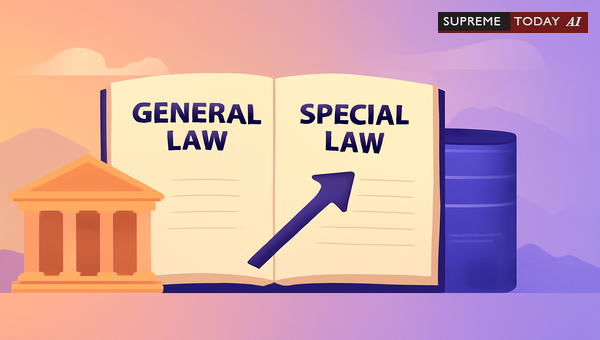
In the complex world of legal interpretation, understanding the distinction between special laws and general laws can make all the difference when navigating overlapping statutes. Many people ask: what is meant by ? This question arises frequently in contexts like industrial disputes, criminal proceedings, family matters, and more. Generally, a is one tailored to a specific subject, issue, or group, and it often takes precedence over broader general laws when conflicts occur. This blog post dives deep into the definition, principles, case laws, and practical applications to help you grasp this crucial concept.
We'll explore how courts apply these rules, drawing from established and , while emphasizing that this is general information—not personalized legal advice. Always consult a qualified lawyer for your specific situation.
Definition and Scope of a
A is a that deals with a specific subject, issue, or category of persons or matters, featuring a focused scope with detailed provisions for that domain. In contrast, general laws apply broadly across multiple subjects. The itself defines it succinctly: ''.-A '' is a law applicable to a particular subject. 2020 0 Supreme(All) 4
The classification hinges on the and . For instance, the (ID Act) is a for investigating and settling industrial disputes, prevailing over broader laws like the (LIC Act) or . 2025 0 Supreme(All) 2272 2014 0 Supreme(SC) 120
Key characteristics include:- Addresses a particular subject or class of persons with specific provisions. 2014 0 Supreme(SC) 120- Contains targeted rules not found in general statutes.- Prevails in conflicts via the maxim (general laws do not derogate from special laws). 2014 0 Supreme(SC) 120 2025 0 Supreme(All) 2272
The Principle: Prevails Over
When a and a cover the same subject, courts apply the principle of to let both coexist where possible. However, if there's irreconcilable conflict, the generally prevails unless the explicitly overrides it. 2014 0 Supreme(SC) 120 2025 0 Supreme(All) 2272
This is encapsulated in the Latin maxim , affirmed in numerous judgments. Courts interpret statutes to uphold legislative intent, focusing on scope and purpose. A law is special if it deals specifically with a particular issue, while general laws cover broader subjects. 2020 0 Supreme(SC) 246
For example, in family law, the , is a for matrimonial disputes among Hindus, but the , as a super specialized law, governs procedures like appeals, with its 30-day limitation overriding the 90-day period under the Hindu Marriage Act. The period of limitation provided in a prevails over the general period of limitation. 2009 0 Supreme(All) 754 2009 0 Supreme(All) 747
Application in Landmark Case Law
Indian courts have consistently upheld this doctrine:
- : The held the ID Act as a vis-à-vis the LIC Act, emphasizing . 2019 0 Supreme(SC) 2232
- vs. Bengal : The ID Act prevailed as the for disputes involving co-operatives. 1958 0 Supreme(Cal) 67
In criminal contexts, special laws like the override aspects of the . gives it , meaning victims lack appeal rights under in joint cases. 2023 0 Supreme(Bom) 1608
Another illustration: The bars from entertaining suits post-amendment, as it establishes special tribunals. The word entertain means consideration on merits. 2012 0 Supreme(Bom) 120
Contextual Examples from Diverse Areas
- Criminal Procedure: saves special laws: Nothing contained in this Code shall... affect any special or local law. under acts like the , exercise powers under . 2023 0 Supreme(All) 756
- : Special laws dictate timelines. In pre-emption suits under , its limitation applies over the . Special laws prescribe periods for specified cases. 2014 0 Supreme(Bom) 446
- Mining and Seizures: No right to insist on trial by special court unless prescribed. State must constitute under Section 30B. 2022 0 Supreme(Ker) 945 2022 Supreme(Online)(Ker) 63640
- Land Disputes: Special acts like define grabbing narrowly, requiring proof of unlawful possession. 2023 0 Supreme(Gau) 318
These examples show how context determines classification—always tied to . 2020 0 Supreme(SC) 246
Exceptions and Limitations
The rule isn't absolute:- If a explicitly repeals or overrides the , it prevails. 2014 0 Supreme(SC) 120- Irreconcilable conflicts may favor the later-enacted law. 2025 0 Supreme(All) 2272- Courts interpret contextually, especially for social justice. 1940 0 Supreme(Lah) 138
For instance, if a subsequent intends comprehensive coverage, it may supersede. Special laws can exclude general ones explicitly. 2014 0 Supreme(SC) 120 2025 0 Supreme(All) 2272
Recommendations for Legal Practitioners and Litigants
- Examine and purpose to classify laws.
- Favor provisions in conflicts absent clear override.
- Consider legislative history and .
Conclusion and Key Takeaways
Understanding special laws is essential for effective legal strategy, as they provide tailored rules that typically trump general ones. Rooted in principles like and , this framework ensures precise application of justice. 2014 0 Supreme(SC) 120
Key Takeaways:- Special laws focus on specific subjects and prevail over general laws. 2014 0 Supreme(SC) 120- Use ; special prevails in conflicts. 2025 0 Supreme(All) 2272- Classification depends on scope and context. 2020 0 Supreme(SC) 246- Exceptions exist for explicit overrides or later laws.
This overview draws from key references like 2014 0 Supreme(SC) 120, 2025 0 Supreme(All) 2272, and others listed. For tailored advice, seek professional counsel.
Disclaimer: This post provides general insights based on and is not legal advice. Laws evolve, so verify with current statutes and experts.
#SpecialLaw #LegalPrecedence #IndianLaw












