


Key Judgments on Suicide Cases in India Under IPC 306
Introduction
Suicide cases in India often raise complex legal questions, particularly when abetment is alleged under . Families, accused individuals, and legal professionals frequently search for clarity on Judgements of Suicide Cases to understand how courts interpret evidence, distinguish suicide from homicide, and apply provisions like abetment to suicide. These cases typically involve sensitive issues such as dowry harassment, , or neglect, demanding rigorous proof from the prosecution.
This blog post delves into landmark principles and judgments, drawing from established case law. It highlights the necessity of substantial evidence, the role of , and considerations. Note: This is general information based on public judgments and not specific legal advice. Consult a qualified lawyer for personalized guidance.
Overview of Legal Framework
India's legal approach to suicide cases centers on , which punishes with up to 10 years' imprisonment and a fine. Courts emphasize that mere allegations are insufficient; the prosecution must prove the accused instigated or aided the act. As one judgment notes, the prosecution must establish that the accused had a role in instigating or aiding the deceased in committing suicide
.
Key themes include:- Abetment proof: forming a complete chain 2011 3 Supreme 729.- Evidence scrutiny: , witness statements, and play pivotal roles
.- Contextual factors: , under , or often feature, but lack of substantiation leads to acquittals 2005 0 Supreme(Jhk) 687.
: Core Principles Under
Proving Abetment
To convict under Section 306, courts require evidence showing the accused's actions directly influenced the suicide. Direct evidence, like explicit threats or instigation, strengthens cases, but circumstantial evidence suffices if it unerringly points to guilt. Courts have held that circumstantial evidence can be sufficient for conviction, provided it forms a complete chain linking the accused to the crime 2011 3 Supreme 729.
In practice, vague fail without corroboration. For instance, if or claims under Section 498A lack proof, courts allow appeals, ruling the suicide unlinked to the accused 2005 0 Supreme(Jhk) 687.
Role of
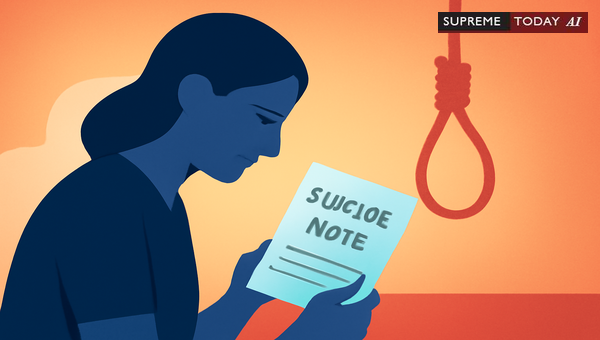
are crucial evidence, often naming the accused. In one case, the deceased on the suicide note wherein the deceased has stated that Gudiya is sole responsible for his suicide
. Similarly, another involved a note near the body, leading to charges against an individual, with courts scrutinizing authenticity under provisions like
.
Notes must be genuine; fabricated or coerced ones are rejected. In a rape-suicide case, the suicide note and the victim's narration as evidence to prove the guilt of the accused appellant under upheld conviction, alongside 2014 0 Supreme(All) 2182.
Evidence Requirements: Direct vs. Circumstantial
Direct Evidence
Prosecution must link the accused's words or deeds to the suicide. In cases where suicide is alleged, the prosecution must provide substantial evidence linking the accused to the act of abetment. This includes demonstrating that the accused's actions or words directly influenced the deceased's decision to take their life 2010 0 Supreme(Mad) 3430.
Circumstantial Evidence
When direct proof is absent, courts rely on a chain of circumstances. Neglect, like failing to maintain a spouse, has been alleged: he had not returned back to the village, that the petitioner has not bothered to maintain his wife and the child and that due to the said conduct of the petitioner the victim had consumed poison and committed suicide
. However, such claims need backing.
In dowry-related suicides, unsubstantiated leads to discharge: evidence did not substantiate claims, so no case of suicide can be established 2005 0 Supreme(Jhk) 687.
Distinguishing Suicide from Homicide
Courts meticulously differentiate suicide from homicide. Courts have emphasized the need to differentiate between suicide and homicide. The defense may argue that the death was a result of suicide rather than homicide, which requires careful examination of the evidence presented 1998 0 Supreme(Cal) 54 1995 0 Supreme(Mad) 653.
Forensic analysis, injury patterns, and motives are key. In a case where a wife died by hanging, allegations tied it to the husband's prior marriage, but courts probed deeper: the deceased died by hanging as the present applicant is talking to her first wife... and aggrieved by the act of applicant, the deceased committed suicide
.
Relevant Case Law Highlights
and Dowry Claims: Evidence failing to prove led to acquittal: the evidence presented did not substantiate claims of or , leading to the conclusion that the suicide was not a result of the accused's actions 1995 0 Supreme(Mad) 653.
in Abetment Cases: Accused may secure post-investigation. An accused is entitled to even in serious offenses like abetting suicide, if the investigation is complete, there are no prior , and strict conditions are imposed
. In one instance, was granted after a month in custody, noting no dowry harassment per findings.
Family Disputes: A daughter's suicide by hanging prompted petitions, underscoring neglect claims
. Divorce cases also reference threats: threat to commit suicide ought to have been given with details, or claims fail 2009 0 Supreme(All) 1230.
Rape and Suicide: bolstered rape convictions under Section 376 alongside 306 IPC 2014 0 Supreme(All) 2182.
and Procedural Aspects
under Section 306 is common if investigation ends, no antecedents exist, and conditions like daily police reporting apply. One petitioner, accused of abetting his wife's suicide via neglect, got on Rs. 25,000 bond with sureties
. Courts balance gravity with rights.
Conclusion and Key Takeaways
Judgments in suicide cases underscore evidence's primacy. Prosecution must prove abetment beyond doubt under , distinguishing it from homicide via thorough scrutiny. and witness accounts are vital but must be authentic.
Key Takeaways:- Secure direct or chain circumstantial evidence for abetment claims
2010 0 Supreme(Mad) 3430.- Differentiate suicide/homicide carefully 1998 0 Supreme(Cal) 54 1995 0 Supreme(Mad) 653.- viable post-investigation with conditions.- Unproven dowry/ allegations often fail 2005 0 Supreme(Jhk) 687.
Recommendations:- Document evidence meticulously.- Challenge weak links in defense.- Seek expert forensic and legal analysis.
This landscape evolves; stay informed via reliable sources. Disclaimer: This post summarizes general principles from cited judgments and is not legal advice. Laws vary by facts; professional consultation is essential.
References:
2010 0 Supreme(Mad) 3430 2011 3 Supreme 729 1998 0 Supreme(Cal) 54 1995 0 Supreme(Mad) 653 2005 0 Supreme(Jhk) 687
2014 0 Supreme(All) 2182 2009 0 Supreme(All) 1230' #SuicideCasesIndia, #IPC306, #AbetmentSuicide















