Searching Case Laws & Precedent on Legal Query.....!
Scanned Judgements…!



Searching Case Laws & Precedent on Legal Query.....!
Scanned Judgements…!
Right to Livelihood as Part of Right to Life - The Supreme Court has consistently interpreted the right to livelihood as an integral component of the right to life under Article 21 of the Indian Constitution. It has emphasized that depriving a person of their means of livelihood to the point of abrogation would effectively deprive them of their right to life, which is protected by Article 21 ["2023 Supreme(Online)(KER) 6480"], ["2023 0 Supreme(AP) 59"], ["1993 0 Supreme(SC) 102"], ["1994 0 Supreme(Cal) 168"], ["2010 0 Supreme(AP) 1365"], ["2010 0 Supreme(AP) 1360"], ["1995 0 Supreme(AP) 170"], ["2021 0 Supreme(AP) 25"], ["1991 0 Supreme(Cal) 189"], ["1987 0 Supreme(Kar) 305"], ["
Dr. P.V. Ramana Murthy vs The State of Andhra Pradesh - Andhra Pradesh
"], ["P S VENKATESWARA RAO vs The State of Andhra Pradesh - Andhra Pradesh
"], ["G.Dwarakanath vs The State of Andhra Pradesh - Andhra Pradesh
"], ["1998 0 Supreme(Kar) 778"], ["NAGAM SIVARAMI REDDY, Y.S.R.KADAPA DIST & 37 OTHERS Vs PRL SECY, I & CAD DEPT, HYDERABAD & 4 OTHERS - Andhra Pradesh
"], ["1985 0 Supreme(Kar) 534"].Landmark Judgments - Notable judgments include:
Union of India cases: The Court expanded the interpretation of Article 21 to include the right to decent living and livelihood, emphasizing that deprivation must be in accordance with law ["2023 Supreme(Online)(KER) 6480"], ["2023 0 Supreme(AP) 59"], ["1985 0 Supreme(Kar) 534"].
Main Insights:
Analysis and Conclusion:The Supreme Court's jurisprudence firmly establishes that the right to livelihood is a part of the right to life under Article 21. Several landmark judgments, notably Olga Tellis (1985), have clarified that deprivation of livelihood without following fair procedures infringes upon constitutional protections. This interpretation broadens the understanding of life to include not just animal existence but also the means to a dignified life, reinforcing the importance of livelihood as a fundamental right ["2023 Supreme(Online)(KER) 6480"], ["2023 0 Supreme(AP) 59"].
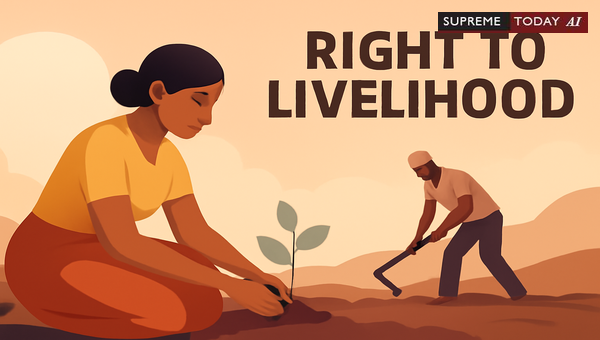
In India's constitutional framework, guarantees the , a provision that has evolved far beyond its literal interpretation. One of the most significant expansions is the recognition that the forms an essential part of this . But what does this mean in practice? Can courts cite judgments declaring that is part of right to life under ? This blog delves into landmark rulings, key quotes, and real-world applications to clarify this vital principle.
Whether you're a worker facing job loss, a homeowner threatened by eviction, or simply interested in constitutional law, understanding this linkage can empower you to protect your rights. Note: This is general information and not specific legal advice; consult a qualified lawyer for your situation.
The cornerstone of this doctrine is the landmark case . Here, a led by Chandrachud CJ addressed the eviction of pavement dwellers in Mumbai, ruling that depriving individuals of their means of living violates . The Court emphatically stated: The sweep of the right to life conferred by is wide and far-reaching... An equally important facet of that right is the because, no person can live without the means of living, that is, the means of livelihood. If the is not treated as a part of the constitutional right to life, the easiest way of depriving a person of his right to life would be to deprive him of his means of livelihood to the point of abrogation... Deprive a person of his and you shall have deprived him of his life. 2017 0 Supreme(SC) 772 1993 0 Supreme(SC) 102 1995 0 Supreme(SC) 678 2026 3 Supreme 259 1996 0 Supreme(SC) 1701 2010 8 Supreme 619
Shri Maruti Shripati Dubal VS State of Maharashtra - Crimes (1986)
Chaitan Gochhayat VS State - Crimes (1988)
1990 0 Supreme(Bom) 278 2009 0 Supreme(AP) 936 2018 0 Supreme(Sikk) 15 2003 3 Supreme 669 1985 0 Supreme(SC) 226This ruling established that evictions impacting livelihoods require , echoing the principles from . It has been repeatedly cited as across contexts like shelter and employment. 2026 3 Supreme 259
The has reaffirmed this principle in several judgments:
: Explicitly held that the '' is an integral part of the 'right to life' under , building on Olga Tellis. 2010 8 Supreme 619 2009 0 Supreme(AP) 936
: Linked the to protections for workers' health, strength, and humane conditions, drawing from (, 41, 42). It emphasized: It is the ... to live with human dignity, free from exploitation... including protection of the health and strength of workers. 1993 0 Supreme(SC) 102
: Declared, springs from the right to life guaranteed under . The health and strength of a worker is an integral facet of right to life. 1995 0 Supreme(SC) 678 2007 0 Supreme(Guj) 679
These cases illustrate how harmoniously incorporates socio-economic rights from , ensuring livelihood protections in labor and employment disputes.
Chaitan Gochhayat VS State - Crimes (1988)
Lower courts have consistently applied this doctrine, integrating it into diverse scenarios:
In a case involving tourist guides prohibited from working, the court observed: the right to life which is guaranteed by Art. 21 includes the and since they will be deprived ... If the is not treated as a part of.... It quashed the executive order as unsustainable under . 1988 0 Supreme(Kar) 446
For teachers' salaries, one ruling affirmed: widening the meaning of word ‘right to life’ includes ‘’, is a , and it is an integral part of right to life guaranteed under . Teachers were entitled to salary from post creation, rejecting deferrals. 2023 0 Supreme(Ker) 637
During communal riots, petitioners successfully claimed compensation, with the court holding: the right to life under includes the and that deprivation of property without due process of law violates this right. 1991 0 Supreme(J&K) 13
Land acquisition cases stress fair procedures: The Apex Court in various judgments interpreted the is a part of right to life under ... if a person is deprived... according to the procedure established by law which must be fair, just and reasonable. 2021 0 Supreme(AP) 935
Assigned land resumptions for landless poor were struck down as violative of , recognizing land as a livelihood means. 2020 0 Supreme(AP) 738
These examples show the doctrine's reach into property, employment, and social security, always requiring due process. 2006 0 Supreme(Guj) 367 2006 0 Supreme(Mad) 42 1997 0 Supreme(Mad) 708
While robust, the has boundaries:- The State isn't obligated to provide jobs but must prevent arbitrary deprivations. 1993 0 Supreme(SC) 102 2017 0 Supreme(SC) 772- Non-revision of pay in loss-making PSUs may not violate without proof of undignified living. 2003 3 Supreme 669- Illegal or immoral livelihoods aren't protected.
Chaitan Gochhayat VS State - Crimes (1988)
- In , regular employment wasn't deemed a , though the law evolves. 2010 8 Supreme 619Deprivation must follow fair procedures, as in suspension cases requiring subsistence allowances. 2020 0 Supreme(AP) 738
This expansion traces from Maneka Gandhi, through and , to education in . Courts read (Arts. 38, 39, 41) into for dignity.
Chaitan Gochhayat VS State - Crimes (1988)
2017 0 Supreme(SC) 772In conclusion, the 's jurisprudence robustly protects livelihood as integral to life under , fostering dignity and justice. This dynamic right continues to safeguard vulnerable groups, but always within fair legal bounds. Stay informed, and seek professional advice for personal matters.
References include cited document IDs for further reading.
#Article21 #RightToLivelihood #SupremeCourtIndia


The Apex Court in various judgments interpreted the right to livelihood is a part of right to life under Article 21 of the Constitution of India and it is relevant to refer the principle in “M. Paul Anthony v. ... Thus, in view of the law laid down by the Apex Court in various judgments (referred supra), widening the meaning of word ‘right to life’ includes ‘right#HL_EN....

According to the learned counsel, the award of the death penalty is a direct deprivation of the right to life under Art.21. The right to liberty under Art.21 is a facet of the core right to existence itself, which, if deprived, renders all liberty meaningless. ... Union of India, 2014 (4) SCC 242 at para 19-21. According to the learned counsel, Art.134 of the Constitution allows an automatic right....

The Hon’ble Supreme Court in Olga Tellis and Ors. Vs Bombay Municipal Corporation and Ors. (1985) 3 SCC 545 held that Article 21 includes the right to livelihood. ... If the right to livelihood is not treated as a part of the constitutional right to life, the easiest way of depriving a person of his right to life would be to deprive him of his means of livelihood#HL_END....
If the right to livelihood is not treated as a part of the constitutional right life, the easiest way of depriving a person of his right to life would be to deprive him of his means of livelihood to the point of abrogation. ... Upon that assumption, the question which we have to consider is whether the right to life includes the right to livelihood. We sees only one answer to tha....

The Supreme Court was persuaded to consider the right of livelihood to be a part of right to life on consideration that the deprivation of the means of livelihood to the point of abrogation would necessarily deprive a person of his right to live. ... ... ( 15 ) IT was right to livelihood in this sense, that was stated to be a constituent of the right to life as....

If the right to livelihood is not treated as a part of the constitutional right to life, the easiest way of depriving a person of his right to life would be to deprive him of his means of livelihood to the point of abrogation" and allowed the writ petition directing to pay compensation to the extent ... But the Supreme Court opened up a new dimension and gave an expanded meaning to the life under ....
After deletion of Art. 19 (1)(f) by inserting Art.300A, right to life includes right to hold property for his decent living and falls under Art.21 of the Constitution. Decent living is a right to life under Art.21. ... UNION OF INDIA (1996) 10 SCC 104, it was held by the Supreme Court that right of agriculturists to cultivation is par....

The Supreme Court considering the scope of Art. 21 of the Constitution observed as follows :"as we have stated while summing up the petitioners' case, the main plank of their argument is that the right to life which is guaranteed by Art. 21 includes the right to livelihood and since they will be deprived ... If the right to livelihood is not treated as a part of....

Thus, in view of the law laid down by the Apex Court in various judgments (referred supra), widening the meaning of word ‘right to life’ includes ‘right to livelihood’, right to livelihood is a fundamental right, and it is an integral part of right to life guaranteed under Article 21 of the Constitution ... The Apex Court in various j....

If the right to livelihood is not treated as a part of the constitutional right to life, the easiest way of depriving a person of his right to life would be to deprive him of his means of livelihood to the point of abrogation. ... But any person, who is deprived of his right to livelihood except according to justice and fair procedure established by law, can challenge the deprivation as offending the righ....
The Apex Court in various judgments interpreted the right to livelihood is a part of right to life under Article 21 of the Constitution of India. However, if a person is deprived of such a right according to the procedure established by law which must be fair, just and reasonable and which is in the larger interest of people, the plea of deprivation of the right to livelihood under Article 21 is unsustainable. The Court opined that the state acquires land in exercise of its power of eminent domain for a public purpose.

In M. Paul Anthony v. Bharat Gold Mines Limited, AIR 1999 SC 1416 : 1999 (3) ALD (S.C.S.N.) 13, the Apex Court held that when a Government servant or one in a public undertaking is suspended pending a departmental disciplinary inquiry against him, subsistence allowance must be paid to him. The Court has emphasized that a Government servant does not use his right to life and other fundamental rights in this case. The Apex Court in various judgments interpreted the right to livelihood is a part of right to life under Article 21 of the Constitution of India.

The aim of fundamental rights is to create an egalitarian society to free all citizens from coercion or restrictions by society and to make liberty available for all. Right to livelihood springs from the right to life guaranteed under Art. 21. The health and strength of a worker is an integral facet of right to life. I am not quoting the quotable quotes from the said judgments to state what is very well known and well established needing no elaboration : c. E. S. C. , Ltd. v. Subhash Chandra Bose, in Para 30, at page 355 and 356:"the right to social justice is a fundamental....

Therefore, before taking any action putting an end to the tenure of an employee workman, fair play requires that a reasonable opportunity to put forth his case is given and domestic inquiry conducted complying with the principles of natural justice. "It is thus well-settled law that right to life enshrined under Art.21 of the Constitution would include right to livelihood. In that case, while dealing with the issue of giving reasonable opportunity to the employee on the basis of the principle of natural justice, the Supreme Court has laid down the law as follows: The order ....

It is thus well settled law that right to life enshrined under Art. 21 of the Constitution would include right to livelihood. Therefore, before taking any action putting an end to the tenure of an employee/workman, fair play requires that a reasonable opportunity to put forth his case is given and domestic inquiry conduct complying with the principles of natural justice. the order of termination of the service of an employee/workmen visits with civil consequences of jeopardising not only his/her livelihood but also career and livelihood of dependents. The Supreme Court in p....


An indispensable Tool for Legal Professionals, Endorsed by Various High Court and Judicial Officers
Please visit our Training & Support
Center or Contact Us for assistance

Scan Me!
India’s Legal research and Law Firm App, Download now!


For Daily Legal Updates, Join us on :



 Back to top


