


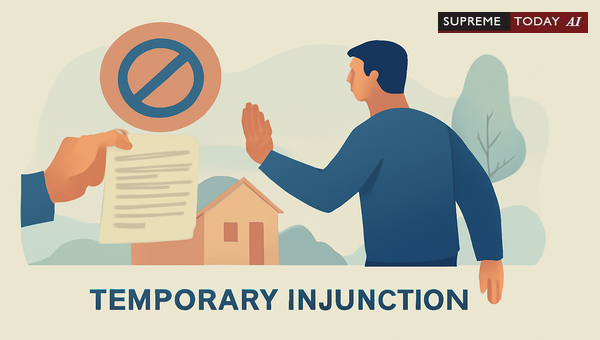
to Stop in India
Introduction
Imagine discovering strangers on your property, refusing to leave, and potentially causing damage or disruption. This scenario raises a critical question for property owners: to Restrain the Defendants from Trespass on the Property. In India, courts can grant temporary injunctions to protect your rights swiftly, preventing further harm while the case is decided. This blog explores the legal framework, criteria, and real-world applications under the and , helping you understand when and how such relief may be available.
Property disputes involving trespass are common, especially in residential or commercial areas. Courts typically intervene through interim measures to maintain the . However, success depends on meeting strict legal tests. Let's break it down.
Understanding Trespass Under Indian Law
Trespass, particularly , is a criminal offence defined under . It occurs when someone enters or remains in a building, vessel used as a human dwelling, place of worship, or for custody of property, with the intent to commit an offence or to intimidate, insult, or annoy any person in possession2017 0 Supreme(Guj) 966 2014 0 Supreme(Pat) 434.
This definition underscores that mere entry isn't enough; intent matters. For civil remedies like injunctions, plaintiffs often pair IPC claims with suits under CPC to seek urgent protection.
Legal Basis for Temporary Injunctions
Temporary injunctions are governed by . These allow courts to restrain defendants from actions like trespassing, dispossessing, or damaging property pending trial. Courts generally consider three key criteria:
1. Serious Question to be Tried ()
There must be a legitimate claim. The plaintiff needs to show a of ownership or possession and that defendants are unlawfully trespassing
. In , the court ruled that cannot be claimed merely on the basis of possession; must be established2017 0 Supreme(MP) 834 2015 0 Supreme(MP) 160.
2.
The court weighs harms: Does denying the injunction cause greater injury to the plaintiff than granting it does to the defendant? This principle from emphasizes preserving the 1984 0 Supreme(Del) 79
.
3.
Plaintiffs must prove harm that can't be compensated by money, like permanent property damage or loss of possession 2015 0 Supreme(MP) 160.
If these are met, courts may grant the injunction to restrain trespass.
Application to Trespass Cases
In a typical suit, plaintiffs demonstrate:- Defendants are trespassing on their property.- A serious question about the legality of defendants' actions exists.- favors the plaintiff.- Irreparable harm looms without relief.
Courts then issue orders restraining defendants, agents, or henchmen. For instance, applications often seek to restrain defendants from causing damage to the suit schedule properties2023 Supreme(Online)(KAR) 12627.
Insights from Recent Case Law and Applications
Indian courts frequently handle such pleas. Here are key examples:
In one application under , the plaintiff sought to restrain/interim injunction over property bearing a specific number, directing steps to implead legal heirs as defendants2024 Supreme(Online)(DEL) 6593. The court ordered amended memos and notices, highlighting procedural rigor.
Another case involved restraining agents or henchmen from dispossessing the plaintiff and damaging properties, with the petition disposed after considerations 2023 Supreme(Online)(KAR) 12627.
Defendants sometimes justify actions, like installing barriers against public trespass. However, courts criticized overlooking context, as in a case where the learned did not consider such issue to be relevant2024 0 Supreme(HP) 148.
appear too, such as directing defendants to demolish and take away all the temporary sheds on suit property 2024 Supreme(Online)(KAR) 36113.
Cyber angles emerge, with pleas for details like IP addresses to block unauthorized access, akin to 2023 Supreme(Online)(Mad) 97018.
Possession disputes often pivot on proof: Defendants 1 and 2 threatened the plaintiffs claiming that said property trespassed by them2022 Supreme(Online)(Kar) 58856.
These illustrate courts' focus on irreparable damage, , and prima facie cases, often under CPC to preserve 2024 Supreme(Online)(DEL) 6593 2023 Supreme(Online)(KAR) 12627 2024 0 Supreme(HP) 148 2024 Supreme(Online)(KAR) 36113.
Procedural steps are vital: File under O39 R1&2, amend plaints if needed (e.g., adding reliefs to restrain defendants 7 and 8 from alienating
), and serve notices
2022 Supreme(Online)(Bom) 5826.
Factors Influencing Court Decisions
- Proof of Possession: Not just physical, but legal 2017 0 Supreme(MP) 834.
- Urgency: Forcible entries or threats trigger faster relief 2022 Supreme(Online)(Kar) 58856.
- : Orders prevent alienation or interference
.
- Public Interest: Sometimes weighed, like road-adjacent land 2024 0 Supreme(HP) 148.
Courts may grant pending hearings, as in to restrain defendant no.13 to 152022 Supreme(Online)(Bom) 5826.
Conclusion and Key Takeaways
To secure a against trespassers, establish a , favoring you, and risk of irreparable harm. Legal principles and precedents like American Cyanamid and Kamal Singh support this, provided criteria are met
2015 0 Supreme(MP) 160 2017 0 Supreme(MP) 834 1984 0 Supreme(Del) 79.
Key Takeaways:- File promptly under CPC Order XXXIX.- Gather evidence of title, possession, and trespass intent.- Demonstrate why monetary damages won't suffice.- Consider impleading all parties 2024 Supreme(Online)(DEL) 6593.
This is general information based on legal principles and cases. It is not specific legal advice. Consult a qualified lawyer for your situation, as outcomes vary by facts and jurisdiction.
#TemporaryInjunction #PropertyTrespass #IndianLaw












