


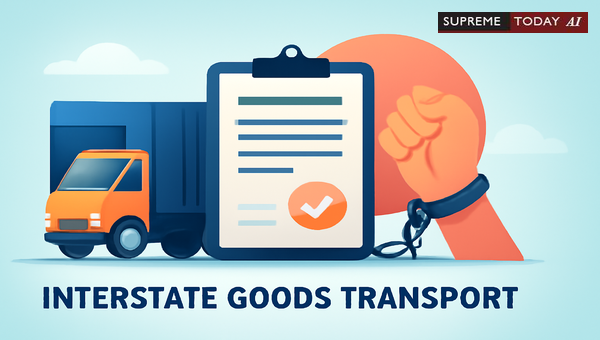
Can Transporters Be Arrested Under IPC or BNS for GST Violations?
In the fast-paced world of interstate commerce, transporters play a crucial role in moving goods across state lines. But what happens when GST authorities flag a potential violation during transit? A common question arises: Can a person who is transporting interstate goods be arrested under IPC or BNS when GST provisions are applicable?
This issue blends administrative tax enforcement with criminal law, often leading to confusion for business owners, drivers, and logistics firms. While GST laws provide mechanisms for detention and penalties, they don't automatically trigger arrests under the or . This post breaks down the legal framework, key provisions, judicial insights, and practical recommendations to help you navigate these scenarios.
Note: This article provides general information based on legal analyses and is not a substitute for professional legal advice. Consult a qualified lawyer for your specific situation.
Understanding GST Framework for Interstate Goods Transport
Under the Goods and Services Tax (GST) regime, falls primarily under the . This act outlines procedures, documentation like e-way bills, and enforcement for such transactions 2018 0 Supreme(All) 528.
Key GST provisions include:- : Requires registered dealers to issue a before or at the time of removal of goods, detailing description, quantity, value, and tax charged 2025 0 Supreme(All) 52. Under the GST Act, the has to be issued in terms of Section 31 of the Act, which prescribes every registered dealer supplying the taxable goods before or at the time of removal of such supply of goods shall issue a showing the description, quantity and value of goods, the tax charged thereon and such other particulars as may be prescribed.- Requirements: allow verification during transit, but any contravention triggers specific actions 2023 0 Supreme(AP) 1191.
When goods are transported across states, GST authorities can inspect under , but actions are typically administrative 2023 0 Supreme(P&H) 2699 2023 0 Supreme(P&H) 3273.
Under GST: Not the Same as Arrest
govern contraventions during transit. These allow for:- of goods or conveyances.- Issuance of a detention order, which must be served properly on the transporter 2023 0 Supreme(Cal) 256.- Penalties and release upon payment or proof of compliance 2021 0 Supreme(Chh) 154 2018 0 Supreme(Ker) 927.
Importantly, The GST laws, including Sections 129 and 130, do not explicitly provide for arrest of individuals; instead, they focus on detention, seizure, and penalties related to non-compliance 2021 0 Supreme(Chh) 154 2018 0 Supreme(Ker) 927. (6) applies inspection, search, and seizure powers mutatis mutandis, but arrest under (2) is not a standard punitive measure for mere violations.
Goods or conveyances cannot be detained or seized without serving a proper order of detention or seizure on the transporter 2025 Supreme(Online)(Kar) 35301 2025 Supreme(Online)(Kar) 35449. Without procedural compliance, such actions may be challenged.
Can IPC or BNS Be Invoked for Arrest?
The IPC (now transitioning to BNS) deals with criminal offenses like or theft. Arrest under these requires proof of , not just a GST paperwork lapse.
- GST violations alone do not authorize arrest under IPC/BNS. The IPC allows arrest for criminal offenses, including or theft, which could theoretically relate to illegal transportation if or is established, but GST laws alone do not mandate or authorize arrest under IPC or BNS solely for inter-State goods transport violations 2021 0 Supreme(Del) 475 2019 0 Supreme(Raj) 1137.
- Courts emphasize that The cannot be invoked independently for offences related to goods transport without first invoking the penal provisions under the GST Act. Courts have held that FIRs or prosecutions based solely on IPC, without referencing GST provisions, are legally invalid 2024 0 Supreme(MP) 642 2024 0 Supreme(MP) 423 2025 Supreme(Online)(Guj) 13060.
GST authorities must follow their own safeguards before escalating to criminal proceedings, obtaining necessary sanctions 2024 Supreme(Online)(MP) 14086.
Judicial Precedents: Administrative vs. Criminal Measures
Indian courts have consistently clarified the distinction:- Detention under GST is an , not a , unless , , or other crimes are proven 2018 0 Supreme(All) 528 2018 0 Supreme(Ker) 927.- Courts have clarified that under GST are administrative measures, not criminal arrests, unless specific criminal offense (e.g., , ) is proven 2018 0 Supreme(All) 528.- Arrests require separate criminal proceedings; GST non-compliance doesn't automatically trigger them.
In cases involving discrepancies or missing invoices, penalties under Section 129 suffice unless deeper criminality is evident 2020 0 Supreme(Mad) 1990. Even buyers or non-sellers in interstate trade can register under relevant acts, but liability doesn't equate to arrest 2020 0 Supreme(Mad) 1725.
Practical Procedures for Authorities and Transporters
For enforcement:1. Verification: Check e-way bills and documents during transit.2. Detention Order: Must be served immediately if contravention found 2023 0 Supreme(AP) 1191.3. Release Options: Pay tax/penalty or provide explanation within timelines.4. Escalation to Arrest: Only if (demands) or 132 (offences) apply, leading to prosecution under GST, not standalone IPC.
Transporters should:- Carry valid tax invoices, e-way bills, and transport documents.- Know rights: Challenge improper detention in if procedures ignored.
Under GST laws, a person transporting inter-State goods can be arrested or detained only in accordance with the procedures specified in the GST Act, including proper service of detention orders and adherence to 2024 0 Supreme(MP) 642 2025 Supreme(Online)(Kar) 35301.
Key Takeaways and Recommendations
- No Automatic Arrest: A transporter cannot be arrested solely under IPC or BNS for GST violations during interstate goods movement. GST focuses on detention, seizure, and penalties 2021 0 Supreme(Chh) 154.
- Criminal Threshold: Arrest possible only if , , or IPC/BNS offenses proven, independent of GST 2021 0 Supreme(Del) 475.
- Procedural Compliance Essential: Authorities must issue proper orders; standalone IPC FIRs often quashed 2024 0 Supreme(MP) 423.
Recommendations:- Always maintain compliant documentation (invoices per Section 31, e-way bills) 2025 0 Supreme(All) 52.- Evaluate for criminal elements before IPC/BNS action.- Use GST mechanisms for routine violations; reserve criminal law for substantive crimes.- Businesses: Train staff on GST transit rules to avoid unnecessary detentions.
In summary, while GST empowers strong enforcement, it protects against overreach into criminal arrests without due process. Staying compliant minimizes risks in interstate transport.
References
- : Sections 31, 67, 129, 130.
- .
- Judicial precedents as cited.















