




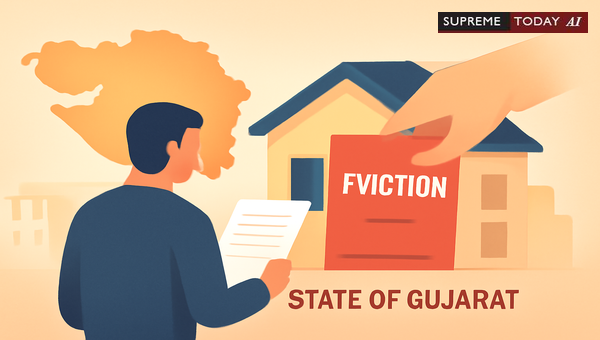
: Key Ruling on Evictions in Town Planning
In the realm of urban development and land rights, few cases have clarified the balance between public interest and individual protections as effectively as . A frequent legal query arises: Please summarise . This landmark judgment addresses critical issues surrounding eviction powers exercised by municipal authorities during the execution of town planning schemes. It underscores that such powers are not merely administrative but , demanding strict adherence to principles of . This blog post breaks down the case, its implications, and related legal insights to help readers navigate similar scenarios.
Whether you're a landowner facing eviction notices, a municipal official, or simply interested in Indian town planning law, understanding this ruling is essential. Note that this is general information and not specific legal advice—consult a qualified attorney for personalized guidance.
Main Legal Findings of the Case
The in held that the 's authority to demand possession of lands allotted or reserved under a sanctioned Town Planning Scheme is in nature. This means it requires:
- A fair hearing for occupants before eviction.
- A —a reasoned decision demonstrating application of mind. 2022 0 Supreme(SC) 209
Key points from the judgment include:
- nature: The power of summary eviction under the is not arbitrary but involves objective assessment based on existing facts. 2022 0 Supreme(SC) 209
- mandatory: Occupants must be heard, and orders must provide reasons to prevent bias or caprice.
- Judicial review available: Eviction orders tainted by extraneous, irrelevant, or considerations can be challenged and set aside via . 2022 0 Supreme(SC) 209
- No need for appellate machinery: The absence of a formal appeal or review process does not invalidate the provision if is observed. 2022 0 Supreme(SC) 209
The Court emphasized: the power to evict occupants is inherently , requiring that the authority exercise it after observing , such as hearing the occupants and passing a reasoned, . 2022 0 Supreme(SC) 209
Detailed Analysis: Nature of Power and
Distinction Between Scheme Preparation and Execution
Under the , govern the making of schemes, while addresses execution. At the execution stage, when calling for possession, the steps into a role. This shift demands procedural fairness, unlike purely administrative actions. The ruling clarifies that decisions on whether occupants are entitled to retain plots must follow a hearing and result in a . 2022 0 Supreme(SC) 209
Principles of in Practice
typically includes:- (hear the other side): Occupants get a chance to present their case.- (no one should be a judge in their own cause): Decisions must be unbiased.
Failure here renders orders voidable. The Court noted: any order of summary eviction based on any extraneous, non-germane, irrelevant or considerations would be subject to of Court. 2022 0 Supreme(SC) 209
Judicial Review and Objectivity
Even without built-in appeals, courts can intervene if powers are exercised or irrationally. The decision must be based on facts, not discretion run amok. This protects against abuse while enabling efficient urban planning. 2022 0 Supreme(SC) 209
Implications for Eviction Proceedings
This judgment has far-reaching effects:
- For Authorities: Eviction notices must now include hearing opportunities and reasoned orders, reducing litigation risks.
- For Occupants: Enhanced rights to contest evictions, especially if orders lack reasoning or stem from improper motives.
- Broader Town Planning: Ensures schemes progress without undue delays from flawed procedures.
Exceptions and limitations:- Orders vulnerable if based on extraneous or considerations. 2022 0 Supreme(SC) 209- Power must remain objective, grounded in scheme facts.
Integrating Related Legal Insights
While Vallibhai Quereshi is pivotal, related precedents reinforce procedural fairness in Gujarat jurisprudence. For instance, in discussions on administrative actions, courts have stressed legal procedures to avoid invalidity, indirectly supporting mandates. 2023 0 Supreme(SC) 401
In other Gujarat contexts, such as Ratansingh Dalsukhbhai Nayak v. State of Gujarat (2004), the examined evidence reliability in criminal matters, highlighting the need for objective assessments—paralleling the scrutiny here. 2018 0 Supreme(All) 2055
Similarly, cases like touch on procedural bars and continuing offenses, reminding that retention issues (e.g., in domestic violence) require ongoing fairness, akin to eviction hearings. 2017 0 Supreme(All) 2295
These connections illustrate a consistent judicial push for reasoned decision-making across domains, from town planning to criminal and civil proceedings.
Recommendations for Stakeholders
To align with this ruling:
- Municipal Bodies: Always provide pre-eviction hearings and issue speaking orders. Document reasons thoroughly to withstand review.
- Affected Parties: Demand hearings if skipped; challenge via writs if orders seem arbitrary.
- Legal Practitioners: Cite this case for arguments in planning disputes.
Authorities should ensure: eviction orders are passed after giving occupants a fair hearing and supported by reasons that demonstrate application of mind. 2022 0 Supreme(SC) 209
Conclusion and Key Takeaways
The case is a cornerstone for balancing urban development with due process. It affirms that eviction under town planning schemes is , mandating . In summary: powers must involve hearings, reasoned orders, and remain free from mala fides, or face judicial invalidation. 2022 0 Supreme(SC) 209
Key Takeaways:- eviction requires . 2022 0 Supreme(SC) 209- Speaking orders prevent arbitrariness.- Judicial review safeguards against abuse.- No appellate need if basics are followed.
This ruling promotes fair governance in India's evolving urban landscape. For tailored advice, reach out to a legal expert familiar with the .
References: 2022 0 Supreme(SC) 209 (core case on eviction); 2023 0 Supreme(SC) 401 (procedural fairness principles); 2018 0 Supreme(All) 2055, 2017 0 Supreme(All) 2295 (related Gujarat precedents).
#VallibhaiQuereshi, #TownPlanningLaw, #NaturalJustice












